“Then” and “than” are both correct words, but they have different meanings. “Then” is an adverb used to refer to a time, sequence, or result, while “than” is a conjunction or preposition used to make comparisons.
Then or than?
These two small English words cause many writing mistakes. They look similar, sound somewhat similar, and often appear in simple sentences. However, their meanings are completely different.
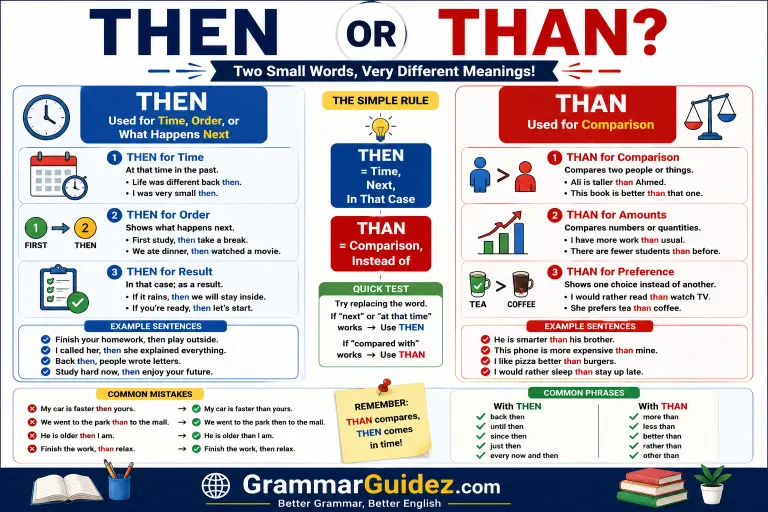
The easiest way to understand them is this:
Than is used for comparison.
Then is used for time, order, or what happens next.
For example:
Ali is taller than Ahmed.
Here, two people are being compared.
Now look at this:
Ali finished his work, then he went home.
Here, then shows what happened next.
A single letter changes the meaning of the sentence. That is why learning the difference between then and than is important for students, writers, bloggers, professionals, and English learners.
The good news is that you do not need complicated grammar rules. Once you learn one simple question to ask yourself, choosing the correct word becomes much easier.
This guide explains the difference between then or than, with simple examples, memory tricks, common mistakes, exercises, and practical writing tips.
Then vs Than: The One-Question Test
When you are unsure which word to use, ask yourself:
Am I comparing two things?
If the answer is yes, use than.
She is taller than her sister.
This book is better than that one.
I would rather walk than wait.
Am I talking about time, order, or what happens next?
If the answer is yes, use then.
We ate dinner, then watched a movie.
Finish your work, then take a break.
Back then, things were different.
This simple test solves most then or than mistakes.
The Main Difference Between Then and Than
| Word | Main Use | Meaning |
| Then | Time | At that time |
| Then | Order | Next |
| Then | Result | In that case |
| Than | Comparison | Compared with |
| Than | Preference | Instead of |
Quick Examples
Then:
First wash the vegetables. Then cut them.
Than:
Vegetables are healthier than candy.
The first sentence shows order.
The second sentence makes a comparison.
When Should You Use “Than”?
The word than is mainly used when comparing people, things, amounts, ideas, or actions.
Think of than as a comparison word.
1. Comparing People
Sara is younger than her brother.
John runs faster than me.
My teacher is taller than I expected.
In every example, one person is compared with another person or expectation.
2. Comparing Things
This phone is more expensive than my old phone.
Summer is hotter than winter.
Tea is cheaper than coffee at this restaurant.
Again, than shows a comparison.
3. Comparing Amounts
I have more work than usual.
She spent less money than last month.
There are fewer students than yesterday.
Words such as these often appear with than:
- more than
- less than
- better than
- worse than
- bigger than
- smaller than
- faster than
- slower than
4. Expressing Preference
Than can also appear when showing a preference.
I would rather stay home than go out.
She prefers reading than watching television.
In natural English, the structure may change depending on the sentence, but than is commonly used when one option is compared with another.
When Should You Use “Then”?
Unlike than, the word then has several jobs.
The easiest way to remember it is to connect then with:
- Time
- Order
- Next
- Result
Then for Time
Use then when talking about a particular time.
I was living in London then.
Life was different back then.
I did not understand English very well then.
In these examples, then means:
at that time
Then for Order
This is one of the most common uses.
Use then to show what happens after something else.
First, open the file. Then, read the instructions.
She got dressed and then left the house.
We finished the meeting and then went for lunch.
You can think of then as meaning:
next
Then for a Result
Then can also show what happens as a result.
If you are tired, then take a break.
If the answer is correct, then continue.
If it rains, then we will stay inside.
In everyday English, people often leave out then:
If it rains, we will stay inside.
Both structures can work depending on the sentence.
Then or Than: Look at These Sentence Pairs
The best way to understand the difference is to see the words side by side.
Example 1
I am older than my brother.
This is a comparison.
Now:
I finished school, then I went home.
This shows what happened next.
Example 2
This test is easier than the last one.
Comparison.
Now:
Take the test, then check your answers.
Order.
Example 3
I would rather read than watch TV.
Comparison between two activities.
Now:
Read the instructions, then start the exercise.
Sequence.
A Simple Memory Trick
Here is an easy way to remember the difference.
THAN Has an “A” for Comparison
Think:
A = Against or Comparison
When you compare one thing against another, you often use than.
Examples:
bigger than
smaller than
better than
more than
This is not an official grammar rule, but it is a useful memory trick.
THEN Has an “E” for Time
Think of words related to time:
when
next
after
then
For example:
First this, then that.
The word then often helps you move through time.
Common Phrases with “Than”
Learning common word combinations can help you remember when than is needed.
More Than
The project took more than two weeks.
Less Than
The journey took less than an hour.
Better Than
This version is better than the old one.
Worse Than
The weather was worse than expected.
Rather Than
I chose tea rather than coffee.
Other Than
No one other than Sarah knew the answer.
Different Than
This situation is different than before.
Usage can vary by style and region in some expressions, but than remains the comparison word in these common structures.
Common Phrases with “Then”
Now look at some common expressions with then.
Back Then
Back then, we did not have smartphones.
Until Then
I will see you next week. Until then, take care.
Since Then
I moved here in 2020, and a lot has changed since then.
Just Then
Just then, the phone rang.
Every Now and Then
I visit my old school every now and then.
Then Again
I do not want to go. Then again, it could be fun.
These expressions usually relate to time, sequence, or a change in thought.
Common Mistakes With Then and Than
Mistake 1: Using Then for a Comparison
❌ My car is faster then yours.
✅ My car is faster than yours.
Why?
The sentence compares two cars.
Use than.
Mistake 2: Using Than for Time
❌ We ate dinner, than went home.
✅ We ate dinner, then went home.
Why?
The sentence shows what happened next.
Use then.
Mistake 3: Confusing “More Than” and “More Then”
❌ More then 100 people attended.
✅ More than 100 people attended.
You are comparing a number.
Therefore, use than.
Mistake 4: Confusing “First, Then”
❌ First, finish your work, than relax.
✅ First, finish your work, then relax.
The sentence shows order.
Use then.
Everyday Examples of Then and Than
At School
Mathematics is harder than English for me.
Finish your homework, then play outside.
At Work
This report is longer than the previous report.
Send the email, then call the client.
While Shopping
This shirt is cheaper than that one.
Choose your size, then pay at the counter.
While Traveling
Flying is faster than driving.
We arrived at the airport and then checked in.
In Daily Conversation
You are better at cooking than I am.
I will call you, then we can discuss it.
The “Comparison or Timeline” Method
Here is another easy way to choose the correct word.
Imagine that every sentence belongs to one of two boxes.
Box 1: Comparison
Use than.
Questions to ask:
- Which one is bigger?
- Which one is better?
- Which one is faster?
- Which one has more?
- Which option do I prefer?
Examples:
She is taller than me.
Today is warmer than yesterday.
Box 2: Timeline
Use then.
Questions to ask:
- What happened next?
- When did it happen?
- What comes after this?
- What was true at that time?
Examples:
First study, then sleep.
I was younger then.
This method is simple and useful when proofreading your writing.
Then and Than in Professional Writing
Small spelling mistakes can affect how professional a document looks.
Imagine writing this in an email:
❌ Our new system is faster then the old system.
The correct sentence is:
Our new system is faster than the old system.
Now look at this:
❌ Please review the document, than send your feedback.
The correct sentence is:
Please review the document, then send your feedback.
The meanings are different.
In professional writing, take a few seconds to check if you are showing:
- A comparison → than
- A sequence → then
This simple habit can prevent a common mistake.
A Quick Proofreading Trick
Before submitting your writing, try replacing the word.
Test for “Than”
Replace it with:
compared with
Example:
My house is bigger than yours.
Becomes:
My house is bigger compared with yours.
The sentence still has a comparison meaning.
So than is correct.
Test for “Then”
Replace it with:
next
Example:
Finish your work, then relax.
Becomes:
Finish your work, next relax.
The wording may need adjustment, but the idea of sequence remains.
Another test is:
at that time
Example:
I was living in Karachi then.
Becomes:
I was living in Karachi at that time.
The meaning works.
So then is correct.
Quick Quiz: Then or Than?
Choose the correct word.
1. My sister is older ___ me.
A. Then
B. Than
2. Finish your breakfast, ___ brush your teeth.
A. Then
B. Than
3. This movie is better ___ the last one.
A. Then
B. Than
4. First open the app, ___ create an account.
A. Then
B. Than
5. He has more experience ___ I do.
A. Then
B. Than
6. We were very different back ___.
A. Then
B. Than
7. Walking is slower ___ driving.
A. Then
B. Than
8. Call me, and ___ tell me what happened.
A. Then
B. Than
Answers
- B — Than
- A — Then
- B — Than
- A — Then
- B — Than
- A — Then
- B — Than
- A — Then
Fill in the Blanks
Choose then or than.
- This book is more interesting ___ that one.
- We went to the store and ___ returned home.
- She is taller ___ her mother.
- Finish the task, ___ take a break.
- I have less free time ___ before.
- Life was simpler back ___.
- He would rather walk ___ take a taxi.
- First read the question, ___ write your answer.
- This phone costs more ___ my old phone.
- I did not know him ___.
Answers
- than
- then
- than
- then
- than
- then
- than
- then
- than
- then
FAQs
What is the main difference between then and than?
Than is mainly used to compare two or more things. Then is mainly used to talk about time, sequence, or what happens next. For example, “She is taller than me” makes a comparison, while “We ate, then left” shows sequence.
How can I remember then or than?
A simple method is to ask if you are comparing something. If you are comparing, use than. If you are talking about time or what happens next, use then.
Is “more then” correct?
No, when discussing an amount or comparison, the correct phrase is more than.
Example:
More than 50 people attended.
The sentence compares the actual number with the number 50.
Is “better then” correct?
No. The correct phrase is better than because you are comparing two things.
This book is better than that one.
Can then mean next?
Yes. Then often means next or after that.
For example:
First, prepare the ingredients. Then, start cooking.
What does “back then” mean?
Back then means at a particular time in the past.
Example:
Back then, we did not use smartphones very often.
Can than be used for time?
Generally, than is used for comparison, not time. If you mean “at that time” or “after that,” you normally need then.
Conclusion
The difference between then and than is easier than it first appears.
Use than when you compare:
bigger than
more than
better than
faster than
rather than
Use then when you talk about time or order:
first this, then that
back then
until then
and then
The most useful question is simple:
Am I comparing something?
If yes, choose than.
If you are describing what happened next or referring to a time, choose then.
These two words may look similar, but their jobs in a sentence are very different. With regular reading and a little practice, you will quickly start noticing the difference automatically.
The next time you write then or than, pause for one second, check if your sentence is about comparison or time, and the correct answer will usually become clear.
Read More Articles:
- To or Too: What Is the Difference?
- As or Like: How to Use Them Correctly
- Lasts or Last: Difference and Examples

I am Elliot Hartwell, an English language writer and the author at GrammarGuidez.com. For the 6 years I have been working with English grammar, vocabulary, spelling and everyday language usage with a focus on making confusing topics easier to understand.
I started GrammarGuidez.com with a goal: to give readers clear and practical answers to common English questions. English can sometimes be confusing especially when two words look or sound similar but have meanings or uses. I enjoy breaking down these differences in a way that’s simple and easy to remember.
I believe learning English should feel simple not overwhelming. My goal is to make every article on GrammarGuidez.com useful, for students, writers, bloggers, teachers and anyone who wants to communicate clearly in English.