“As” and “like” are both correct words, but they are used differently. “As” is commonly used as a conjunction meaning in the way that or because, while “like” is usually a preposition meaning similar to or resembling something.
Choosing between as or like can be tricky, even for people who speak English well. Both words can be used to show similarity, but they do not always work in the same way.
Compare these sentences:
She looks like her mother.
She works as a teacher.
The first sentence says that she is similar to her mother. The second says that teaching is her job or role.
There is another important difference. Like is commonly followed by a noun or pronoun when it means “similar to,” while as can introduce a clause.
He runs like his brother.
He runs as his brother does.
Modern English also allows like in some structures where traditional grammar preferred as, especially in informal speech. Oxford notes that this use is common in informal English but is not generally preferred in formal writing.
So, should you write as or like? The answer depends on what you want to say and what comes after the word.
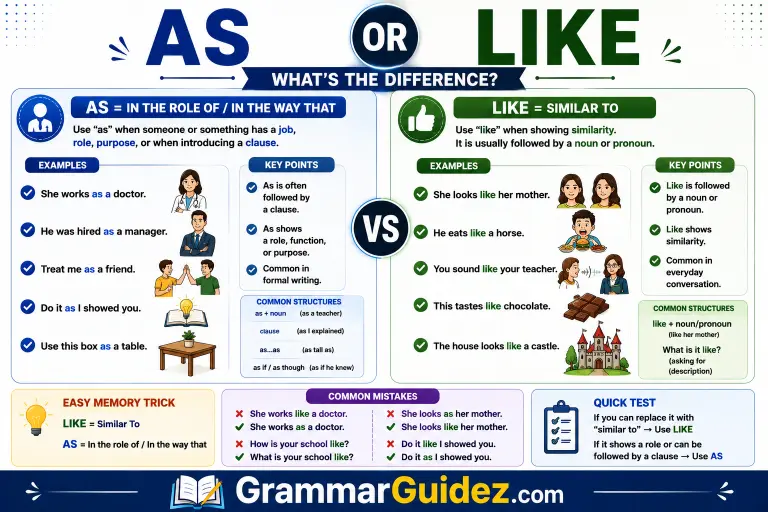
As or Like: The Short Answer
Use like when you mean “similar to” and it is followed by a noun or pronoun.
Your sister looks like you.
He eats like a horse.
Use as when you mean “in the role of” or when it introduces a clause.
She works as a doctor.
Do it as I showed you.
Cambridge explains the basic distinction clearly: as + noun can show a role, while like + noun generally means “similar to.”
Quick rule
LIKE = similar to
AS = in the role of / in the way that
There are also important structures such as as…as, as if, as though, and the same as, which we will cover below.
The Real Difference: Similarity vs Role
A useful way to understand as or like is to ask:
Am I talking about similarity or a real role/function?
Similarity → LIKE
He looks like his father.
He is not his father. They simply look similar to him.
Role → AS
He works as a teacher.
He really is a teacher.
This difference becomes especially clear in sentences involving jobs.
She works as a nurse.
This means nursing is her profession.
But:
She talks like a nurse.
This means her way of talking is similar to that of a nurse. It does not say that she is a nurse.
That small difference can completely change the meaning.
When “Like” Is the Better Choice
Use like to compare one person, thing, or action with another.
The meaning is usually:
similar to
With people
He looks like his father.
She sings like her sister.
You sound like your teacher.
With things
This tastes like chocolate.
The house looks like a castle.
Your new phone feels like mine.
Cambridge specifically notes that like is commonly used with verbs such as look, sound, feel, taste, and seem when expressing similarity.
A simple test
If you can replace like with similar to, the choice is probably correct.
This looks like a diamond.
= This looks similar to a diamond.
When “As” Is the Better Choice
Use as when someone or something has a particular role, job, purpose, or function.
Jobs
She works as a teacher.
He was hired as a manager.
I worked as a waiter during college.
Roles
Treat me as a friend.
They see him as a leader.
Functions
We used the box as a table.
The box is actually being used as a table.
Cambridge gives examples of as + noun for roles and purposes, such as working as a particular professional or using something as something else.
The Meaning Can Change Completely
Look at these pairs carefully.
1. He works as a teacher.
He is a teacher.
They talk like a teacher.
2. She works as a doctor.
She is a doctor.
Her clothes look similar to what a doctor might wear.
3. He was treated as a leader.
People regarded him in the role of a leader.
He acted like a leader.
His behavior was similar to that of a leader.
These examples show why choosing as or like is not simply a grammar exercise. It can affect the meaning of the entire sentence.
As Before a Clause, Like Before a Noun
This is one of the most useful rules for formal writing.
A clause usually contains a subject and a verb.
Like + noun/pronoun
She looks like her mother.
He runs like his brother.
As + clause
She looks as her mother does.
He runs as his brother does.
Oxford explains that like is used as a preposition before nouns and pronouns, while as can be used before a clause.
This gives you a practical formula:
LIKE + noun/pronoun
AS + clause
However, real English is more flexible than this simple rule, especially in conversation.
“As” in Formal Writing
In formal writing, as is often preferred when it introduces a complete clause.
For example:
Please complete the form as I explained.
She did exactly as her manager instructed.
Nobody understands him as I do.
These structures are common in careful written English. Cambridge gives examples where as introduces a clause in comparisons.
A more casual speaker might say:
Nobody understands him like I do.
This is common and natural in informal English, but as can sound more formal and traditional in writing.
As vs Like in “As…As” Comparisons
Do not confuse as or like with the comparison structure as…as.
We use:
as + adjective/adverb + as
to compare things that are equal in some way.
For example:
She is as tall as her sister.
This car is as fast as that one.
He runs as quickly as I do.
Cambridge describes as…as as a structure used to compare things that are equal in some way.
Negative form
You can also say:
She is not as tall as her sister.
This test is not as easy as the last one.
The form not as…as is more common than not so…as in modern English.
As Much As and As Many As
Another common use of as is to compare quantities.
Use:
as much as + uncountable noun
and:
as many as + plural countable noun
Examples:
She earns as much money as her brother.
We need as much time as possible.
There are as many students as teachers.
Cambridge confirms this distinction between as much for uncountable nouns and as many for plural nouns.
You can also use these expressions for surprisingly large amounts:
As many as 500 people attended the event.
As or Like After “Be”
This is another area where learners often hesitate.
Compare:
What is your new teacher like?
This asks for a description of the teacher’s personality, behavior, or general qualities.
What is your new teacher like?
She is friendly but quite strict.
Cambridge recommends What is…like? when asking for a description.
Do not normally say:
❌ How is your new teacher like?
Instead:
✅ What is your new teacher like?
However, How is your teacher? is also correct when asking about the teacher’s health or condition.
How is your teacher?
She is fine.
The two questions have different purposes.
Like After Verbs of the Senses
Like is especially common after verbs that describe how something appears, sounds, feels, tastes, or seems.
Look like
That building looks like a palace.
Sound like
You sound like your father.
Feel like
This fabric feels like silk.
Taste like
This drink tastes like lemon.
Seem like
He seems like a nice person.
These structures express similarity. Cambridge specifically highlights this use of like.
As or Like in Everyday Speech
Real spoken English does not always follow the strict rules taught in traditional grammar books.
For example, you may hear:
Nobody understands me like she does.
or:
Do it like I told you.
These forms are common in informal speech.
Oxford notes that like is frequently used as a conjunction instead of as in informal English. It also notes that these forms are generally not preferred in formal written English.
So the best advice is not simply:
“Like is wrong.”
That would be too simplistic.
Instead:
Casual conversation
Like is often natural.
Formal writing
As may be the better choice when it introduces a clause.
Common Mistakes With As and Like
Mistake 1: Using “as” for simple similarity
❌ She looks as her mother.
✅ She looks like her mother.
Why?
Because you are comparing appearance.
Mistake 2: Using “like” for a real job
❌ He works like a doctor.
If you mean that being a doctor is his actual job:
✅ He works as a doctor.
Mistake 3: “As” before a noun in a comparison
❌ She sings as her sister.
If you mean she sings in a similar way:
✅ She sings like her sister.
Mistake 4: “How is…like?”
❌ How is your new school like?
✅ What is your new school like?
The second question asks for a description.
As or Like? A Comparison Table
| Feature | As | Like |
| Main idea | Role, function, manner, comparison | Similarity |
| Common structure | As + clause | Like + noun/pronoun |
| Job meaning | Yes | No |
| Example | She works as a doctor. | She looks like a doctor. |
| Formal writing | Often preferred before clauses | Less formal in some clause structures |
| Meaning “similar to” | Sometimes, in specific structures | Very common |
| Example with “look” | — | It looks like rain. |
The distinction is not absolute in every English construction, but this table gives you a reliable starting point.
A Useful “Role or Similarity?” Test
When you are stuck between as or like, ask yourself one question:
Is the person or thing actually serving that role?
If yes → AS
She works as a lawyer.
She really is a lawyer.
If no, but it is similar → LIKE
She argues like a lawyer.
She may not be a lawyer. Her style is simply similar.
Try another:
He used the chair as a ladder.
The chair was used in that function.
He climbed the wall like a monkey.
He did not become a monkey. His movement was similar.
This test works surprisingly well.
“As If” and “As Though”
Also As appears in expressions that describe something unreal, possible, or apparently true.
As if
He talks as if he knows everything.
As though
She looked as though she had seen a ghost.
These structures are different from simple like + noun comparisons.
In informal speech, you may hear:
It looks like we’re going to be late.
Oxford notes that like is commonly used instead of as if in informal English.
For formal writing, however, as if or as though may be the safer choice.
British English vs American English
The basic distinction between as and like exists in both British and American English.
However, informal use of like as a conjunction is widespread in spoken English.
For example:
Nobody understands him like I do.
This is common in conversation.
In more formal writing, many style guides and traditional grammar references prefer:
Nobody understands him as I do.
Oxford specifically describes the like + clause construction as common in informal English but not generally considered correct in formal written English.
So the practical rule is:
Formal writing → prefer the standard clause structure with as.
Informal speech → like may be completely natural.
How to Choose the Right Word in 5 Seconds
Use this checklist.
Choose LIKE if:
- You mean similar to.
- It comes before a noun or pronoun.
- You are describing appearance.
- You are describing sound.
- You are describing behavior.
- You are making a simple comparison.
Examples:
looks like rain
sounds like music
acts like a child
Choose AS if:
- You mean in the role of.
- You mean for the purpose of.
- You introduce a clause.
- You are using as…as.
- You are using as if/as though.
- You are writing formally and need a clause after the comparison.
Examples:
works as a nurse
use it as a tool
do it as I showed you
Quick Quiz
Choose as or like.
1. She works ___ a teacher.
2. She looks ___ her teacher.
3. This tastes ___ orange.
4. Use the box ___ a table.
5. He runs ___ his brother.
6. Do it ___ I showed you.
7. What is your new manager ___?
8. He talks ___ he knows everything.
9. This car is ___ fast as mine.
10. She sings ___ a professional.
Answers
- as
- like
- like
- as
- like
- as
- like
- as if
- as
- like
FAQs
Is it “as me” or “like me”?
When you mean similar to me, use like me.
She has blue eyes like me.
Cambridge specifically gives this type of comparison with like.
However, as can be used when it introduces a clause:
She works as I do.
Is “like” wrong in formal English?
Not always. Like is completely standard when it means “similar to” and is used correctly. The issue arises when like is used as a conjunction before a clause in formal writing. Oxford notes that this use is common in informal English but is not generally preferred in formal written English.
Is it “I work as a teacher” or “I work like a teacher”?
If teaching is your actual job, say:
I work as a teacher.
If you mean that you work in a way that resembles a teacher’s work, like may be appropriate.
Is “as” more formal than “like”?
Not in every situation. Both words are normal English words. However, as is often preferred in formal writing when it introduces a clause, while like is common in informal speech in that position.
Is it “What is it like?” or “How is it like?”
The standard question is:
What is it like?
Use it when asking someone to describe a person, place, thing, or experience. Cambridge specifically warns against using How is it like? for this purpose.
Can “as” and “like” mean the same thing?
Sometimes, yes. Both can express similarity in certain comparison structures. For example, “Nobody understands him as I do” and “Nobody understands him like I do” can communicate a similar idea. The second is more informal.
What is the easiest way to remember as vs like?
Remember:
LIKE = similar to
AS = role or in the way that
So:
She looks like her mother.
but:
She works as a doctor.
This simple distinction will help you get most everyday sentences right.
Final Thoughts: As or Like?
The choice between as or like becomes much easier when you focus on the meaning rather than the word itself.
Use like when you are showing similarity:
He looks like his father.
Use as when someone or something has a real role or function:
He works as a teacher.
Use as before a clause in formal structures:
Do it as I showed you.
And remember that spoken English is flexible. You will often hear like used before clauses in everyday conversation. That does not mean the word is useless or “wrong”; it simply means the level of formality matters.
When writing an essay, report, application, or professional document, choose the more formal structure when needed.
The easiest memory trick is still the best:
LIKE = similar to
AS = role / function / in the way that
Once you learn that difference, choosing between as and like becomes much more natural.
Read More Articales:
- Follow or Fallow: What’s the Difference and Which One Should You Use?
- Apologising or Apologizing: Which Spelling Should You Use?

I am Elliot Hartwell, an English language writer and the author at GrammarGuidez.com. For the 6 years I have been working with English grammar, vocabulary, spelling and everyday language usage with a focus on making confusing topics easier to understand.
I started GrammarGuidez.com with a goal: to give readers clear and practical answers to common English questions. English can sometimes be confusing especially when two words look or sound similar but have meanings or uses. I enjoy breaking down these differences in a way that’s simple and easy to remember.
I believe learning English should feel simple not overwhelming. My goal is to make every article on GrammarGuidez.com useful, for students, writers, bloggers, teachers and anyone who wants to communicate clearly in English.