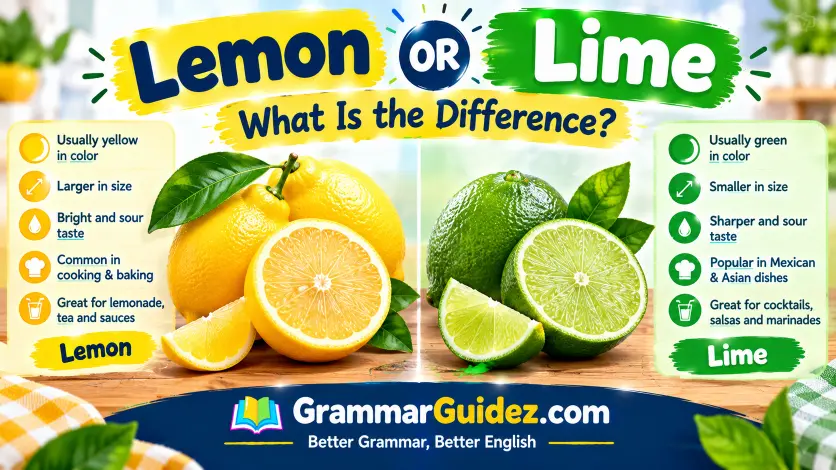
“Lemon” and “Lime” are both correct words, but they refer to different fruits. Lemon = a yellow citrus fruit with a sour taste. Lime = a usually green citrus fruit with a sharp, sour taste.
Are you confused about lemon or lime?
Lemons and limes are both citrus fruits. They look similar, taste sour, and are used in many of the same foods and drinks. But they are not the same fruit.
A lemon is usually larger and has yellow skin when ripe. A lime is usually smaller and has green skin. Limes often have a sharper and more intense sour taste, while lemons have a brighter and slightly milder flavor.
Both fruits are useful in cooking, baking, drinks, sauces, and desserts.
In this guide, you will learn the difference between lemon and lime, including their color, taste, size, uses, nutrition, and common examples.
Quick Answer: Lemon or Lime?
Lemon and lime are two different citrus fruits.
A lemon is usually yellow, larger, and has a bright sour taste.
A lime is usually green, smaller, and has a sharper, more intense sour taste.
| Feature | Lemon | Lime |
|---|---|---|
| Color | Usually yellow | Usually green |
| Size | Usually larger | Usually smaller |
| Taste | Sour and bright | Sour and sharper |
| Shape | Oval or slightly round | Usually round or oval |
| Skin | Usually thicker | Usually thinner |
| Common use | Tea, lemonade, baking | Cocktails, Mexican and Asian dishes |
| Juice | Yellowish or pale | Usually pale green |
| Family | Citrus | Citrus |
Both are healthy citrus fruits and both can add fresh flavor to food.
What Is a Lemon?
A lemon is a yellow citrus fruit.
It has a sour taste and a fresh smell. Lemons are widely used around the world.
You can use both the juice and zest of a lemon.
Common uses include:
- lemonade
- tea
- cakes
- cookies
- sauces
- salad dressings
- seafood
- marinades
- desserts
- cooking
Lemons are also commonly used to add acidity to food. A small amount of lemon juice can make many dishes taste brighter.
What Does a Lemon Look Like?
A ripe lemon is usually bright yellow.
Most lemons have an oval shape. Their skin can feel slightly rough or textured.
Inside, the fruit contains:
- juicy sections
- seeds in some varieties
- pale yellow flesh
- acidic juice
The peel contains fragrant oils that give lemons their strong citrus smell.
What Is a Lime?
A lime is another type of citrus fruit.
Limes are usually smaller than lemons. Many common limes have green skin, although some varieties become yellowish when fully ripe.
Limes have a strong sour taste. Their flavor can seem sharper than lemon.
Lime juice is especially common in:
- drinks
- sauces
- seafood
- Mexican food
- Thai food
- Indian food
- salads
- desserts
- marinades
Lime zest can also add a strong citrus smell and flavor to food.
What Does a Lime Look Like?
A lime is often smaller and rounder than a lemon.
Its skin is usually green.
Inside, it contains juicy sections and may contain small seeds depending on the variety.
The flesh is normally pale green to yellow-green.
Lemon vs Lime: Appearance
One of the easiest ways to tell a lemon from a lime is by looking at the outside.
Lemon
A lemon is usually:
- yellow
- larger
- oval-shaped
- slightly pointed at the ends
- thicker-skinned
Lime
A lime is usually:
- green
- smaller
- round or oval
- thinner-skinned
- compact
However, color alone does not always tell you which fruit you have.
Some ripe limes can become yellowish. Some lemon varieties can have unusual colors.
So, size, shape, smell, and taste can also help.
Lemon vs Lime: Taste
Taste is another important difference.
Lemons have a strong sour taste with a bright and fresh citrus flavor.
Limes are also sour, but their flavor is often sharper and more intense.
For example:
Lemon gives the tea a fresh, sour flavor.
Lime gives a drink a sharp citrus taste.
The difference can be small in some recipes, but it can be noticeable when you use a lot of juice.
Which Is More Sour: Lemon or Lime?
This question does not have one simple answer because different varieties can have different levels of acidity.
In general, limes often taste sharper and more intense, while lemons have a bright sour flavor.
The taste also depends on:
- the variety
- ripeness
- growing conditions
- freshness
- amount of juice used
So, you should not assume that every lime is more sour than every lemon.
Lemon vs Lime: Color
Color is one of the most familiar differences.
Lemon Color
Most ripe lemons are:
Yellow
Lime Color
Most common limes are:
Green
But there is an important detail.
Limes can become yellow as they ripen. Therefore, a green color is a useful clue, but it is not a perfect rule.
Likewise, different lemon varieties can have slightly different shades.
Lemon vs Lime: Size and Shape
Lemons are generally larger than limes.
A typical lemon is oval-shaped.
A typical lime is smaller and often more rounded.
However, fruit size can vary by variety.
This means you should use several clues instead of relying on size alone.
Lemon or Lime for Drinks?
Both fruits work well in drinks.
Lemon Drinks
Lemon is commonly used in:
- lemonade
- lemon tea
- iced tea
- sparkling water
- hot water with lemon
- soft drinks
A classic example is:
Fresh lemon juice makes a refreshing lemonade.
Lime Drinks
Lime is especially common in:
- limeade
- sparkling water
- mocktails
- cocktails
- iced drinks
- fruit drinks
Lemon or Lime for Cooking?
Both fruits are excellent for cooking.
Lemon is often used with:
- fish
- chicken
- vegetables
- pasta
- rice
- salads
- sauces
Lime is often used with:
- tacos
- salsa
- seafood
- rice dishes
- Asian dishes
- spicy foods
- marinades
The best choice depends on the recipe and the flavor you want.
Lemon or Lime for Baking?
Lemon is very common in baking.
You can find it in:
- lemon cake
- lemon cookies
- lemon pie
- lemon bars
- lemon cheesecake
- lemon muffins
Lime is also used in desserts.
Popular lime desserts include:
- key lime pie
- lime cheesecake
- lime sorbet
- lime cake
- lime cookies
Lemon often gives desserts a familiar bright citrus taste. Lime can provide a stronger and more tropical flavor.
Can You Substitute Lemon for Lime?
Yes, you can often substitute one for the other.
However, the final taste may change.
For example, if a recipe asks for lime juice and you use lemon juice, the dish may taste brighter and less sharp.
Likewise, replacing lemon with lime can make a recipe taste stronger and more intense.
A substitution usually works best when citrus flavor is not the main feature of the recipe.
When Substitution May Work Well
You can often substitute them in:
- salad dressings
- marinades
- sauces
- sparkling drinks
- some desserts
- general cooking
When Substitution May Change the Recipe
Be more careful with recipes where the fruit is the main flavor.
Examples include:
- key lime pie
- lemon curd
- lemon cake
- lime-based sauces
- special cocktails
In these recipes, the difference in flavor can be easy to notice.
Lemon vs Lime Nutrition
Both lemons and limes provide useful nutrients.
They contain vitamin C and other plant compounds.
They are also naturally low in calories when compared with many other foods.
However, most people do not eat large amounts of either fruit at once. They usually use a small amount of juice or zest in food and drinks.
The nutritional value can also vary based on:
- fruit size
- variety
- serving size
- if you eat the pulp or only use the juice
So, both can be part of a balanced diet.
Lemon and Lime Juice
Both fruits are excellent sources of juice.
Lemon juice is commonly used in:
- lemonade
- sauces
- tea
- salad dressing
- baking
Lime juice is commonly used in:
- drinks
- marinades
- salsa
- seafood
- sauces
Fresh juice usually gives food a stronger citrus aroma than many bottled products.
Lemon Zest vs Lime Zest
The zest is the colored outer part of the citrus peel.
Both lemon and lime zest can add strong citrus flavor.
Lemon Zest
Lemon zest has a bright, fresh citrus smell.
It works well in:
- cakes
- cookies
- pasta
- sauces
- desserts
Lime Zest
Lime zest has a sharper citrus aroma.
It works well in:
- desserts
- sauces
- rice dishes
- seafood
- drinks
When using zest, avoid taking too much of the white layer underneath the skin because it can taste bitter.
Lemon or Lime: Common Uses
Here is a simple comparison.
| Use | Lemon | Lime |
|---|---|---|
| Lemonade/Limeade | ✅ | ✅ |
| Tea | ✅ | Sometimes |
| Baking | ✅ | ✅ |
| Seafood | ✅ | ✅ |
| Marinades | ✅ | ✅ |
| Salad dressing | ✅ | ✅ |
| Mexican dishes | Sometimes | ✅ |
| Thai dishes | Sometimes | ✅ |
| Key lime pie | ❌ | ✅ |
| Lemon pie | ✅ | ❌ |
| Lemon cake | ✅ | Sometimes |
| Cocktails and mocktails | ✅ | ✅ |
Are Lemon and Lime the Same Fruit?
No.
Lemons and limes are different citrus fruits.
They share many similarities, but they differ in appearance, flavor, size, and common culinary uses.
This is similar to comparing two related fruits that can sometimes be used in the same recipe.
The fact that you can substitute one for the other in some situations does not mean they are the same fruit.
Lemon or Lime for Water?
Both can be added to water.
Lemon water is very popular because lemon adds a fresh sour flavor.
Lime water can provide a sharper citrus taste.
For example:
Add a few slices of lemon to cold water.
or:
Add fresh lime juice to sparkling water.
There is no need to choose only one. Both can make plain water taste more interesting.
Lemon or Lime for Fish?
Both are commonly paired with fish and seafood.
Lemon is a classic choice for many fish dishes.
Lime is also popular, especially in dishes with spicy, tropical, Mexican, or Asian flavors.
For example:
Squeeze fresh lemon juice over grilled fish.
Add lime juice to a seafood marinade.
The choice depends on the style of the dish.
Lemon or Lime for Chicken?
Lemon works very well with chicken.
Lime can also work well with chicken, especially when the recipe contains:
- chili
- garlic
- cilantro
- spices
- tropical flavors
Both fruits can add acidity and freshness.
Lemon or Lime: Which One Should You Use?
There is no single fruit that works best for every recipe.
Choose lemon when you want:
- a bright citrus flavor
- a classic sour taste
- lemon desserts
- lemonade
- lemon tea
- a traditional pairing with fish
Choose lime when you want:
- a sharper citrus flavor
- a stronger tropical note
- lime-based drinks
- Mexican-style dishes
- Thai-style dishes
- salsa and spicy foods
Your recipe should guide your choice.
Common Mistakes About Lemon and Lime
Mistake 1: Thinking They Are the Same
Lemons and limes are related citrus fruits, but they are different fruits.
Mistake 2: Believing Every Lime Is Always Green
Most common limes are green, but some limes can turn yellowish as they mature.
Mistake 3: Thinking They Taste Exactly the Same
Both are sour, but their flavor profiles are different.
Mistake 4: Using Lemon and Lime Interchangeably in Every Recipe
You can substitute them in many recipes, but the flavor may change.
Mistake 5: Judging Only by Color
Color helps, but it is not always enough to identify a citrus fruit.
Easy Way to Remember Lemon vs Lime
Use this simple memory trick:
Lemon = Yellow
Lime = Green
Think:
Lemon is usually yellow, while lime is usually green.
Then remember the taste:
Lemon = bright and sour
Lime = sharp and citrusy
This makes the basic difference easy to remember.
Lemon or Lime: Quick Comparison
| Question | Lemon | Lime |
|---|---|---|
| Is it a citrus fruit? | Yes | Yes |
| Usually yellow? | Yes | Usually no |
| Usually green? | No | Yes |
| Usually larger? | Yes | No |
| Sour taste? | Yes | Yes |
| Used in drinks? | Yes | Yes |
| Used in cooking? | Yes | Yes |
| Used in desserts? | Yes | Yes |
| Can they sometimes be substituted? | Yes | Yes |
Frequently Asked Questions
What is the main difference between lemon and lime?
The main differences are their appearance, size, and flavor. Lemons are usually larger and yellow, while limes are usually smaller and green.
Is lime more sour than lemon?
Limes often have a sharper and more intense sour flavor, but acidity varies between varieties and individual fruits.
Can I use lemon instead of lime?
Yes, lemon can replace lime in many recipes. However, the final flavor may be different.
Can I use lime instead of lemon?
Yes, lime can replace lemon in some recipes. It usually gives the dish a sharper citrus flavor.
Are lemons and limes related?
Yes. Both are citrus fruits and are closely related, but they are different fruits.
Is lemon yellow and lime green?
Usually, yes. Most ripe lemons are yellow, while common limes are green. However, color can vary by variety and ripeness.
Which is better for cooking, lemon or lime?
Both are useful. Lemon is common in many European-style dishes and baking, while lime is especially common in Mexican, Thai, and other cuisines.
Which tastes better, lemon or lime?
Taste is personal. Lemon has a bright sour flavor, while lime often has a sharper and more intense citrus flavor.
Can you eat lemon and lime peel?
The outer zest can be used in cooking and baking, but the peel is quite strong and bitter. Wash the fruit well before using the zest.
Final Verdict: Lemon or Lime?
Lemon and lime are both citrus fruits, but they are not the same.
A lemon is usually larger, yellow, and has a bright sour flavor.
A lime is usually smaller, green, and has a sharper citrus flavor.
Both are useful in cooking, baking, drinks, sauces, marinades, and desserts.
The easiest way to remember the difference is:
Lemon = usually yellow
Lime = usually green
When choosing between them, think about the recipe and the flavor you want.
Read More Articles:

I am Elliot Hartwell, an English language writer and the author at GrammarGuidez.com. For the 6 years I have been working with English grammar, vocabulary, spelling and everyday language usage with a focus on making confusing topics easier to understand.
I started GrammarGuidez.com with a goal: to give readers clear and practical answers to common English questions. English can sometimes be confusing especially when two words look or sound similar but have meanings or uses. I enjoy breaking down these differences in a way that’s simple and easy to remember.
I believe learning English should feel simple not overwhelming. My goal is to make every article on GrammarGuidez.com useful, for students, writers, bloggers, teachers and anyone who wants to communicate clearly in English.