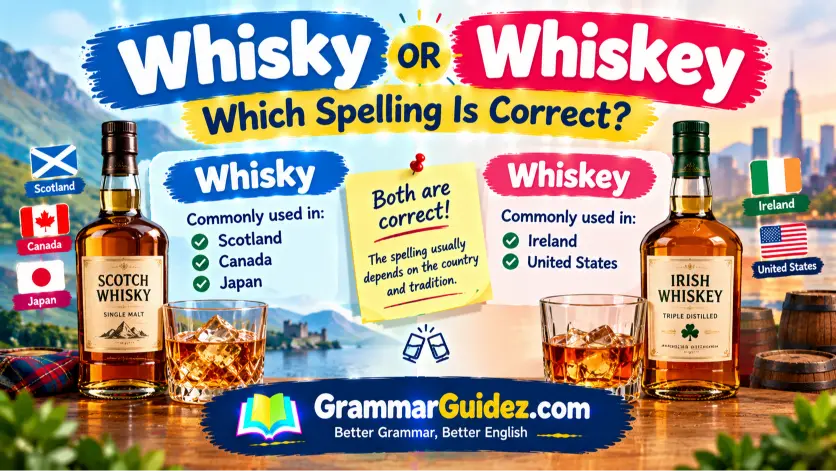
“Whisky” and “Whiskey” are both correct spellings, but the preferred spelling often depends on the country or style. Whisky = commonly used for Scotch whisky and in countries such as Scotland, Canada, and Japan. Whiskey = commonly used for Irish and American whiskey
Have you seen both whisky and whiskey and wondered which spelling is correct?
The good news is that both whisky and whiskey are correct. The main difference is usually connected to the country where the spirit is made and the spelling used by that producer.
In general, Scotland, Canada, and Japan use “whisky,” while Ireland and the United States commonly use “whiskey.” However, this is a general pattern, not an absolute rule. Some producers use a different spelling for historical or branding reasons.
So, if you are writing about a specific bottle, the safest choice is to follow the spelling used by the producer.
Quick Answer: Whisky or Whiskey?
Whisky and whiskey refer to the same broad family of distilled grain spirits.
The spelling usually changes by region:
| Spelling | Commonly Associated With |
| Whisky | Scotland, Canada, Japan |
| Whiskey | Ireland, United States |
There are exceptions, so the spelling on the bottle or official product information should always be checked.
The difference is mainly about regional tradition and naming conventions, not simply about the type or quality of the drink.
What Does Whisky Mean?
Whisky is a standard spelling for the spirit in several whisky-producing traditions.
The spelling without the e is strongly associated with Scotland. This is why the familiar term is Scotch whisky, not Scotch whiskey.
Canada and Japan also commonly use whisky.
Whisky is generally made from fermented grain mash, distilled, and matured according to the rules that apply to its particular style and country.
The exact production rules can differ greatly between regions.
What Does Whiskey Mean?
Whiskey is another standard spelling for the same broad family of spirits.
The spelling with the e is strongly associated with Ireland and the United States.
You will commonly see terms such as:
- Irish whiskey
- American whiskey
- Bourbon whiskey
- Tennessee whiskey
In the United States, different types of whiskey have their own legal standards. For example, bourbon has specific federal requirements that distinguish it from other American whiskey styles.
Whisky vs Whiskey: The Main Difference
The biggest difference is usually where the spirit comes from and which spelling the producer follows.
Think of the spelling as a useful geographical clue.
Whisky
Whisky is commonly used for:
- Scotch whisky
- Canadian whisky
- Japanese whisky
Whiskey
Whiskey is commonly used for:
- Irish whiskey
- American whiskey
- Bourbon whiskey
- Tennessee whiskey
This does not mean every bottle from these countries must follow the same spelling.
Individual producers can have their own traditions.
Why Does Whisky Have No “E”?
The spelling difference developed through language, history, and regional traditions.
The word ultimately comes from Gaelic expressions related to “water of life.” Over time, the word developed into the English forms used today.
During the 19th century, Scottish and Irish producers developed different spelling traditions. Irish producers increasingly used whiskey, while Scottish producers generally continued with whisky.
American usage was influenced strongly by Irish immigration and Irish-American distilling traditions.
As these traditions became established, the two spellings became closely connected with different producing regions.
So, the extra e is not a modern grammar rule. It is part of the history of the word.
Is Whisky or Whiskey More Correct?
Neither spelling is automatically more correct.
Both are established English spellings.
The better spelling depends on what you are talking about.
For example, if you are discussing Scotch, whisky is the expected spelling.
If you are discussing Irish whiskey, whiskey is the normal spelling.
If you are discussing an American product, check the producer’s official spelling.
This is especially important when writing about a particular brand or bottle.
Scotch Whisky or Scotch Whiskey?
The standard term is:
Scotch whisky
Scotch whisky is whisky produced in Scotland under the rules that govern Scotch whisky.
So, when writing about Scotch, use whisky without the e.
Using “Scotch whiskey” may be understood, but Scotch whisky is the established term.
Irish Whiskey or Irish Whisky?
The standard term is:
Irish whiskey
Irish producers traditionally use the spelling with the e.
Therefore, when referring specifically to whiskey made in Ireland, Irish whiskey is the usual form.
Bourbon Whisky or Bourbon Whiskey?
In the United States, the standard term is generally:
bourbon whiskey
Bourbon is a type of American whiskey with specific legal requirements.
This is an important point because whisky and whiskey are not simply two different types of alcohol.
The spelling tells you about regional naming tradition, while terms such as bourbon, Scotch, single malt, and blended describe particular categories or styles.
What About American Whiskey?
American producers generally use whiskey.
Common examples of American whiskey categories include:
- Bourbon
- Tennessee whiskey
- Rye whiskey
- Corn whiskey
- Wheat whiskey
However, there are exceptions.
Some American producers use whisky rather than whiskey. Historical tradition and brand identity can influence the choice.
That is why you should not assume that every American bottle must contain the letter e.
What About Canadian Whisky?
Canadian producers commonly use:
Canadian whisky
The spelling usually appears without the e.
Canadian whisky has its own production traditions and legal requirements.
So, if you are writing about Canadian whisky, whisky is normally the appropriate spelling.
What About Japanese Whisky?
Japanese producers also commonly use:
Japanese whisky
Japan’s modern whisky tradition was strongly influenced by Scotch whisky.
The spelling whisky is therefore widely associated with Japanese products.
When discussing a specific Japanese whisky, however, it is still best to follow the spelling used by the producer.
Is the Pronunciation Different?
Usually, whisky and whiskey are pronounced essentially the same way.
The main difference is in the spelling.
The pronunciation can vary slightly between accents, but the extra e does not normally create a completely different pronunciation.
This is why the two words can be confusing when you hear them in conversation.
You often need to see the written word to know which spelling someone has chosen.
Whisky and Whiskey Are Not Two Completely Different Drinks
A common misunderstanding is that whisky and whiskey are two completely separate drinks.
That is not the best way to understand the difference.
Both words belong to the same broad family of distilled grain spirits.
The important differences between individual products can involve:
- Country of production
- Grain used
- Distillation methods
- Aging requirements
- Type of barrel
- Blending
- Local laws
- Production traditions
The spelling alone does not tell you all of these things.
For example, two products may both use the word whisky or whiskey but still have very different production methods and flavor profiles.
Does the Spelling Tell You Where It Comes From?
Often, yes.
The spelling can give you a useful clue.
Whisky usually suggests:
Scotland → whisky
Canada → whisky
Japan → whisky
Whiskey usually suggests:
Ireland → whiskey
United States → whiskey
But remember the word usually.
Some producers do not follow the most common regional pattern.
For a specific product, always follow the producer’s own spelling.
Whisky or Whiskey in Formal Writing
If you are writing an article, report, menu, product description, or academic paper, consistency matters.
Use the spelling that matches the spirit you are discussing.
For example, a document about Scotch should consistently use whisky.
A document about Irish whiskey should consistently use whiskey.
If you are discussing both traditions, you can use both spellings.
You do not need to change one spelling into the other simply to make the article consistent.
The two forms can correctly appear in the same article when they refer to different regional traditions.
A Simple Memory Trick
Here is an easy way to remember the difference:
Scotland = whisky
Ireland = whiskey
The same general pattern extends to many products from Canada and Japan on the whisky side and the United States on the whiskey side.
Another useful tip is:
Follow the bottle.
If you are unsure about a particular brand, check its official label or product information and copy the spelling used by the producer.
Common Mistakes With Whisky and Whiskey
Mistake 1: Saying one spelling is always wrong
Both spellings are established.
The correct choice depends on context.
Mistake 2: Calling Scotch “Scotch whiskey”
The established term is Scotch whisky.
Mistake 3: Calling Irish spirits “Irish whisky”
The usual term is Irish whiskey.
Mistake 4: Assuming every American producer uses “whiskey”
Most do, but individual producers may use whisky.
Always check the producer’s spelling when discussing a particular product.
Mistake 5: Thinking the spelling determines quality
The presence or absence of e does not tell you if a whisky or whiskey is high quality.
It is mainly a spelling and regional convention.
Whisky vs Whiskey: Quick Comparison
| Feature | Whisky | Whiskey |
| Spelling | No “e” | Includes “e” |
| Scotland | Common | Not the usual form |
| Ireland | Not the usual form | Common |
| United States | Some exceptions | Common |
| Canada | Common | Not the usual form |
| Japan | Common | Not the usual form |
| Pronunciation | Usually similar | Usually similar |
| Meaning | Broad family of grain spirits | Broad family of grain spirits |
| Main difference | Regional convention | Regional convention |
Which One Should You Use?
Use whisky when the product or tradition uses that spelling.
Use whiskey when the product or tradition uses that spelling.
If you are writing about a specific brand, bottle, distillery, or product, check the official name first.
This is more accurate than trying to apply one spelling to every type of spirit.
Whisky or Whiskey in American English
American English commonly uses whiskey.
This is especially common when discussing American whiskey, bourbon, and Tennessee whiskey.
However, American brands can choose their own traditional spelling.
Therefore, “American = always whiskey” is too strong.
A better rule is:
American products commonly use whiskey, but check the individual producer.
Whisky or Whiskey in British English
British English commonly uses whisky, especially when discussing Scotch whisky.
However, British English also uses whiskey when referring to Irish or American products that use that spelling.
This is important because British English does not require every spirit to be spelled without the e.
The spelling can follow the name and tradition of the product.
Is Whisky the Same as Scotch?
No.
Whisky is a broad term.
Scotch whisky is a specific category of whisky produced in Scotland under defined rules.
Other whiskies come from other countries and follow their own standards.
So:
Scotch whisky = a type of whisky
But:
Not all whisky is Scotch.
The same idea applies to whiskey.
American whiskey and Irish whiskey are different styles with their own production traditions.
Is Whiskey the Same as Bourbon?
No.
Bourbon is a type of American whiskey.
That means bourbon belongs to the larger whiskey family.
However, not every whiskey is bourbon.
Bourbon has specific legal requirements under U.S. regulations.
So the relationship is:
Whiskey → American whiskey → Bourbon
Bourbon is therefore more specific than whiskey.
A Note About Product Labels
When you are writing about alcohol products, the spelling on the official label is important.
In the United States, the Alcohol and Tobacco Tax and Trade Bureau (TTB) requires distilled spirits to carry a class/type designation that follows applicable standards of identity.
Official U.S. labeling examples include terms such as Whisky and Bourbon Whiskey.
This is another reason not to assume that the spelling is simply a matter of personal preference.
FAQs
Is whisky or whiskey correct?
Both whisky and whiskey are correct spellings. The choice usually depends on regional tradition and the product being discussed.
Is Scotch whisky or whiskey?
The standard term is Scotch whisky, without the e.
Is Irish whisky or whiskey?
The standard term is Irish whiskey, with the e.
Is American whisky or whiskey?
American products commonly use whiskey, although some American producers use whisky.
Is Canadian whisky or whiskey?
Canadian products commonly use whisky, without the e.
Is Japanese whisky or whiskey?
Japanese products commonly use whisky, without the e.
Are whisky and whiskey pronounced differently?
Usually, no major pronunciation difference exists. The spelling is the main visible difference.
Does whisky mean Scotch?
No. Scotch is a specific type of whisky made in Scotland. Whisky is a broader term.
Is bourbon whisky or whiskey?
In U.S. usage, bourbon is generally called bourbon whiskey. Bourbon is a type of American whiskey.
Which spelling should I use in an article?
Use the spelling that matches the country, product, or producer you are discussing. For a specific brand, follow its official spelling.
Final Answer: Whisky or Whiskey?
Whisky and whiskey are both correct.
The difference is mainly based on regional spelling and production traditions.
- Whisky is commonly associated with Scotland, Canada, and Japan.
- Whiskey is commonly associated with Ireland and the United States.
- Scotch whisky uses no “e.”
- Irish whiskey uses an “e.”
- Bourbon whiskey is the common U.S. term.
- Some producers use an alternative spelling, so the official product name should always be checked.
The easiest rule is simple:
Do not ask which spelling is universally correct. Ask which spelling belongs to the product or tradition you are discussing.
Read More Articles:

I am Elliot Hartwell, an English language writer and the author at GrammarGuidez.com. For the 6 years I have been working with English grammar, vocabulary, spelling and everyday language usage with a focus on making confusing topics easier to understand.
I started GrammarGuidez.com with a goal: to give readers clear and practical answers to common English questions. English can sometimes be confusing especially when two words look or sound similar but have meanings or uses. I enjoy breaking down these differences in a way that’s simple and easy to remember.
I believe learning English should feel simple not overwhelming. My goal is to make every article on GrammarGuidez.com useful, for students, writers, bloggers, teachers and anyone who wants to communicate clearly in English.