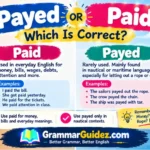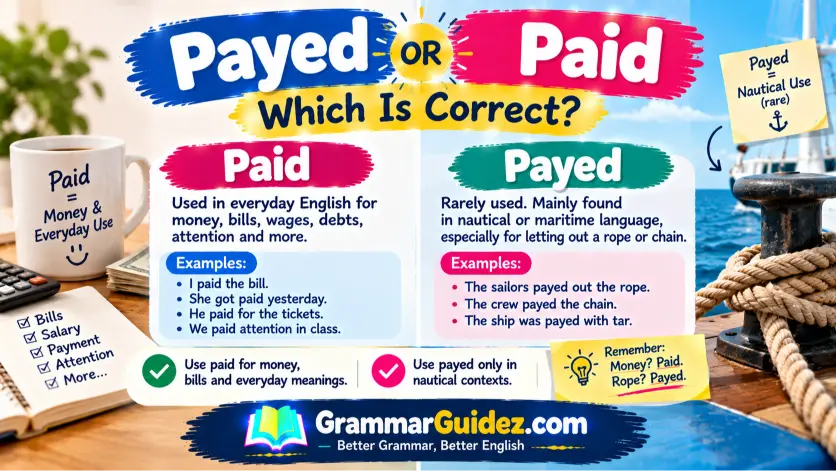
“Paid” and “Payed” are both real words, but they have different uses. Paid = the standard past tense and past participle of pay, meaning to give money for something. Payed = a rare nautical term used for sealing or waterproofing parts of a ship
If you are unsure if to write payed or paid, you are not alone. These two words look very similar, and payed may seem like the natural past tense of pay.
But in modern everyday English, paid is almost always the correct choice.
Paid is the past tense and past participle of pay when you talk about money, bills, salaries, prices, debts, attention, or other common meanings of the verb.
Payed is a real word, but it is rare. It is mainly used in nautical or maritime language, especially when talking about letting out a rope or chain or sealing parts of a ship.
So, if you are talking about money, remember:
Pay → Paid → Paid
Quick Answer: Payed or Paid?
Paid is correct in almost all everyday situations.
Payed is a rare specialized word used mainly in nautical contexts.
| Word | Main Use | Correct? |
| Paid | Money, bills, wages, debts, attention, and general uses of pay | ✅ Yes |
| Payed | Rare nautical or maritime uses | ✅ Yes, but uncommon |
For example:
- I paid the bill.
- She paid for the tickets.
- He has paid his debt.
- The sailors payed out the rope.
The first three use the normal form paid. The last uses the rare nautical form payed.
What Does “Paid” Mean?
Paid is the standard past tense and past participle of pay in ordinary English.
The basic verb forms are:
pay → paid → paid
We use paid when someone gives money, settles a bill, receives money, or deals with many figurative uses of pay.
For example:
- She paid the bill.
- We paid for the food.
- He was paid yesterday.
- They have paid the full amount.
Paid is also used when pay does not involve money directly.
For example:
- She paid attention to the teacher.
- He paid a visit to his friend.
- They paid their respects.
- The mistake paid off in the end.
The important point is that paid covers most normal meanings of pay.
What Does “Payed” Mean?
Payed is a real English word, but it has a very limited use.
It is mainly found in nautical language.
One use means to let out or slacken a rope, cable, or chain.
For example:
The sailors payed out the rope.
Another nautical use refers to applying a protective substance such as tar or pitch to parts of a ship to make them watertight.
This use is uncommon in everyday English.
That is why most English learners will rarely need to use payed.
Payed vs Paid: The Main Difference
The easiest way to understand the difference is to look at the meaning.
Paid
Use paid for ordinary meanings of pay.
This includes:
- giving money
- settling a bill
- paying a debt
- receiving wages
- paying for something
- paying attention
- paying a visit
- paying respects
- paying a price
Payed
Use payed only in certain specialized nautical uses.
This can include:
- letting out a rope
- letting out a chain
- slackening a rope
- applying a protective coating to a ship
So the rule is simple:
Money or ordinary English → paid
Rare nautical use → payed
Scribbr and other grammar references make the same distinction: paid is the normal form, while payed has specialized maritime uses.
Why Do People Write “Payed”?
The confusion is easy to understand.
Many English verbs form their past tense by adding -ed.
For example:
- walk → walked
- work → worked
- play → played
- clean → cleaned
- open → opened
Because of this pattern, someone may think:
pay → payed
But pay is an irregular verb in its common use.
The correct form is:
pay → paid
This is similar to other irregular verbs:
- say → said
- lay → laid
- make → made
- take → took
- buy → bought
So you should not create payed simply by adding -ed to pay.
Is “Payed” a Real Word?
Yes.
This is an important point.
It would be inaccurate to say that payed is never a word.
Dictionaries and grammar references recognize payed in specialized nautical contexts. It can describe letting out a rope or chain or applying a protective coating to a ship.
However, that does not make payed an alternative spelling of paid.
You cannot normally replace paid with payed when talking about money.
For example:
❌ I payed the bill.
✅ I paid the bill.
The first sentence uses payed incorrectly for the normal financial meaning.
Paid as the Past Tense of Pay
When pay is used in the normal sense, its simple past form is paid.
Present
I pay the bill every month.
Past
I paid the bill yesterday.
Past participle
I have paid the bill.
Notice that both the past tense and past participle use paid.
So:
Present: pay
Past: paid
Past participle: paid
This makes paid the form you will use in most everyday writing.
Paid or Payed for Something
When you give money for something, use paid.
Correct forms include:
- paid for the meal
- paid for the ticket
- paid for the service
- paid for the house
- paid for the repair
For example:
We paid for the hotel room.
Not:
We payed for the hotel room.
The same rule applies if the payment is small or large.
Paid or Payed a Bill
When you settle a bill, the correct word is paid.
Examples include:
She paid the electricity bill.
I paid my credit card bill.
They paid the restaurant bill.
He paid the bill online.
Never use payed for these ordinary financial meanings.
Paid or Payed Attention
The expression pay attention does not normally involve money, but its past form is still paid attention.
Correct:
She paid attention in class.
Incorrect:
She payed attention in class.
The same applies to other common expressions with pay.
For example:
- paid a visit
- paid respects
- paid the price
- paid attention
- paid off
So you should not limit the rule to financial situations.
The broader rule is:
Use paid for normal meanings of the verb pay.
Payed Out or Paid Out?
This area can cause extra confusion.
In ordinary modern English, paid out is common when talking about money.
For example:
The company paid out bonuses.
The insurance company paid out the claim.
But payed out can appear in nautical language when referring to letting out rope or chain.
For example:
The sailor payed out the rope.
Some modern sources also note that paid out may be used for the nautical sense, so writers who are not working in specialized maritime language should generally prefer paid.
Paid or Payed in American English
American English uses paid in normal situations.
For example:
I paid the bill.
She paid for the service.
He paid his employees.
There is no American spelling rule that changes paid to payed.
If you are writing an American English article, email, report, or school assignment, paid is the correct choice for ordinary uses.
Paid or Payed in British English
British English also uses paid for normal meanings of pay.
For example:
I paid for the meal.
She paid her rent.
They paid the full amount.
The difference between paid and payed is therefore not an American vs British spelling difference.
Both major varieties use paid in everyday English.
Payed is a specialized word rather than a British alternative to paid.
Common Mistakes With Payed and Paid
Mistake 1: “I Payed the Bill”
This is one of the most common errors.
❌ I payed the bill.
✅ I paid the bill.
Use paid for money and bills.
Mistake 2: “She Got Payed”
Another common mistake appears when talking about wages.
❌ She got payed yesterday.
✅ She got paid yesterday.
The correct phrase is got paid.
Mistake 3: “He Payed for Dinner”
When someone gives money for food, use paid.
❌ He payed for dinner.
✅ He paid for dinner.
Mistake 4: “I Payed Attention”
The correct expression is paid attention.
❌ I payed attention.
✅ I paid attention.
Mistake 5: Thinking Payed Is Always Wrong
This is the opposite mistake.
Although paid is correct in almost all ordinary situations, payed does exist.
It has specialized nautical uses.
So the better rule is not:
“Payed is always wrong.”
The better rule is:
“Use paid for normal meanings of pay. Payed is a rare nautical form.”
How to Remember Paid or Payed
Here is an easy memory trick:
Money? Choose PAID.
If you are talking about:
- money
- bills
- wages
- prices
- debts
- attention
- visits
- respects
choose paid.
Only think about payed when the sentence involves specialized nautical language.
You can also remember:
Pay has a special past form: PAID.
So:
pay → paid → paid
not:
pay → payed → payed
Payed or Paid: Comparison Table
| Feature | Paid | Payed |
| Common in modern English | Yes | No |
| Past tense of normal “pay” | Yes | No |
| Past participle of normal “pay” | Yes | No |
| Used for money | Yes | No |
| Used for salaries | Yes | No |
| Used for bills | Yes | No |
| Used for “pay attention” | Yes | No |
| Nautical use | Sometimes | Yes, specialized |
| Common in everyday writing | Very common | Very rare |
Payed or Paid in a Sentence
Here are some quick examples.
Paid
I paid the bill yesterday.
She has paid for the tickets.
The company paid its workers on time.
He paid close attention.
We paid a visit to our neighbors.
Payed
The sailor payed out the rope.
The crew payed out the chain slowly.
The first group uses the normal form of pay.
The second group uses the specialized nautical form.
FAQs
Is it payed or paid?
Paid is correct in almost all everyday situations. Payed is a rare word mainly used in nautical contexts.
Is “payed” a correct word?
Yes, but it has a very limited use. It is mainly used in nautical or maritime contexts, such as letting out rope or chain or sealing parts of a ship.
Is “I payed the bill” correct?
No. The correct sentence is “I paid the bill.”
Is “I paid for it” correct?
Yes. Paid is the correct past tense of pay when you give money for something.
Is “got paid” or “got payed” correct?
Got paid is correct.
For example:
I got paid yesterday.
Is it paid attention or payed attention?
The correct phrase is paid attention.
Is payed used in British English?
Payed can appear in specialized nautical language, but it is not the normal British past tense of pay. British English uses paid for ordinary meanings.
Is payed a spelling mistake?
Usually, yes, if the writer is using it as the normal past tense of pay. However, payed is a legitimate specialized nautical word.
What is the past tense of pay?
The normal past tense is paid.
Pay → paid
What is the past participle of pay?
The normal past participle is also paid.
Pay → paid → paid
Final Answer: Payed or Paid?
For almost everything you write, choose paid.
Paid is the normal past tense and past participle of pay. Use it for money, bills, salaries, prices, debts, attention, visits, and other common meanings.
Payed is a real but rare word. It is mainly found in specialized nautical language, especially when talking about letting out rope or chain or sealing parts of a ship.
The easiest rule is:
Everyday English → PAID
Specialized nautical use → PAYED
So if you are writing an email, article, assignment, CV, business document, or social media post, paid will almost always be the correct choice.
Read More Articles:

I am Evan Whitmore, an English language writer and the person who started GrammarGuidez.com. I made GrammarGuidez.com to make grammar, spelling, vocabulary and words that are often confused easier to understand.
I like taking to understand English words and grammar rules and turning them into simple and clear explanations. My aim is to help students, writers, bloggers, ESL learners and regular English speakers feel more sure when they write and talk.
At GrammarGuidez.com I work on real life examples easy to understand explanations comparing words, spelling changes and how American English is used every day.
I think learning English doesn’t need to be hard. A good explanation and some good examples can make tough grammar topics much simpler to learn