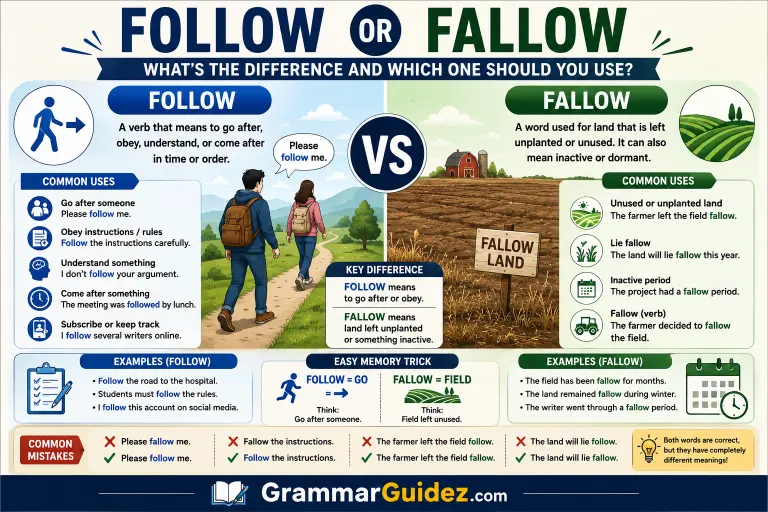
“Follow” and “fallow” are both correct words, but they have different meanings. “Follow” is a verb meaning to go after someone or something, or to obey or understand something, while “fallow” is an adjective describing land that is left uncultivated for a period of time.
Follow or fallow? These two words look and sound similar, but they have very different meanings. Using the wrong one can change the meaning of a sentence completely.
Follow is a common verb that means to go after someone or something, obey instructions, understand something, or come after something in time or order. Merriam-Webster also lists uses related to watching, pursuing, and subscribing to someone on social media.
Fallow, on the other hand, is mainly connected with land that is left unplanted or unused. It can also describe something that is inactive or dormant, as in “a fallow period.” It can be a noun, verb, or adjective.
Because the words are close in spelling and pronunciation, learners often confuse them. In this guide, we will explain follow or fallow, their meanings, differences, examples, common mistakes, and an easy way to remember which word to use.
Read More About: Collectables or Collectibles: What’s the Difference?
Follow or Fallow – Quick Answer
The quick answer is simple:
Follow means to go after, come after, obey, understand, or keep track of something.
Fallow usually describes land that is left without crops for a period of time. It can also mean inactive or unused.
For example:
Please follow me.
Here, follow means to go with or behind someone.
The farmer left the field fallow.
Here, fallow means the land was left unplanted.
So, follow and fallow are not interchangeable.
Easy rule
Follow = go after or obey
Fallow = unused or unplanted
What Does Follow Mean?
Definition of Follow
Follow is mainly a verb. It has several common meanings.
It can mean to move behind someone or something:
The dog followed the boy home.
It can mean to obey instructions:
Please follow the directions carefully.
It can mean to understand something:
I don’t follow your argument.
It can also mean to come after something in time or order:
The meeting was followed by lunch.
Merriam-Webster lists these and several other meanings, including watching something closely and subscribing to a social-media account.
Pronunciation of Follow
Follow is pronounced approximately:
FAH-loh in American English
FOL-oh in British English
Cambridge gives the US pronunciation as /ˈfɑː.loʊ/ and the UK pronunciation as /ˈfɒl.əʊ/.
Examples of Follow
- Follow me to the car.
- Please follow these instructions.
- I follow several writers online.
- The children followed their teacher.
- Success may follow hard work.
- I don’t follow what you mean.
What Does Fallow Mean?
Definition of Fallow
Fallow has a very different meaning.
It often describes farmland that is not planted with crops for a period of time.
For example:
The farmer left the field fallow for a year.
The purpose may be to allow the soil to recover or to manage weeds and moisture.
Cambridge defines fallow land as land that is not planted with crops, while Merriam-Webster describes fallow land as cultivated land allowed to lie idle during the growing season.
Fallow as an Adjective
Fallow can also describe something that is inactive, unused, or dormant.
For example:
The project remained fallow for several years.
The word is often used in the phrase:
lie fallow
This means to remain unused or inactive.
Fallow as a Verb
Fallow can also be used as a verb.
For example:
The farmer decided to fallow the field.
As a verb, it refers to leaving or treating land without planting it. Merriam-Webster includes fallow as a verb meaning to work the land without seeding it.
Examples of Fallow
- The farmer left the field fallow.
- The land remained fallow during the winter.
- They allowed the soil to lie fallow.
- The project had a fallow period.
- Some farmland is left fallow to manage soil conditions.
What Is the Difference Between Follow and Fallow?
The biggest difference is meaning and usage.
| Feature | Follow | Fallow |
| Main meaning | Go after, obey, understand, or come after | Left unplanted, unused, or inactive |
| Common part of speech | Verb | Adjective, noun, and verb |
| Common context | People, instructions, paths, events, social media | Land, farming, inactivity |
| Example | Follow the road. | Leave the field fallow. |
| Related idea | Going after something | Leaving something unused |
| Pronunciation | FAH-loh / FOL-oh | FAL-oh |
| Common phrase | Follow instructions | Lie fallow |
| Everyday use | Very common | Less common |
The two words may sound similar, but their meanings are clearly different.
Follow vs Fallow in Sentences
Looking at the words side by side makes the difference easier to see.
Follow
Follow the road until you reach the bridge.
Here, follow means to travel along the road.
Fallow
The farmer left the field fallow.
Here, fallow means the field was left without crops.
Another Example
Follow the instructions before using the machine.
But:
The farmland remained fallow for several months.
These sentences cannot switch the two words.
Follow as a Verb
It has many everyday uses.
Follow a Person
The child followed his mother into the store.
Follow a Path
This path to the lake.
Follow Instructions
Always follow the safety instructions.
Follow a Rule
Students must follow the school rules.
Follow a Conversation
I couldn’t follow the conversation.
Follow Someone Online
I follow several science accounts on social media.
Merriam-Webster includes the social-media meaning of follow as subscribing to someone’s feed.
Follow an Event
Millions of people followed the election closely.
Fallow as an Adjective
The adjective fallow is most often used with land.
Fallow Land
The farmer left the field fallow.
Fallow Field
We walked past a fallow field.
Fallow Period
The word can also describe a period when little happens.
The writer went through a fallow period.
Cambridge notes this broader use for a period of time in which very little happens.
Fallow in Farming
The word fallow has a strong connection with agriculture.
Farmers may leave land unplanted for a period of time for various agricultural reasons.
For example:
The farmer decided to leave the field fallow.
This does not mean that someone is following the field.
It means the field is not being planted.
Merriam-Webster defines fallow land as cultivated land allowed to lie idle during the growing season.
Common Farming Phrases
- fallow land
- fallow field
- leave land fallow
- lie fallow
- fallow period
British English vs American English
Unlike some word pairs, follow and fallow do not have a major British-versus-American spelling difference.
Both words are used in both varieties of English.
| Region | Follow | Fallow |
| United States | Follow | Fallow |
| United Kingdom | Follow | Fallow |
| Canada | Follow | Fallow |
| Australia | Follow | Fallow |
| International English | Follow | Fallow |
The main difference between the words is meaning, not regional spelling.
The pronunciation does have some regional variation. Cambridge gives different UK and US pronunciations for follow, while fallow also has UK and US pronunciation entries.
Which One Should You Use?
Use the word based on what you want to say.
Use Follow When You Mean:
- Go after someone
- Go along a path
- Obey instructions
- Obey rules
- Understand an idea
- Watch something
- Come after something
- Subscribe to an online account
Example:
Follow me.
Use Fallow When You Mean:
- Land without crops
- Unused farmland
- Something inactive
- A dormant period
Example:
The field has been fallow for two years.
Common Mistakes
Mistake 1: Using Fallow for People
❌ Please fallow me.
✅ Please follow me.
Why?
You mean “go after me,” so follow is correct.
Mistake 2: Using Follow for Farmland
❌ The farmer left the field follow.
✅ The farmer left the field fallow.
Why?
The field was left unplanted, so fallow is correct.
Mistake 3: Confusing “Follow Instructions”
❌ Please fallow the instructions.
✅ Please follow the instructions.
The correct phrase is follow instructions.
Cambridge specifically gives follow instructions/orders as a common use of follow.
Mistake 4: Confusing “Lie Fallow”
❌ The land will lie follow.
✅ The land will lie fallow.
Lie fallow means to remain unused or unplanted.
Everyday Examples
In an Email
Please follow the instructions in the attached document.
In School
Students should follow the teacher’s directions.
In Business
The company plans to follow the new policy.
On Social Media
I follow several language-learning pages.
In Farming
The farmer left the field fallow.
In Writing
The author experienced a fallow period before starting the new book.
In Conversation
Sorry, I don’t follow what you’re saying.
Tips to Remember the Difference
Use these simple memory tricks:
- Follow has a strong connection with going after someone.
- Follow is used with instructions: follow instructions.
- Follow is used with rules: follow the rules.
- Fallow is connected with fields and farming.
- Fallow can mean inactive or unused.
- Remember the phrase “lie fallow.”
Easy Memory Trick
Think:
FOLLOW = Go
FALLOW = Field
If someone is going after you, they follow you.
If a field is not being planted, it may lie fallow.
Follow or Fallow: Quick Examples
| Sentence | Correct Word |
| Please ___ me. | follow |
| ___ the instructions. | follow |
| The farmer left the field ___. | fallow |
| I ___ this account online. | follow |
| The land has been ___ for a year. | fallow |
| Please ___ the road. | follow |
| The project remained ___ for months. | fallow |
| Always ___ the rules. | follow |
Quiz
1. Which word means to go after someone?
A. Fallow
B. Follow
C. Fellow
D. Fallowing
2. Which sentence is correct?
A. Please fallow me.
B. Please follow me.
C. Please fallow the road.
D. Please follow the field.
3. What does fallow usually describe?
A. A person
B. A conversation
C. Land left unplanted
D. A social-media account
4. Which sentence is correct?
A. Follow the instructions.
B. Fallow the instructions.
C. Follow the farmland.
D. Fallow me home.
5. What does “lie fallow” mean?
A. To move quickly
B. To remain unused or inactiv
6. Which word can mean “obey”?
A. Fallow
B. Follow
C. Both
D. Neither
7. Which sentence is correct?
A. The farmer left the field follow.
B. The farmer left the field fallow.
C. The farmer fallowed the instructions.
D. The farmer followed the field.
8. Which word can refer to subscribing to someone’s social-media feed?
A. Follow
B. Fallow
C. Both
D. Neither
Answers
- B — Follow
- B — Please follow me.
- C — Land left unplanted
- A — Follow the instructions.
- B — To remain unused or inactive
- B — Follow
- B — The farmer left the field fallow.
- A — Follow
Fill in the Blanks
Choose follow or fallow.
- Please ___ me to the office.
- Always ___ the safety rules.
- The farmer left the land ___.
- I ___ several news accounts online.
- The field remained ___ during the season.
- Can you ___ what I am saying?
- The writer had a long ___ period.
- Please ___ this road to the village.
- The farmer decided to leave the field ___.
- The students must ___ the teacher’s instructions.
Answers
- follow
- follow
- fallow
- follow
- fallow
- follow
- fallow
- follow
- fallow
- follow
FAQs
What is the difference between follow and fallow?
Follow means to go after someone or something, obey instructions, understand something, or come after something in sequence. Fallow usually describes land that is left unplanted or unused. It can also describe something inactive or dormant. The two words have different meanings and cannot normally be substituted for each other.
Is it “follow me” or “fallow me”?
The correct phrase is “follow me.” Use follow when you mean “go after me” or “come with me.” For example: “Please follow me to the meeting room.” Fallow does not have this meaning. It is generally associated with unused or unplanted land and, more broadly, inactivity.
Is it follow or fallow the instructions?
The correct expression is “follow the instructions.” Here, follow means to do what the instructions tell you to do. Fallow the instructions is incorrect because fallow does not mean obey or comply. Cambridge lists “follow instructions/orders” as a standard use of the verb follow.
What does fallow mean in farming?
In farming, fallow describes land that is left without crops for a period of time. A farmer may leave a field fallow rather than plant it. Merriam-Webster defines fallow land as cultivated land that is allowed to lie idle, while Cambridge describes fallow land as land not planted with crops.
Can fallow describe something other than land?
Yes. Fallow can describe something that is inactive or dormant. For example, you can say, “The project remained fallow for several years.” Cambridge also gives fallow period for a period when very little happens.
What does “lie fallow” mean?
Lie fallow means to remain unused, inactive, or unplanted. It is especially common when talking about farmland. For example: “The farmer allowed the field to lie fallow.” The expression can also be used more broadly for an inactive period.
Is follow a verb?
Yes. Follow is primarily used as a verb. It can mean to go after someone, travel along a route, obey instructions, understand something, watch something, or come after something in time or sequence. It also has a noun use, although the verb is much more common in everyday English.
Are follow and fallow homophones?
They are not exact homophones for all English speakers, although their pronunciations can sound quite similar. Both words have two syllables and end with an “-oh” sound, but the vowel sounds can differ by accent. This similarity in sound is one reason learners sometimes confuse them.
Conclusion
So, follow or fallow which one is correct? Both are correct words, but they have completely different meanings.
Use follow when you mean to go after someone, travel along a path, obey instructions, understand something, watch something, or come after something in time. For example, “Please follow me” and “Follow the instructions.”
Use fallow when you are talking about land that is left unplanted or unused. It can also describe something inactive or dormant. For example, “The farmer left the field fallow” or “The project had a fallow period.”
The easiest way to remember the difference is:
Follow = go after
Fallow = unused land
Once you connect fallow with a field and follow with going after something, the two words become much easier to remember.

I am Evan Whitmore, an English language writer and the person who started GrammarGuidez.com. I made GrammarGuidez.com to make grammar, spelling, vocabulary and words that are often confused easier to understand.
I like taking to understand English words and grammar rules and turning them into simple and clear explanations. My aim is to help students, writers, bloggers, ESL learners and regular English speakers feel more sure when they write and talk.
At GrammarGuidez.com I work on real life examples easy to understand explanations comparing words, spelling changes and how American English is used every day.
I think learning English doesn’t need to be hard. A good explanation and some good examples can make tough grammar topics much simpler to learn