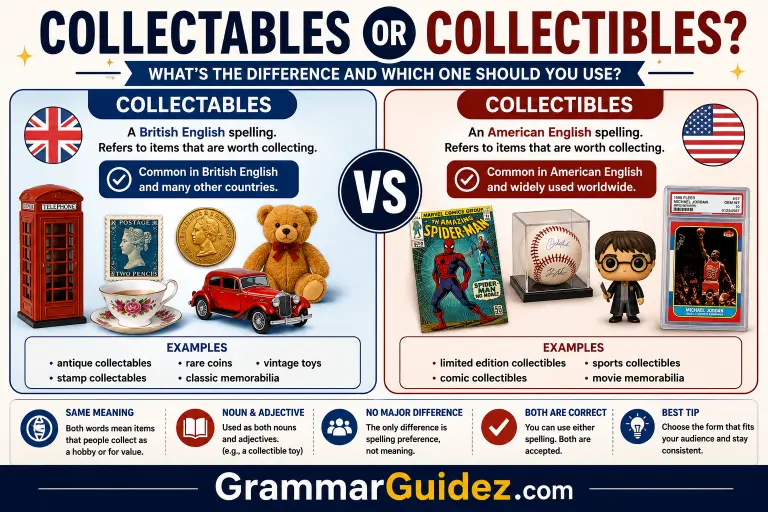
“Collectibles” and “collectables” are both correct spellings, but “collectibles” is more common, especially in American English. “Collectibles” are items valued or saved as part of a collection, while “collectables” is an alternative spelling that is more common in British English.
Have you ever wondered if the correct spelling is collectables or collectibles? You are not alone. These two words look almost identical, and both are used to describe things that people enjoy collecting.
The good news is simple: both “collectables” and “collectibles” are correct spellings. The main difference is regional preference and usage style.
Collectible is the more common spelling in American English. Collectable is also correct and is especially common in British English. Major dictionaries recognize both forms. Merriam-Webster lists collectable as a less common variant of collectible, while Cambridge and Oxford also recognize both spellings.
The words can work as both nouns and adjectives. As a noun, a collectible or collectable is an item people want to collect. As an adjective, it describes something worth collecting.
In this guide, we will explain collectables vs collectibles, their meanings, spelling, pronunciation, regional use, examples, common mistakes, and which form you should use.
Collectables or Collectibles – Quick Answer
Collectables and collectibles have the same basic meaning. Both are correct.
They refer to objects that people collect as a hobby or because they may have special value. Examples include trading cards, toys, coins, comic books, stamps, figurines, and sports memorabilia.
The main difference is spelling preference.
- Collectibles — more common in American English
- Collectables — common in British English and also accepted elsewhere
- Collectible — singular form
- Collectables/collectibles — plural forms
For example:
She has a large collection of vintage collectibles.
You could also write:
She has a large collection of vintage collectables.
Both sentences are grammatically correct. Merriam-Webster gives collectible as the main entry and lists collectable as a less common variant.
What Does Collectable Mean?
Definition of Collectable
Collectable can be an adjective or a noun.
As an adjective, it means something that is worth collecting or suitable for collecting.
For example:
These old comic books are highly collectable.
As a noun, a collectable is an object that people collect.
For example:
The shop sells vintage collectables.
Cambridge defines collectable as an object people want to collect as a hobby. It also uses the word as an adjective for things considered worth collecting.
Pronunciation of Collectable
Collectable is generally pronounced:
kuh-LEK-tuh-buhl
The pronunciation is essentially the same as collectible.
Examples of Collectable
- This old toy is highly collectable.
- She sells antique collectables.
- Vintage posters can become valuable collectables.
- He owns several rare collectables.
- These books are becoming increasingly collectable.
What Does Collectible Mean?
Definition of Collectible
Collectible has the same basic meaning as collectable.
As an adjective, it means something suitable or desirable for collecting.
As a noun, it means an object that people collect.
For example:
The limited-edition figure is a popular collectible.
Merriam-Webster defines collectible as something suitable for being collected and also as an object collected by enthusiasts. It lists collectable as a variant.
Pronunciation of Collectible
Collectible is pronounced approximately:
kuh-LEK-tuh-buhl
Both spellings have essentially the same pronunciation.
Examples of Collectible
- The card became a valuable collectible.
- She collects sports collectibles.
- These toys are popular collectibles.
- The company released a limited-edition collectible.
- His collection contains hundreds of collectibles.
What Is the Difference Between Collectables and Collectibles?
The biggest point to remember is that there is no major difference in meaning.
The difference is mainly spelling and regional preference.
| Feature | Collectables | Collectibles |
| Meaning | Items worth collecting | Items worth collecting |
| Spelling | British-style variant | American-style/common form |
| Singular | Collectable | Collectible |
| Plural | Collectables | Collectibles |
| Part of speech | Noun and adjective | Noun and adjective |
| Pronunciation | Similar | Similar |
| US English | Correct but less common | Very common |
| UK English | Common | Also understood |
| Formal writing | Correct | Correct |
| Meaning difference | None in this context | None in this context |
Merriam-Webster treats collectable as a less common variant of collectible, while Cambridge lists the two forms together.
So, if you see collectables or collectibles, you are usually looking at two spellings of the same word.
Collectable vs Collectible as an Adjective
Both words can describe something that is worth collecting.
Collectable
This vintage poster is highly collectable.
Collectible
This vintage poster is highly collectible.
The meaning does not change.
Both sentences say that the poster is desirable to collectors.
Merriam-Webster gives collectible the adjective meaning “suitable for being collected” and lists collectable as a variant.
Collectable vs Collectible as a Noun
Both forms can also refer to an actual item.
Collectable
The auction featured several rare collectables.
Collectible
The auction featured several rare collectibles.
Again, the meaning is the same.
Oxford lists collectable as a noun meaning an object worth collecting because it is beautiful or may become valuable, and notes collectible as another form.
Where Did These Words Come From?
Both words are built from the verb collect.
The basic idea is easy:
collect + -able / -ible → collectable / collectible
The word collect comes from older Latin roots connected with the idea of gathering together. Merriam-Webster traces collect to Latin colligere, meaning “to gather together.”
The adjective collectible dates back to the 19th century. Merriam-Webster records its first known use in 1874, while its noun use dates to 1943.
Over time, both forms developed in English.
That is why you can find both collectable and collectible in modern dictionaries.
British English vs American English
This is where the spelling difference becomes most useful.
United States
In American English, collectible is generally the preferred spelling.
For example:
The store sells rare baseball collectibles.
American dictionaries commonly use collectible as the main form. Merriam-Webster lists collectable as a less common variant.
United Kingdom
In British English, collectable is commonly used.
For example:
The shop specializes in antique collectables.
However, collectible is also understood and used.
Canada
Both forms may appear in Canadian English.
Your choice can depend on the publication, audience, and style guide you follow.
Australia
Both spellings are understood. Collectable is a natural choice when following British-style spelling conventions.
International English
If you are writing for a global audience, either spelling can work.
The most important thing is consistency.
| Region | Common Preference |
| United States | Collectibles |
| United Kingdom | Collectables |
| Canada | Both |
| Australia | Both |
| International | Both |
Cambridge explicitly lists the forms as alternatives, while its dictionary entries show regional labeling for the two forms.
Which One Should You Use?
The best spelling depends on your audience.
For American Readers
Use collectibles.
Vintage collectibles are popular among American collectors.
For British Readers
Use collectables.
The museum displays several historic collectables.
For a Business Website
Follow the spelling your target market expects.
An American online store may prefer:
Rare Sports Collectibles
A British shop may prefer:
Rare Sports Collectables
For Academic Writing
Either form can be correct. Follow the style guide used by your school, university, journal, or organization.
For Bloggers
Choose the spelling that matches your target audience.
If most readers are in the United States, collectibles is usually the safer choice.
If your audience is mainly British, collectables may feel more natural.
Common Mistakes
Mistake 1: Thinking One Spelling Is Wrong
❌ “Collectable is always incorrect.”
✅ “Collectable is a valid variant of collectible.”
Major dictionaries recognize both forms.
Mistake 2: Mixing Styles
You may write:
Our website sells collectibles.
Then later:
We have hundreds of collectables.
This is not grammatically wrong, but it can make your writing look inconsistent.
Better: Pick one form and use it consistently.
Mistake 3: Confusing Collectible With Collector
A collector is a person who collects things.
A collectible is an item that people collect.
For example:
Maria is a collector.
Maria bought a rare collectible.
Mistake 4: Confusing Collectible With Collection
A collection is a group of collected items.
A collectible is one item.
For example:
He has a large collection of baseball cards.
This card is a rare collectible.
Everyday Examples
Emails
We are looking for rare sports collectibles for our store.
British-style version:
We are looking for rare sports collectables for our shop.
Academic Writing
Historical objects can become valuable collectibles over time.
Business Writing
Our company specializes in limited-edition collectibles.
Social Media
Check out my new comic-book collectible!
Daily Conversation
That old toy could be a valuable collectible someday.
Shopping
The store has a great selection of vintage collectibles.
Collectables or Collectibles in Common Phrases
You may see these words in many common phrases.
Collectible Items
The store sells collectible items.
Collectible Cards
He has hundreds of collectible cards.
Collectible Toys
Vintage collectible toys can attract serious collectors.
Collectible Coins
Some old coins are highly collectible.
Collectable Items
The market has many rare collectable items.
Collectable Toys
The auction included several collectable toys.
Both forms work in these phrases.
Tips to Remember the Difference
You do not need a complicated rule.
Use these simple tips:
- Collectibles is a strong choice for American English.
- Collectables is a common British-style spelling.
- Both forms are correct.
- Both can be nouns and adjectives.
- Their pronunciation is almost identical.
- Their basic meaning is the same.
- Keep your spelling consistent.
- Match your spelling to your audience.
Easy Memory Trick
Think:
US → Collectibles
UK → Collectables
This is not an absolute rule, but it is a useful writing guide.
Quiz
1. Which spelling is commonly preferred in American English?
A. Collectables
B. Collectibles
C. Collectiblees
D. Collectabels
2. Which spelling is commonly used in British English?
A. Collectables
B. Collectibels
C. Collectibles only
D. Collectablles
3. Are collectables and collectibles usually different in meaning?
A. Yes
B. No
C. Only in Canada
D. Only as verbs
4. What is a collectible?
A. A person who collects items
B. An item people collect
C. A collection room
D. A museum
5. Which sentence is correct?
A. She owns several rare collectibles.
B. She owns several rare collectibels.
C. She owns several collectablees.
D. She owns several collectablles.
6. What is the British-style spelling?
A. Collectibel
B. Collectable
C. Collectabel
D. Collectuble
7. Can “collectible” be an adjective?
A. Yes
B. No
C. Only in slang
D. Only in British English
8. What is the best approach for a website?
A. Mix both spellings randomly
B. Never use either word
C. Choose the form that fits your audience and stay consistent
D. Always use collectable
Answers
- B — Collectibles
- A — Collectables
- B — No
- B — An item people collect
- A — She owns several rare collectibles.
- B — Collectable
- A — Yes
- C — Choose the form that fits your audience and stay consistent
Fill in the Blanks
- A person who collects things is called a ______.
- An item that people collect can be called a ______.
- American English commonly uses ______.
- British English commonly uses ______.
- Both spellings have nearly the same ______.
- A group of collected items is called a ______.
- Collectible can be used as a noun and an ______.
- Both collectable and collectible are ______ spellings.
Answers
- collector
- collectible / collectable
- collectible
- collectable
- pronunciation
- collection
- adjective
- correct
FAQs
Is collectables or collectibles correct?
Both are correct. Collectibles is commonly preferred in American English, while collectables is common in British English. Dictionaries such as Merriam-Webster, Cambridge, and Oxford recognize both forms. The choice usually depends on regional spelling preference and the audience you are writing for.
Is collectables British or American?
Collectables is commonly associated with British English, although it is not limited to Britain. American English generally prefers collectibles. Both spellings are understood in many English-speaking countries, so the difference is mainly one of spelling preference rather than meaning.
Is collectibles American English?
Yes. Collectibles is the common American English form. Merriam-Webster uses collectible as its main dictionary entry and lists collectable as a less common variant.
What is the plural of collectible?
The plural of collectible is collectibles. For example: “The store sells vintage collectibles.” The plural of collectable is collectables. Both forms follow normal English plural rules.
What is the difference between a collector and a collectible?
A collector is a person who collects things. A collectible is an item that people collect. For example, “John is a collector” describes the person, while “The baseball card is a collectible” describes the object.
Can collectable be an adjective?
Yes. Collectable can be an adjective. It describes something that is worth collecting or suitable for collecting. For example: “These old comics are highly collectable.” Cambridge and Oxford both recognize this adjective use.
Is collectible one word?
Yes. Collectible is normally written as one word. The same is true of collectable. For example, “collectible cards” and “collectable cards” are both correctly written as two-word phrases, with the adjective functioning before the noun.
Which spelling should I use for a US website?
For a US-focused website, collectibles is usually the better choice because it matches common American usage. If your site targets British readers, collectables may be more natural. Most importantly, use one spelling consistently throughout the website.
Conclusion
So, collectables or collectibles which spelling is correct? The answer is both.
The two words have the same basic meaning. They can describe objects that people enjoy collecting, such as coins, cards, toys, books, stamps, antiques, and memorabilia. They can also work as adjectives to describe things that are worth collecting.
The main difference is regional preference. Collectibles is the more common choice in American English. Collectables is common in British English and is also a valid form in other varieties of English. Major dictionaries recognize both spellings.
If you write for a US audience, choose collectibles. If you write mainly for a UK audience, collectables may be a better fit.
You do not need to worry that one is grammatically wrong. Instead, focus on audience, consistency, and context.
The easiest rule to remember is:
American English → collectibles
British English → collectables
Once you know this small spelling difference, choosing the right form becomes easy.

I am Elliot Hartwell, an English language writer and the author at GrammarGuidez.com. For the 6 years I have been working with English grammar, vocabulary, spelling and everyday language usage with a focus on making confusing topics easier to understand.
I started GrammarGuidez.com with a goal: to give readers clear and practical answers to common English questions. English can sometimes be confusing especially when two words look or sound similar but have meanings or uses. I enjoy breaking down these differences in a way that’s simple and easy to remember.
I believe learning English should feel simple not overwhelming. My goal is to make every article on GrammarGuidez.com useful, for students, writers, bloggers, teachers and anyone who wants to communicate clearly in English.