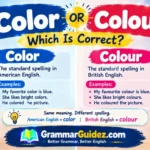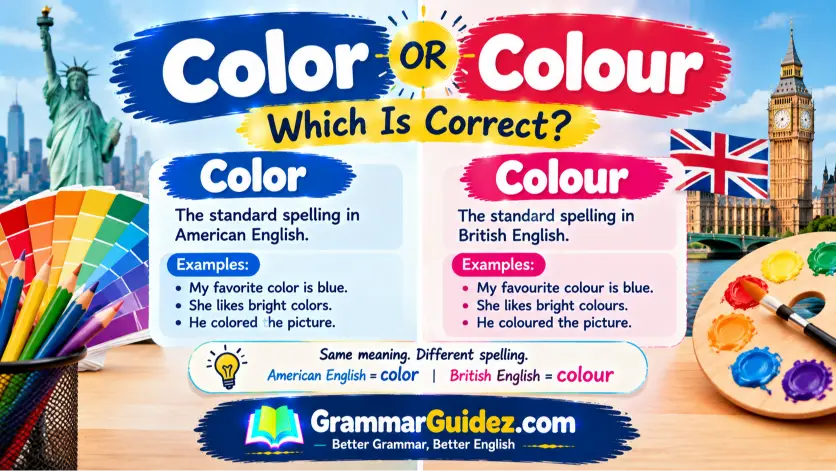
“Color” and “Colour” are both correct spellings. The difference is mainly American vs. British English. Color = American English spelling. Colour = British English spelling.
If you are not sure if to write color or colour, you are not alone. Both spellings are correct.
The difference is mainly based on the type of English you use.
Color is the standard spelling in American English.
Colour is the standard spelling in British English.
Both words have the same meaning, pronunciation, and grammar. The main difference is the extra u in the British spelling. Cambridge and Oxford both identify color as the American form and colour as the British form.
Quick Answer: Color or Colour?
Color and colour are both correct.
| Spelling | English Variety | Correct? |
| Color | American English | ✅ Yes |
| Colour | British English | ✅ Yes |
Use color when following American English.
Use colour when following British English.
For example:
- American English: My favorite color is blue.
- British English: My favourite colour is blue.
The meaning stays the same.
What Is the Difference Between Color and Colour?
The main difference between color and colour is spelling.
They both describe the visual quality of something. This includes colors such as red, blue, green, yellow, black, and white.
Cambridge defines color as the American spelling of colour. It also defines colour as the appearance of something produced by light.
So, there is no difference in basic meaning.
The difference is regional:
American English → color
British English → colour
This is similar to other spelling pairs:
- color / colour
- favor / favour
- honor / honour
- labor / labour
- neighbor / neighbour
- favorite / favourite
What Does “Color” Mean?
Color is the American English spelling.
As a noun, color refers to the appearance of something based on how it reflects light.
It can describe a specific shade or the general use of colors.
Examples include:
- red
- blue
- green
- yellow
- purple
- orange
The word can also describe paint, dye, or another substance used to give something a particular appearance.
Color as a Verb
Color can also be a verb.
As a verb, it can mean to add color to something.
For example:
- Please color the picture.
- She colored the drawing.
- The artist used bright colors.
The verb can also have a figurative meaning. If something colors your opinion, it influences how you think about something. Oxford lists this use as well.
What Does “Colour” Mean?
Colour is the British English spelling.
It has the same basic meaning as color.
It can describe a shade, hue, or the appearance of something.
For example:
- The colour of the wall is beautiful.
- Blue is my favorite colour.
- The artist used many bright colours.
Colour can also be a verb.
For example:
- Please colour the picture.
- She coloured the drawing.
- The children are colouring.
Cambridge lists colour as the UK form of color and gives both noun and verb uses.
Color or Colour in American English
In American English, the standard spelling is color.
American writers normally use:
- color
- colors
- colored
- coloring
- colorful
- colorless
For example:
The color of the car is beautiful.
She likes bright colors.
The children are coloring pictures.
If you are writing for people in the United States, color is usually the best choice.
This applies to school work, websites, business writing, emails, and other forms of American English.
Color or Colour in British English
In British English, the standard spelling is colour.
British writers normally use:
- colour
- colours
- coloured
- colouring
- colourful
- colourless
For example:
The colour of the car is beautiful.
She likes bright colours.
The children are colouring pictures.
The British spelling keeps the letter u.
So, if you are following British English, use colour throughout your writing.
Color vs Colour: Related Words
The spelling difference continues in other forms of the word.
| American English | British English |
| color | colour |
| colors | colours |
| colored | coloured |
| coloring | colouring |
| colorful | colourful |
| colorless | colourless |
| discolor | discolour |
| recolor | recolour |
Oxford also identifies forms such as coloring as American English, with colouring as the British form.
This means you should not write color in one part of a sentence and suddenly use colouring later if you are trying to follow one consistent English style.
Color or Colour: Which Is Used in the USA?
The United States uses color.
For American writing, use:
color
colors
colored
coloring
colorful
For example:
What is your favorite color?
Not:
What is your favourite colour?
The second sentence uses British spelling.
If you are writing for a US audience, staying with American spelling makes your writing more consistent.
Is It Colour or Color in the UK?
The standard British spelling is colour.
British English uses:
colour
colours
coloured
colouring
colourful
For example:
What is your favourite colour?
The spelling with u is the normal British form. Cambridge and Oxford both mark colour as the British form and color as the American form.
Color or Colour in Canada
Canadian English can show both British and American influences.
However, colour is commonly used in Canadian English. Cambridge labels colour as the Canadian British form alongside British usage.
So, if you are writing specifically for Canada, colour is generally a safe choice, but you should follow the style guide used by the school, company, publisher, or organization.
The important point is that Canadian English does not always follow American English simply because Canada is next to the United States.
Color or Colour in Australia
Australian English generally uses colour.
Common Australian forms include:
- colour
- colours
- coloured
- colouring
- colourful
For example:
The room has a bright colour.
The garden has many beautiful colours.
Australian English generally follows British spelling conventions for this word.
Color or Colour Around the World
Here is a simple guide:
| Country or Variety | Common Form |
| United States | color |
| United Kingdom | colour |
| Canada | colour is common |
| Australia | colour |
| New Zealand | colour |
| India | colour is common |
| South Africa | colour is common |
However, national spelling practices can vary by organization, publication, and style guide. The safest rule is to check the English standard your audience expects.
Why Are Color and Colour Spelled Differently?
The spelling difference comes from the history of English.
The word has roots connected to Latin color and entered English through French forms that included colour. Over time, spelling traditions developed differently in Britain and the United States.
American spelling was influenced by spelling reforms associated with Noah Webster in the early nineteenth century.
Webster supported simpler spellings for some English words.
This helped establish American forms such as:
- colour → color
- honour → honor
- labour → labor
- favour → favor
British English kept the traditional -our spelling in these words.
This is why the difference between color and colour is part of a larger American-British spelling pattern.
Do Color and Colour Have the Same Pronunciation?
Yes, they are generally pronounced the same word.
The spelling does not create a different meaning.
The exact sound may vary slightly because American and British accents can differ, but the spelling choice itself does not create a new word.
So:
color = colour
in meaning and basic pronunciation.
The important difference is how the word is written.
Colors or Colours: Which Is Correct?
Both colors and colours are correct.
Use colors in American English.
Use colours in British English.
For example:
American:
The painting has many bright colors.
British:
The painting has many bright colours.
The same rule applies to the singular form.
color → colors
colour → colours
Common Mistakes With Color and Colour
Mistake 1: Thinking One Spelling Is Wrong
Some people think colour is a spelling mistake because they are used to American English.
Others think color is wrong because they follow British English.
Both ideas are incorrect.
Both spellings are standard in their respective varieties.
Mistake 2: Mixing American and British Spelling
Avoid changing spelling styles in the same document without a reason.
For example:
My favorite colour is blue.
This mixes favorite, an American spelling, with colour, a British spelling.
For American English, write:
My favorite color is blue.
For British English, write:
My favourite colour is blue.
The goal is consistency.
Mistake 3: Forgetting Related Words
The spelling difference does not stop at color.
If you use American English, write:
color → colorful → coloring → colored
If you use British English, write:
colour → colourful → colouring → coloured
Oxford confirms the US/British distinction in related forms such as coloring/colouring.
Mistake 4: Changing a Brand Name
Do not change the official spelling of a company, product, title, or brand just to match your English variety.
If an official name contains Color, keep Color.
If an official name contains Colour, keep Colour.
Proper names should normally keep their official spelling.
How to Remember Color vs Colour
Use this simple rule:
America drops the U → color
Britain keeps the U → colour
You can use the same memory trick for similar words:
- American: favor
- British: favour
- American: honor
- British: honour
- American: neighbor
- British: neighbour
Once you remember the -or / -our pattern, these words become easier to spell.
Color or Colour: Which One Should You Use?
Choose the spelling based on your audience.
Use color when:
- You are writing for Americans.
- You follow American English.
- Your school or company uses US English.
- Your website targets a US audience.
Use colour when:
- You are writing in British English.
- Your audience is mainly British.
- Your style guide requires British spelling.
- You are following a spelling system that uses the -our form.
If you write for an international audience, choose one English style and use it consistently.
Color or Colour Examples
Here are some simple examples:
| American English | British English |
| My favorite color is blue. | My favourite colour is blue. |
| The wall has a bright color. | The wall has a bright colour. |
| She likes warm colors. | She likes warm colours. |
| He colored the picture. | He coloured the picture. |
| The child is coloring. | The child is colouring. |
| It is a colorful design. | It is a colourful design. |
The meaning remains the same in every pair.
Only the spelling changes.
FAQs
Is color or colour correct?
Both color and colour are correct. Color is the standard American English spelling, while colour is the standard British English spelling.
Is color American or British?
Color is the standard American English spelling.
Is colour American or British?
Colour is the standard British English spelling.
Is colour wrong in American English?
It is not a misspelling, but color is the normal American English form.
Is color wrong in British English?
Color is recognized as the American form, but colour is the standard spelling in British English.
Do color and colour mean the same thing?
Yes. They have the same basic meaning. Both refer to the visual quality or appearance of something.
Is it colors or colours?
Both are correct.
Colors is American English.
Colours is British English.
Is it colorful or colourful?
Colorful is the American spelling.
Colourful is the British spelling.
Is it coloring or colouring?
Coloring is the American spelling.
Colouring is the British spelling.
Which spelling should I use for a US website?
Use color if your website follows American English.
Which spelling should I use for a UK website?
Use colour if your website follows British English.
Final Answer: Color or Colour?
Color and colour are both correct.
The difference is regional, not a difference in meaning.
Use color for American English.
Use colour for British English and other varieties that follow the -our spelling.
The same pattern appears in related words:
American: color, colors, colored, coloring, colorful
British: colour, colours, coloured, colouring, colourful
The easiest rule is simple: American English uses color, while British English uses colour.
Most importantly, choose one spelling style and stay consistent throughout your writing. That will make your articles, school work, business documents, and website content look clear and professional.
Read More Articles:

I am Elliot Hartwell, an English language writer and the author at GrammarGuidez.com. For the 6 years I have been working with English grammar, vocabulary, spelling and everyday language usage with a focus on making confusing topics easier to understand.
I started GrammarGuidez.com with a goal: to give readers clear and practical answers to common English questions. English can sometimes be confusing especially when two words look or sound similar but have meanings or uses. I enjoy breaking down these differences in a way that’s simple and easy to remember.
I believe learning English should feel simple not overwhelming. My goal is to make every article on GrammarGuidez.com useful, for students, writers, bloggers, teachers and anyone who wants to communicate clearly in English.