“Anxiety” and “Depression” are both mental health terms, but they describe different experiences. Anxiety = a condition involving excessive worry, fear, nervousness, or a sense of danger. Depression = a condition involving persistent low mood, loss of interest, hopelessness, or reduced energy.
Anxiety or depression are two different mental health conditions, but they can share some symptoms. Both can affect sleep, focus, energy, mood, work, school, and relationships.
The main difference is often the feeling at the center of the problem.
Anxiety is often linked with excessive worry, fear, nervousness, or a sense that something bad may happen. Depression is often linked with ongoing sadness, hopelessness, low energy, or losing interest in things you once enjoyed. (National Institute of Mental Health)
A person can also have both anxiety and depression at the same time. (Mayo Clinic)
This article explains the difference in simple terms. It is not a diagnosis. If symptoms are severe, last for a long time, or affect daily life, a healthcare professional can help determine what is happening.
Quick Answer: Anxiety or Depression?
Anxiety and depression are not the same condition.
| Anxiety | Depression |
| Often centers on worry or fear | Often centers on sadness or low mood |
| May involve feeling on edge | May involve hopelessness or emptiness |
| Can cause racing thoughts | Can cause slowed thinking or low energy |
| May cause physical tension | May cause fatigue and physical aches |
| Often involves fear about what may happen | Often involves loss of interest in life or activities |
However, these symptoms can overlap. Someone with depression may also feel anxious, and someone with an anxiety disorder may later develop depression. (Mayo Clinic)
What Is Anxiety?
Anxiety is a normal human response to stress.
Almost everyone feels anxious sometimes. You might feel nervous before an exam, job interview, presentation, medical appointment, or important event.
This does not automatically mean you have an anxiety disorder.
An anxiety disorder is different. The worry or fear can become intense, persistent, difficult to control, and disruptive to daily life. (National Institute of Mental Health)
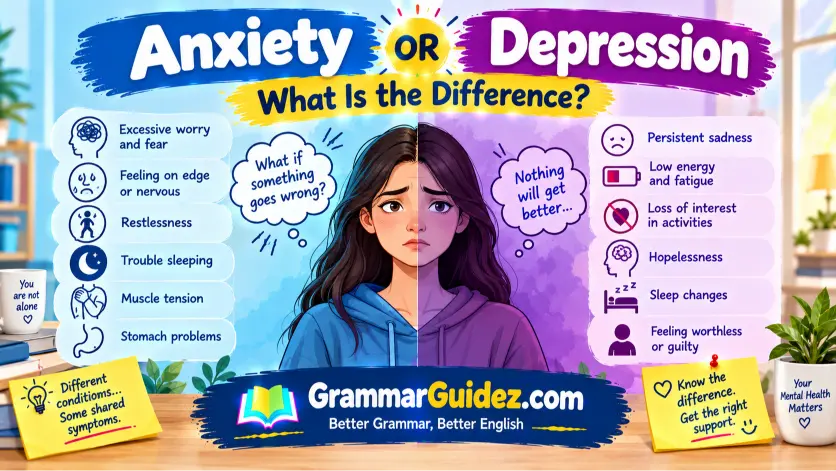
Common Anxiety Symptoms
Anxiety can affect both the mind and body.
Common symptoms may include:
- Excessive worry
- Nervousness
- Feeling on edge
- Restlessness
- Trouble relaxing
- Difficulty concentrating
- Trouble sleeping
- Muscle tension
- Headaches
- Stomach problems
- Sweating
- Trembling
- Feeling short of breath
Not everyone experiences the same symptoms. Anxiety disorders also include different conditions, such as generalized anxiety disorder, panic disorder, social anxiety disorder, and specific phobias.
What Is Depression?
Depression is more than feeling sad for a short time.
Clinical depression can cause symptoms that affect how a person feels, thinks, sleeps, eats, works, studies, and handles everyday activities.
One common form is major depressive disorder, also called major depression.
Common Depression Symptoms
Depression may involve:
- Persistent sadness
- An empty or low mood
- Hopelessness
- Feelings of guilt or worthlessness
- Loss of interest in activities
- Low energy
- Fatigue
- Trouble concentrating
- Sleep changes
- Appetite or weight changes
- Irritability
- Physical aches or pains
Some people with depression may also experience anxiety or restlessness.
Anxiety vs Depression: The Main Difference
A simple way to understand the difference is to look at the emotional focus.
Anxiety often asks:
“What if something goes wrong?”
The mind may focus on future problems, danger, uncertainty, or things that might happen.
For example, a person may repeatedly worry about work, health, money, family, school, or other everyday concerns.
Depression often feels like:
“Nothing will get better.”
A person may feel hopeless, empty, tired, or disconnected from activities they once enjoyed.
These are simple descriptions, not diagnostic tests. Real symptoms can be more complicated, and people can experience both conditions together.
Anxiety and Depression Can Share Symptoms
This is one reason people sometimes confuse the two.
Both anxiety and depression can affect:
- Sleep
- Concentration
- Energy
- Mood
- Work
- School
- Relationships
- Daily responsibilities
For example, difficulty sleeping can occur with both conditions.
Trouble concentrating can also occur with both.
This means one symptom alone usually cannot tell you which condition a person has. A healthcare professional considers the complete pattern, how long symptoms have lasted, and how they affect daily life.
Can You Have Anxiety and Depression Together?
Yes.
A person can experience an anxiety disorder and depression at the same time. These conditions are different, but they commonly occur together. (Mayo Clinic)
For example, someone may have constant worry about the future while also feeling tired, hopeless, and uninterested in activities.
The two conditions can also affect each other. Mayo Clinic notes that depression can be associated with the development of anxiety, and anxiety disorders can also be followed by depression.
This is why it is important not to assume that a person has only one problem based on a few symptoms.
Anxiety or Depression: How Do Symptoms Feel Different?
The following comparison can make the difference easier to understand.
| Experience | Anxiety | Depression |
| Main feeling | Fear or worry | Sadness, emptiness, or hopelessness |
| Time focus | Often future | Often focused on the present or past |
| Thoughts | “What if?” | “Why bother?” or “Nothing will change” |
| Energy | May feel restless or tense | May feel tired or slowed down |
| Sleep | May struggle to fall or stay asleep | May sleep too little or too much |
| Interest | May avoid things because of fear | May lose interest or pleasure |
| Body | Tension, sweating, trembling | Fatigue, aches, slowed movement |
These are general patterns, not rules. A person may experience symptoms from both columns.
Anxiety Can Affect the Body
Anxiety is not only about thoughts.
Strong or ongoing anxiety can produce physical symptoms. NIMH lists symptoms such as muscle aches, stomachaches, fatigue, sleep problems, sweating, trembling, and shortness of breath among symptoms that can occur with generalized anxiety disorder. (National Institute of Mental Health)
This can make anxiety feel like a physical problem.
However, physical symptoms can have many possible causes. A healthcare professional can help rule out other medical conditions when needed.
Depression Can Affect Everyday Life
Depression can change more than a person’s mood.
It can affect:
- Eating
- Sleeping
- Working
- Studying
- Social activities
- Relationships
- Concentration
- Decision-making
- Personal responsibilities
NIMH explains that depression symptoms can interfere with daily activities and cause significant distress. (National Institute of Mental Health)
Someone who is depressed may stop enjoying hobbies they normally like.
They may also withdraw from family or friends.
This does not mean the person is lazy or simply choosing to be negative. Depression can be a serious health condition that needs proper care.
Anxiety or Depression After Stress
Stress and mental health conditions are related, but they are not exactly the same.
Everyone experiences stress. It can happen because of work, school, money, relationships, health problems, or major life changes.
NIMH explains that anxiety can occur as a response to stress, but anxiety disorders involve more persistent symptoms that can interfere with daily life. (National Institute of Mental Health)
A stressful event can also affect mood.
If sadness, worry, fear, or other symptoms continue and begin interfering with daily activities, talking with a healthcare professional can be useful.
How Are Anxiety and Depression Diagnosed?
There is no single symptom that proves someone has anxiety or depression.
A healthcare professional may ask about:
- Your symptoms
- When they started
- How often they happen
- How long they last
- Your sleep
- Your mood
- Your thoughts
- Your daily activities
- Your medical history
- Medicines you take
- Other mental or physical health conditions
For depression, NIMH notes that a major depressive episode involves symptoms most of the day, nearly every day, for at least two weeks, with depressed mood or loss of interest being a key part of the diagnostic criteria. (National Institute of Mental Health)
Anxiety disorders have different diagnostic criteria depending on the specific disorder.
This is why online quizzes or symptom lists should not replace a professional evaluation.
How Are Anxiety and Depression Treated?
Treatment depends on the person and the specific condition.
Common treatment approaches can include:
- Psychotherapy, or talk therapy
- Medicines when appropriate
- Lifestyle changes
- Support from family and friends
- Regular physical activity
- Better sleep habits
- Stress-management strategies
Mayo Clinic notes that psychotherapy, medication, or a combination of both may be used for anxiety and depression. (Mayo Clinic)
A healthcare professional can help decide which approach is appropriate.
Do not start, stop, or change prescription medication without discussing it with a qualified healthcare professional.
When Should You Seek Professional Help?
Consider talking with a healthcare professional when symptoms:
- Continue for a significant period
- Become difficult to manage
- Interfere with work or school
- Affect relationships
- Make everyday tasks difficult
- Cause major changes in sleep or appetite
- Become increasingly severe
NIMH recommends seeking professional help when depression symptoms persist or interfere with daily life. (National Institute of Mental Health)
You do not have to wait until symptoms become extreme before asking for help.
What If You Have Thoughts of Suicide or Self-Harm?
Thoughts of suicide or self-harm require immediate attention.
If you or someone else is in immediate danger, contact your local emergency service or go to the nearest emergency department.
In the United States, you can call or text 988 for the Suicide & Crisis Lifeline. NIMH recommends immediate help for people experiencing suicidal thoughts or urges to hurt themselves.
If you are outside the United States, use your country’s emergency or crisis service.
You do not need to handle a mental health crisis alone.
Anxiety or Depression: Which One Do I Have?
It is tempting to compare your symptoms with an online list and choose one condition.
But anxiety and depression can overlap.
A person can also have another mental health condition or a physical health problem that causes similar symptoms.
For example, some medical conditions and medications can produce symptoms that look similar to depression. NIMH notes that healthcare providers may use an examination, interview, and sometimes laboratory tests to rule out other causes.
So instead of asking only:
“Do I have anxiety or depression?”
a better question is:
“What symptoms am I experiencing, how long have they lasted, and how are they affecting my life?”
Those details can help a healthcare professional understand what support may be appropriate.
Simple Ways to Support Your Mental Health
Healthy daily habits cannot replace professional treatment when treatment is needed, but they can support overall well-being.
Helpful habits may include:
- Keeping a regular sleep schedule
- Staying physically active
- Eating regular, balanced meals
- Spending time with supportive people
- Taking breaks from stressful activities
- Practicing relaxation or breathing exercises
- Talking with someone you trust
- Getting professional help when needed
NIMH lists regular exercise, healthy eating, sleep, social connection, meditation or breathing exercises, and low-stress activities among steps that may help with mild symptoms.
If symptoms become worse or do not improve, professional support is important.
Anxiety vs Depression: A Simple Example
Imagine two people facing the same important exam.
One person may spend days worrying:
“What if I fail?”
They may feel nervous, tense, restless, and unable to stop thinking about possible problems.
This pattern may look more like anxiety.
Another person may think:
“There is no point. I cannot do anything right.”
They may lose interest in studying, feel hopeless, become very tired, and stop enjoying things they normally like.
This pattern may include depression symptoms.
A real person can experience both patterns at the same time.
Common Misunderstandings
“Anxiety is just worrying.”
Not always. Occasional worry is normal. Anxiety disorders involve symptoms that can become persistent, intense, difficult to control, and disruptive.
“Depression only means being sad.”
No. Depression can also involve loss of interest, fatigue, concentration problems, sleep changes, appetite changes, guilt, hopelessness, and physical symptoms.
“You cannot have both.”
You can. Anxiety and depression commonly occur together.
“A person can diagnose themselves from one symptom.”
One symptom is not enough to establish a diagnosis. Professional assessment looks at the broader pattern.
FAQs
Is anxiety the same as depression?
No. They are different mental health conditions, although some symptoms overlap.
Which is worse, anxiety or depression?
There is no simple answer. Both can range from mild to severe and can significantly affect daily life. The impact varies from person to person.
Can anxiety turn into depression?
Anxiety and depression can occur together, and one condition can be associated with the development of the other.
Can depression cause anxiety?
A person with depression may also experience significant anxiety. Depression and anxiety frequently occur together.
Can you have anxiety and depression at the same time?
Yes. Many people experience symptoms of both conditions.
Does anxiety cause tiredness?
It can. Anxiety may interfere with sleep and can be associated with fatigue.
Can depression cause sleep problems?
Yes. Depression can involve difficulty sleeping, waking early, or sleeping too much. (National Institute of Mental Health)
When should I talk to a professional?
Consider seeking professional help when symptoms persist, become severe, or interfere with everyday life. (National Institute of Mental Health)
Final Thoughts on Anxiety or Depression
Anxiety and depression are different, but they can look similar and occur together.
Anxiety often involves persistent worry, fear, nervousness, or feeling on edge.
Depression often involves persistent low mood, hopelessness, low energy, or loss of interest and pleasure.
Both can affect sleep, concentration, work, school, relationships, and daily life.
The most important point is that an online article cannot tell you if you have anxiety, depression, both, or another condition. If symptoms are persistent or affecting your life, a qualified healthcare professional can provide a proper assessment and discuss appropriate support.
If you are experiencing thoughts of suicide or self-harm, seek immediate crisis or emergency support rather than waiting.

I am Evan Whitmore, an English language writer and the person who started GrammarGuidez.com. I made GrammarGuidez.com to make grammar, spelling, vocabulary and words that are often confused easier to understand.
I like taking to understand English words and grammar rules and turning them into simple and clear explanations. My aim is to help students, writers, bloggers, ESL learners and regular English speakers feel more sure when they write and talk.
At GrammarGuidez.com I work on real life examples easy to understand explanations comparing words, spelling changes and how American English is used every day.
I think learning English doesn’t need to be hard. A good explanation and some good examples can make tough grammar topics much simpler to learn