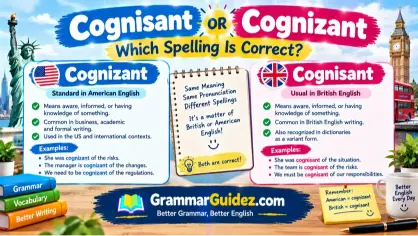
“Cognisant” and “Cognizant” are both correct spellings. The main difference is British vs. American English. Cognisant = British English spelling; means aware or conscious of something. Cognizant = American English spelling; has the same meaning
Cognisant and cognizant are two spellings of the same adjective. They have the same basic meaning, but the spelling often depends on the variety of English being used.
Cognizant is the standard spelling in American English, while cognisant is the usual British English form. Cambridge lists cognizant as the main entry and notes that UK English usually uses cognisant. Oxford also lists cognisant as a British English form.
Both words mean aware of, informed about, or having knowledge or understanding of something.
So, neither spelling is simply “wrong.” The better choice depends on your English style and audience.
Quick Answer: Cognisant or Cognizant?
Use cognizant when following American English.
Use cognisant when following the usual British English spelling.
| Word | Common usage | Meaning |
| Cognizant | American English | Aware or informed |
| Cognisant | British English | Aware or informed |
Both are adjectives, and both are commonly followed by of.
For example:
- She was cognizant of the risks.
- She was cognisant of the risks.
The meaning is the same.
What Does Cognizant Mean?
Cognizant is an adjective meaning aware, informed, or understanding something.
Cambridge describes the word as formal and defines it as understanding or realizing something.
For example:
The manager was cognizant of the problem.
This means:
The manager was aware of the problem.
Other simple synonyms include:
- aware
- informed
- conscious
- knowledgeable
- mindful
However, cognizant is more formal than the simple word aware.
Examples
- We must be cognizant of the risks.
- She was cognizant of the changes.
- The team remained cognizant of its responsibilities.
- Employees should be cognizant of company policies.
What Does Cognisant Mean?
Cognisant has the same basic meaning as cognizant.
It means:
aware of something or having knowledge or understanding of it.
For example:
The manager was cognisant of the risks.
This means the manager knew about or understood the risks.
The spelling with -s- is commonly associated with British English. Collins identifies cognisant as the British form of cognizant.
Examples
- She was cognisant of the problem.
- We are cognisant of the need for change.
- The company remained cognisant of customer concerns.
- He was fully cognisant of the possible consequences.
Cognisant vs. Cognizant: What Is the Difference?
The main difference is spelling convention, not meaning.
Think of it this way:
Cognizant → usually American English
Cognisant → usually British English
The pronunciation and basic meaning remain the same.
| Feature | Cognisant | Cognizant |
| Part of speech | Adjective | Adjective |
| Meaning | Aware or informed | Aware or informed |
| Common spelling | British English | American English |
| Meaning difference | None | None |
| Common construction | cognisant of | cognizant of |
| Style | Formal | Formal |
Cambridge and Oxford both support the regional relationship between the two spellings.
Is Cognisant British or American?
Cognisant is usually the British English spelling.
Cambridge specifically marks cognizant as “UK usually cognisant.”
So, in British-style writing, you will commonly see:
The company was cognisant of the risks.
In American English, the usual spelling is:
The company was cognizant of the risks.
The word itself is not different. Only the spelling changes.
Is Cognizant American or British?
Cognizant is the standard American spelling.
However, it would be too strong to say that British English never uses cognizant.
Cambridge includes cognizant as its main entry and says UK English usually uses cognisant. Oxford similarly lists cognisant as the British English form.
So the practical rule is:
- American English: cognizant
- British English: cognisant is usually preferred
- Meaning: the same
Why Does One Have S and the Other Z?
The difference comes from a broader spelling pattern in English.
Some words have -ise/-ise and -ize forms depending on the variety or style being followed.
This gives us related forms such as:
- cognisant / cognizant
- cognisance / cognizance
- cognise / cognize
The s and z do not create a different meaning here.
They reflect different spelling traditions.
The same general pattern can be seen in other English words:
- recognise / recognize
- organise / organize
- realise / realize
However, spelling practices can vary by dictionary and style guide, so it is better to think of these as English spelling conventions, not a simple rule that applies to every word.
Cognisant and Cognizant Mean “Aware”
The easiest way to understand this word is to replace it with aware.
For example:
She was cognizant of the problem.
Means:
She was aware of the problem.
Likewise:
She was cognisant of the problem.
Also means:
She was aware of the problem.
Cambridge lists aware, conscious, and witting among related words for cognizant.
Simple Meaning
Cognizant/cognisant = aware
This is the easiest definition to remember.
The Common Pattern: Cognizant of
One of the most important usage patterns is:
cognizant of + noun
or
cognisant of + noun
Examples:
We are cognizant of the risks.
She was cognisant of the situation.
The students became cognizant of the problem.
The company is cognizant of customer needs.
Collins specifically identifies cognizant of as a standard construction.
Why “Of” Matters
Many learners know the word cognizant but are unsure what comes after it.
The easiest pattern is:
cognizant of something
For British spelling:
cognisant of something
For example:
❌ He was cognizant about the problem.
✅ He was cognizant of the problem.
Cognizant That: Is It Correct?
You may also encounter cognizant that.
For example:
The manager was cognizant that the situation could change.
This construction appears in real English usage. Collins includes examples of cognizant followed by that.
However, cognizant of is the more familiar pattern for many learners.
Compare:
She was cognizant of the risks.
She was cognizant that the risks had increased.
Both structures can occur, but cognizant of is especially useful when you are learning the word.
Cognizant Is a Formal Word
Cognizant is not usually the word you would choose in very casual conversation.
It has a formal tone.
For example:
I am cognizant of the issue.
This sounds more formal than:
I know about the issue.
Or:
I am aware of the issue.
Cambridge and Oxford both mark the word as formal.
Where You May See It
You can commonly encounter it in:
- Business writing
- Academic writing
- Legal writing
- Government documents
- Professional reports
- Research papers
- Formal emails
For simple everyday English, aware is often more natural.
Cognisant in British Writing
If your document follows British English, cognisant can fit naturally into formal writing.
For example:
The researchers were cognisant of the limitations of the study.
Another example:
The organization was cognisant of its responsibilities.
This spelling works well alongside other British spellings when the entire document follows that style.
For example:
The organisation recognised the problem and remained cognisant of the risks.
Here, organisation, recognised, and cognisant all follow a British spelling style.
Cognizant in American Writing
In American English, use cognizant.
For example:
The organization was cognizant of the risks.
You may also see:
Researchers must remain cognizant of the study’s limitations.
And:
Consumers are becoming more cognizant of privacy issues.
The z spelling fits standard American usage.
Common Mistakes
1. Mixing the Two Spellings
Avoid switching styles without a reason.
For example:
The organisation recognised the problem but was cognizant of the risks.
This mixes British-style organisation/recognised with the American-style cognizant.
A consistent British version would be:
The organisation recognised the problem but was cognisant of the risks.
A consistent American version would be:
The organization recognized the problem but was cognizant of the risks.
The important point is consistency.
2. Writing Cognizant About
A common learner mistake is:
❌ She was cognizant about the problem.
The standard pattern is:
✅ She was cognizant of the problem.
The same applies to the British spelling:
✅ She was cognisant of the problem.
3. Confusing Cognizant With Cognitive
These words look related, but they have different meanings.
Cognizant means:
aware or informed
Cognitive relates to:
thinking, learning, remembering, and other mental processes
For example:
The manager was cognizant of the risks.
But:
The study examined cognitive development.
Do not use these words interchangeably.
Cognizant vs. Conscious
These words can overlap, but they are not exactly the same.
Cognizant focuses on being aware or informed about something.
Conscious has several meanings, including being aware, awake, or deliberately aware of something.
For example:
She was cognizant of the problem.
This means she knew about the problem.
But:
She was unconscious after the accident.
Here, conscious refers to being awake, not simply being informed.
So cognizant is narrower than conscious.
Cognisant vs. Aware
If you want simple English, aware is usually easier.
Compare:
He was cognizant of the changes.
He was aware of the changes.
The second sentence is simpler and more natural for everyday communication.
Cognizant is useful when you want a formal tone.
Simple Rule
Everyday English → aware
Formal English → cognizant/cognisant
This does not mean one is better in every situation. The best word depends on the audience and tone.
Pronunciation of Cognizant and Cognisant
The spelling changes, but the words are normally pronounced the same.
A simple pronunciation guide is:
cognizant: KOG-ni-zuhnt
cognisant: KOG-ni-zuhnt
Cambridge gives UK and US pronunciations for cognizant, while Oxford also provides pronunciation information.
So when speaking, the s/z spelling difference is usually not noticeable.
This is mainly a written distinction.
Word Forms You May See
The same word family includes several related forms.
Cognizant / Cognisant
Adjective:
She was cognizant of the risks.
Cognizance / Cognisance
Noun:
The court took cognizance of the matter.
Cambridge lists cognizance as a formal or specialized noun and notes that UK English usually uses cognisance.
Cognize / Cognise
These are related verb forms, though they are much less common in everyday modern English.
The important forms for most writers are:
cognizant / cognisant
and
cognizance / cognisance
Cognisant or Cognizant in Academic Writing
Both forms can appear in academic writing.
The important thing is to follow the spelling style required by your institution, publisher, or target audience.
American Style
Researchers must be cognizant of the limitations of the study.
British Style
Researchers must be cognisant of the limitations of the study.
Neither sentence changes the underlying meaning.
If your paper uses American spelling throughout, use cognizant.
If it follows British spelling, cognisant is the usual choice.
Cognisant or Cognizant in Business Writing
The word is common in formal business language.
For example:
Managers must be cognizant of changing customer expectations.
British-style version:
Managers must be cognisant of changing customer expectations.
You may see the word in discussions about:
- risks
- regulations
- customers
- costs
- responsibilities
- market changes
- business goals
- company policies
But remember that aware is often clearer for a general audience.
A Simple Memory Trick
Use the letter Z to remember the common American spelling:
cognizant → Z → American English
Use S for the usual British form:
cognisant → S → British English
Then remember the meaning:
Cognizant/Cognisant = Aware
So:
Cognizant of = aware of
Cognisant of = aware of
That is enough to remember the basic difference.
Examples: American vs. British
American English
- The manager was cognizant of the risks.
- Employees should be cognizant of company rules.
- Researchers were cognizant of the limitations.
- She became cognizant of the problem.
- Consumers are cognizant of rising costs.
British English
- The manager was cognisant of the risks.
- Employees should be cognisant of company rules.
- Researchers were cognisant of the limitations.
- She became cognisant of the problem.
- Consumers are cognisant of rising costs.
The meaning stays the same.
Only the spelling changes.
Which Spelling Should You Choose?
Use this simple guide:
| Your writing style | Recommended form |
| American English | Cognizant |
| British English | Cognisant |
| US academic writing | Cognizant |
| UK academic writing | Cognisant |
| US business writing | Cognizant |
| UK business writing | Cognisant |
| Mixed international audience | Follow your chosen style consistently |
Do not change the spelling randomly from sentence to sentence.
Mini Quiz
Choose the correct form for each sentence.
1. The manager was ___ of the risks.
a) cognizant
b) cognisant
Answer: Both can be correct. Choose according to your English style.
2. Which form is usually associated with British English?
a) cognizant
b) cognisant
Answer: b) cognisant
3. Which form is standard in American English?
a) cognisant
b) cognizant
Answer: b) cognizant
4. What does cognizant mean?
a) angry
b) aware
c) confused
Answer: b) aware
5. Which phrase is standard?
a) cognizant of the problem
b) cognizant about the problem
Answer: a) cognizant of the problem
6. Do cognisant and cognizant have different meanings?
a) Yes
b) No
Answer: b) No. They have the same basic meaning.
FAQs
Is cognisant or cognizant correct?
Both are correct. Cognizant is the standard American spelling, while cognisant is the usual British English spelling.
Is cognisant British spelling?
Yes. Cognisant is commonly used as the British English form of cognizant.
Is cognizant American spelling?
Yes. Cognizant is the standard American spelling.
Do cognisant and cognizant mean the same thing?
Yes. Both mean aware, informed, or having knowledge or understanding of something.
Is cognizant a formal word?
Yes. Cambridge and Oxford both mark cognizant as a formal adjective.
What is the simplest synonym for cognizant?
The simplest synonym is usually aware.
Is “cognizant of” correct?
Yes. Cognizant of is a standard construction.
She was cognizant of the risks.
Collins specifically gives cognizant of as a common construction.
Can I use cognisant in American English?
It can be understood, but cognizant is the standard American spelling. If you are following American English consistently, use cognizant.
Can I use cognizant in British English?
Yes. British English recognizes the z form, but cognisant is usually the British form. Cambridge specifically says UK English usually uses cognisant.
Is cognizant the same as cognitive?
No.
Cognizant means aware or informed.
Cognitive relates to mental processes such as thinking, learning, and remembering.
Final Verdict: Cognisant or Cognizant?
Cognisant and cognizant are both correct spellings of the same adjective.
The practical difference is regional spelling:
Cognizant → standard American English
Cognisant → usual British English
Both mean aware, informed, or having knowledge of something. Major dictionaries support this relationship, with Cambridge noting that UK English usually uses cognisant and Oxford identifying it as the British English form.
The easiest way to remember it is:
American → cognizant
British → cognisant
And remember the common grammar pattern:
cognizant/cognisant of something
If you are writing for a specific audience, follow that audience’s spelling style and keep it consistent throughout your article, essay, report, or website.
Read More Articles:

I am Evan Whitmore, an English language writer and the person who started GrammarGuidez.com. I made GrammarGuidez.com to make grammar, spelling, vocabulary and words that are often confused easier to understand.
I like taking to understand English words and grammar rules and turning them into simple and clear explanations. My aim is to help students, writers, bloggers, ESL learners and regular English speakers feel more sure when they write and talk.
At GrammarGuidez.com I work on real life examples easy to understand explanations comparing words, spelling changes and how American English is used every day.
I think learning English doesn’t need to be hard. A good explanation and some good examples can make tough grammar topics much simpler to learn