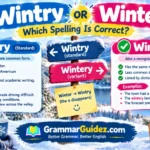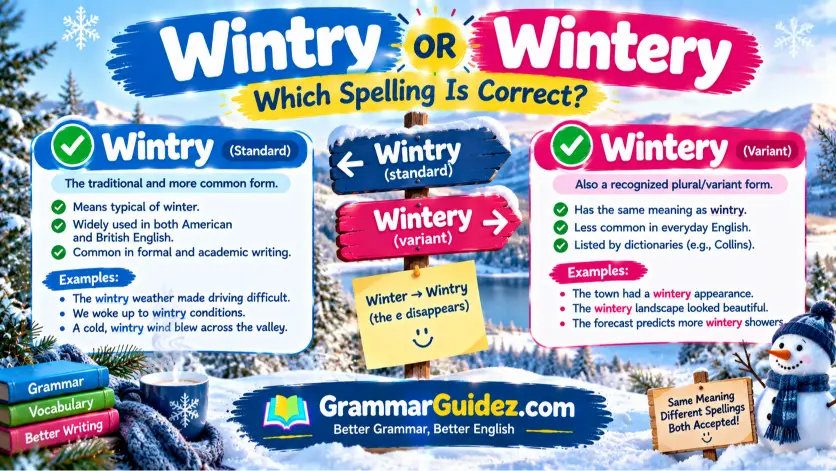
“Wintry” and “Wintery” are both found in English, but wintry is the standard and much more common spelling. Wintry = having the cold, snowy, or chilly qualities of winter. Wintery = an alternative, less common form of wintry
Wintry and wintery look almost the same, so it is easy to wonder which spelling you should use.
The standard and more common form is wintry. It means “typical of winter” or “having the qualities of winter.” Wintery is also a recognized variant, but it is less common. Collins lists both forms, while Cambridge uses wintry as its main dictionary entry.
So, if you need one spelling for school, work, academic writing, or general English, wintry is the safest choice.
But there is more to this pair than simply saying one is right and the other is wrong.
Quick Answer: Wintry or Wintery?
Wintry is the standard spelling.
Wintery is also found in English as a variant spelling with the same basic meaning.
| Word | Status | Meaning |
| Wintry | Standard/main form | Typical or characteristic of winter |
| Wintery | Recognized variant | Typical or characteristic of winter |
| Winterly | Old-fashioned/rare | Like or related to winter |
Cambridge defines wintry as “typical of winter” and gives examples involving wintry weather, showers, and conditions.
What Does Wintry Mean?
Wintry is an adjective.
It describes something that is typical of winter or has the qualities we normally associate with winter.
For example, wintry conditions may involve:
- Cold temperatures
- Snow
- Ice
- Strong winds
- Sleet
- Gray skies
- A cold or bleak atmosphere
Cambridge also records a figurative use of wintry for something unfriendly or disapproving, such as a wintry smile.
Examples of Wintry
- The wintry weather made driving difficult.
- We woke up to wintry conditions.
- A cold, wintry wind moved across the valley.
- The mountains looked beautiful in the wintry landscape.
- The road became dangerous during the wintry storm.
Notice that wintry does not always mean snowy.
A day can be wintry because it is cold, windy, icy, gray, or otherwise feels like winter.
What Does Wintery Mean?
Wintery has essentially the same meaning as wintry.
It is an adjective used to describe something connected with or characteristic of winter.
The main difference is not meaning. The main difference is frequency and standard usage.
Collins lists wintery as an alternative form of wintry in both its British and American English entries.
For example:
The town had a wintery appearance.
This communicates the same basic idea as:
The town had a wintry appearance.
However, wintry is the form most readers will expect.
Why Is Wintry Spelled Without the Extra E?
This is the part that causes most of the confusion.
The base word is:
winter
It seems logical to add -y:
winter + y = wintery
But the established standard form is:
winter → wintry
The second e disappears.
English has many words whose spelling changes when a suffix is added. The result is not always as simple as adding the suffix to the complete original word.
That is why wintry may look unusual at first.
A Simple Way to Remember It
Think:
WINTER → WINTRY
Remove the e before the y.
So:
❌ wintery less common variant
✅ wintry standard form
You do not need to think of wintery as meaningless. It is a recognized variant. But when you want the standard form, choose wintry.
Wintry and Wintery Have the Same Basic Meaning
There is no major difference in the basic meaning of these two forms.
Both can describe something associated with winter.
For example:
Wintry weather
and
Wintery weather
both refer to weather that has the qualities of winter.
The important difference is usage:
| Feature | Wintry | Wintery |
| Part of speech | Adjective | Adjective |
| Basic meaning | Characteristic of winter | Characteristic of winter |
| Standard/main form | Yes | No |
| Recognized variant | Yes | Yes |
| Formal writing | Preferred | Less common |
| Common in dictionaries | Yes | Listed as a variant in some dictionaries |
This is why simply calling wintery “wrong” is too strong. Dictionary evidence supports treating it as a variant rather than an ordinary spelling mistake.
Wintry Weather vs. Winter Weather
These phrases are closely related, but they have a small difference in focus.
Winter Weather
Winter weather simply means weather associated with the winter season.
For example:
Winter weather can change quickly.
Wintry Weather
Wintry weather emphasizes the character of the weather.
It may suggest cold, snow, ice, wind, sleet, or other conditions that feel strongly like winter.
For example:
The city experienced harsh wintry weather.
Both expressions are correct.
The adjective wintry adds a stronger sense of “like winter.”
Wintry Does Not Always Mean Snowy
This is an important detail that is sometimes missed.
A snowy day specifically has snow.
A wintry day can have snow, but it does not have to.
For example:
The roads were icy and wintry.
There may be no snow at all.
The word can describe the overall winter-like character of a situation.
Cambridge gives examples of wintry showers and wintry conditions, showing that the word is broader than simply “snowy.”
Wintry Can Describe More Than Weather
Many people first learn wintry through weather phrases.
But the word can describe appearance, atmosphere, expressions, and even emotional behavior.
Consider:
The forest had a wintry appearance.
Here, wintry describes the appearance.
Now consider:
She gave him a wintry smile.
Here, wintry has a figurative meaning. Cambridge defines this literary use as unfriendly or disapproving.
So wintry can describe both physical winter-like conditions and a cold emotional feeling.
Examples
- a wintry landscape
- a wintry morning
- a wintry sky
- a wintry wind
- a wintry scene
- a wintry expression
- a wintry smile
Is Wintery Wrong?
Not necessarily.
This is one of the most important points for this keyword.
It would be too broad to say:
“Wintery is always wrong.”
Collins lists wintery as an alternative form of wintry.
So a better explanation is:
Wintry is the standard and preferred form, while wintery is a recognized but less common variant.
That distinction is useful because English dictionaries often record variants that are used less frequently than the main form.
Practical Rule
If you are unsure:
Use wintry.
It is the standard form and will work naturally in both general and formal English.
Is Wintry American or British English?
Wintry is used in both American and British English.
This is not a simple American-versus-British spelling difference like:
- color / colour
- recognize / recognise
- theater / theatre
Cambridge provides both UK and US entries for wintry.
Collins also records wintery as an alternative in both British and American English.
So you should not choose wintery simply because you are writing for a particular English-speaking country.
For a general audience, wintry is the safer standard form.
What About Winterly?
There is a third form that can cause confusion:
winterly
It is a real but uncommon form.
Cambridge marks winterly as old-fashioned.
For modern everyday English, wintry is much more natural.
Compare:
- wintry weather natural and common
- wintery weather recognized but less common
- winterly weather old-fashioned/unusual
You may encounter winterly in older or literary writing, but it is not the form most writers should choose today.
Wintry in Formal Writing
For formal writing, wintry is the better choice.
Use it in:
- School assignments
- Academic writing
- News articles
- Weather reports
- Business writing
- Blog posts
- Professional emails
- General publications
Examples:
The region experienced severe wintry conditions.
Several roads were closed because of wintry weather.
The research team worked through difficult wintry conditions.
These sentences sound natural and clear.
Wintry in Everyday English
You will often see wintry in ordinary phrases.
Some common combinations include:
Wintry Weather
The wintry weather lasted for several days.
Wintry Conditions
Drivers should prepare for wintry conditions.
Wintry Mix
A wintry mix can describe a mixture of winter precipitation such as snow, sleet, and freezing rain.
Wintry Landscape
The wintry landscape looked beautiful after the snowfall.
Wintry Morning
It was a cold wintry morning.
These combinations are natural because wintry quickly creates a picture of winter.
Wintry Can Describe a Mood
English often uses weather words to describe feelings or behavior.
Wintry can have this figurative sense too.
For example:
He gave me a wintry look.
This does not mean his face literally looked like winter.
It suggests a cold, unfriendly, or disapproving expression.
Cambridge specifically records this literary use of wintry.
This makes wintry more flexible than a simple weather adjective.
Wintry, Wintrier, and Wintriest
Wintry also has comparative and superlative forms.
Basic adjective:
It was a wintry day.
Wintrier
Used to compare two things:
This winter has been wintrier than last year.
Wintriest
Used for the highest degree:
January was the wintriest month of the year.
Collins lists the forms wintrier and wintriest.
These forms may look unusual, but they are standard word forms.
Common Mistakes With Wintry and Wintery
Mistake 1: Always Calling Wintery Wrong
❌ “Wintery is never a real English word.”
This is too absolute.
Some dictionaries recognize wintery as a variant.
Better:
✅ “Wintry is the standard form, while wintery is a less common variant.”
Mistake 2: Using Winterly in Normal Writing
❌ The winterly weather was cold.
This is understandable, but winterly is old-fashioned and uncommon.
Better:
✅ The wintry weather was cold.
Mistake 3: Adding an Extra E to Wintry
If you want the standard spelling:
❌ wintery
✅ wintry
Remember:
WINTER → WINTRY
Mistake 4: Thinking Wintry Means Only Snowy
This is too narrow.
Wintry can describe cold, windy, icy, gray, bleak, or otherwise winter-like conditions.
Wintry or Wintery: Example Sentences
Here are some natural examples:
- The wintry weather forced the event indoors.
- We drove carefully through the wintry conditions.
- A wintry wind blew across the field.
- The mountains had a beautiful wintry appearance.
- The city looked peaceful under the wintry sky.
- The forecast predicts more wintry showers.
- She gave him a wintry smile.
- The road became dangerous during the wintry storm.
- The forest looked especially wintry after the leaves fell.
- The weather became wintrier as the month continued.
You can replace wintry with wintery in many of these sentences, but the standard form remains wintry.
A Quick Memory Trick
Use this simple pattern:
Winter → Wintry
The e disappears.
Think:
Winter loses E when it becomes wintry.
So if you are writing a school paper or professional article, remember:
WINTRY = standard
WINTERY = recognized variant
This gives you a simple rule without pretending that the variant does not exist.
Wintry or Wintery: Quick Comparison
| Question | Answer |
| Which is the standard spelling? | Wintry |
| Is wintery a word? | Yes, as a recognized variant |
| Do they have the same basic meaning? | Yes |
| Is wintry more common? | Yes |
| Is wintery an American-only form? | No |
| Is wintry British English? | Yes |
| Is wintry American English? | Yes |
| Can wintry describe emotions? | Yes |
| Can wintry mean snowy only? | No |
| What is the comparative? | Wintrier |
| What is the superlative? | Wintriest |
| Is winterly common today? | No, it is old-fashioned/rare |
Mini Quiz: Wintry or Wintery?
Choose the best answer.
1. The roads are dangerous because of the conditions.
a) wintry
b) wintery
Answer: a) wintry
2. Which spelling is the standard/main form?
a) wintery
b) wintry
Answer: b) wintry
3. Is wintery completely meaningless in English?
a) Yes
b) No
Answer: b) No. It is recognized as a variant.
4. Which word is old-fashioned?
a) wintry
b) wintery
c) winterly
Answer: c) winterly
5. What is the comparative form of wintry?
a) winterier
b) wintrier
c) more wintry
Answer: b) wintrier
FAQs
Is wintry or wintery correct?
Wintry is the standard and preferred spelling. Wintery is also a recognized variant, but it is less common.
Is wintery a real word?
Yes. Wintery is recognized as a variant of wintry by dictionary sources such as Collins.
Is wintery a misspelling?
Not necessarily. Because it is recorded as a variant, calling it always incorrect would be too strong. However, wintry is the standard form to use when you want the most conventional spelling.
What does wintry mean?
Wintry means typical of or characteristic of winter. It can describe cold weather, snow, ice, wind, a winter-like scene, or even a cold or unfriendly expression.
Is wintry American or British?
It is used in both American and British English. It is not a regional spelling difference.
What is the plural of wintry?
Adjectives do not normally have plural forms. The adjective stays wintry:
- wintry day
- wintry days
- wintry weather
- wintry conditions
What is the comparative of wintry?
The comparative form is wintrier.
Today is wintrier than yesterday.
What is the superlative of wintry?
The superlative form is wintriest.
That was the wintriest day of the month.
Is winterly correct?
Winterly is a real but old-fashioned and uncommon form. Cambridge labels it old-fashioned, so wintry is much more natural in modern writing.
Final Verdict: Wintry or Wintery?
If you are deciding between wintry or wintery, use wintry when you want the standard form.
Wintry is the main dictionary form and is widely used in modern English. Wintery has the same basic meaning and is recognized as a variant, but it is less common.
The easiest rule is:
Winter → Wintry
Remember that wintry can describe more than snow. It can describe cold weather, icy conditions, a winter-like scene, or even a cold and unfriendly expression.
So:
Wintry = standard and preferred
Wintery = recognized but less common variant
Winterly = old-fashioned/rare
When in doubt, choose wintry.
Read More Articles:

I am Elliot Hartwell, an English language writer and the author at GrammarGuidez.com. For the 6 years I have been working with English grammar, vocabulary, spelling and everyday language usage with a focus on making confusing topics easier to understand.
I started GrammarGuidez.com with a goal: to give readers clear and practical answers to common English questions. English can sometimes be confusing especially when two words look or sound similar but have meanings or uses. I enjoy breaking down these differences in a way that’s simple and easy to remember.
I believe learning English should feel simple not overwhelming. My goal is to make every article on GrammarGuidez.com useful, for students, writers, bloggers, teachers and anyone who wants to communicate clearly in English.