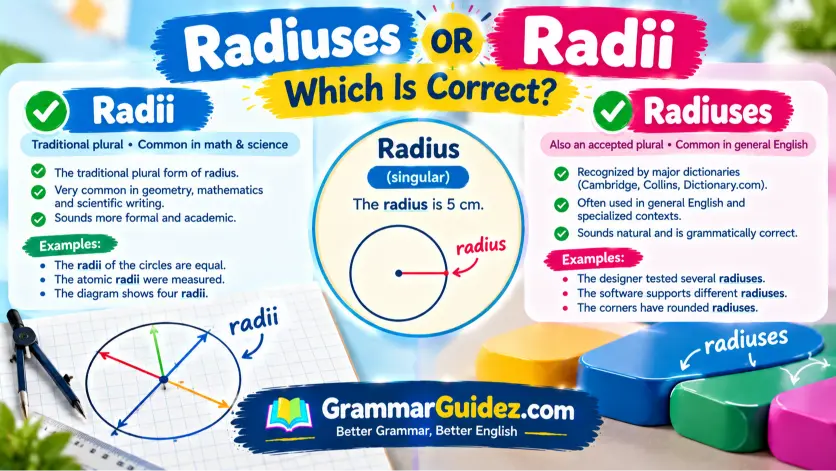
“Radiuses” and “Radii” are both correct plural forms, but they are used differently. Radiuses the plural of “radius,” commonly used in general English. Radii the traditional Latin-derived plural of “radius,” especially common in mathematics, geometry, and science.
If you need the plural of radius, you may wonder if to write radiuses or radii.
The good news is that both forms can be found in English. However, radii is the traditional plural and is especially common in mathematics, science, and technical writing. Radiuses is also an accepted English plural, particularly in general English and in some contexts where the regular English ending feels natural.
So, if you are writing about circles, geometry, or scientific measurements, radii is usually the safest and most familiar choice.
Quick Answer: Radiuses or Radii?
Radii and radiuses can both be plural forms of radius.
- Radius = singular
- Radii = traditional plural
- Radiuses = accepted English plural
- Radii is especially common in mathematical and scientific writing.
- Radiuses appears in general English and is also recorded by major dictionaries.
Examples
- The radius of the circle is 10 cm.
- The two circles have equal radii.
- The designer used different radiuses for the rounded corners.
For geometry, radii will usually sound more natural.
What Does Radius Mean?
Radius is a noun.
In geometry, a radius is the distance from the center of a circle to its edge. It can also refer to the straight line from the center of a circle to a point on its circumference.
For example:
The radius of the circle is 5 inches.
The word also has other meanings.
It can describe a distance around a central point:
There are several schools within a five-mile radius.
Radius also refers to one of the bones in the human forearm. Cambridge lists both the geometric meaning and the anatomical meaning.
What Is the Plural of Radius?
The traditional plural is radii.
The word comes from Latin, where radius has the plural radii. English has kept this traditional form, especially in technical and academic language.
For example:
- one radius
- two radii
- several radii
- the radii of several circles
Cambridge lists radii as the plural of radius, and Oxford also defines radii simply as the plural of radius. (Cambridge Dictionary)
Why Does Radii End in -i?
English has many words borrowed from Latin.
Some of these words kept older Latin-style plural forms.
For example:
- radius → radii
- alumnus → alumni
- nucleus → nuclei
- focus → foci
However, English does not always keep the original plural. Some borrowed words develop regular English plural forms as well.
That is why radiuses can also be used.
Is Radiuses Correct?
Yes, radiuses is an accepted plural form of radius.
This is an important point because some grammar guides incorrectly present radiuses as simply wrong.
Major English references recognize the form. Collins gives radii or radiuses as plural forms, while Dictionary.com also lists both forms. (Collins Dictionary)
For example:
The engineers calculated the different radiuses needed for the curved parts.
You may also see:
The engineers calculated the different radii needed for the curved parts.
Both sentences can be grammatically correct.
The choice often depends on context and style.
Radii vs. Radiuses in Mathematics
In mathematics, radii is generally the more familiar choice.
For example:
The radii of the two circles are equal.
This sounds natural in a geometry textbook.
You will also commonly see radii in scientific writing:
The atomic radii of the elements were compared.
Cambridge’s examples include technical uses such as atomic radii and the radii of circular forms. (Cambridge Dictionary)
Use Radii for Formal Geometry
If you are writing:
- a mathematics textbook
- a geometry assignment
- a scientific paper
- a technical report
- an academic article
radii is usually the clearest choice.
When Can You Use Radiuses?
Radiuses can be useful when you are talking about several separate distances, ranges, or curved measurements in ordinary English.
For example:
The search teams worked within different radiuses around the town.
You can also find radiuses in descriptions of rounded edges and curves.
For example:
The designer tested several radiuses for the corners of the table.
Dictionary.com provides real-world examples of radiuses in phrases such as “turning radiuses” and different “radiuses” in design contexts. (Dictionary.com)
This shows that radiuses is not simply a spelling mistake.
Radii or Radiuses: Side-by-Side Comparison
| Word | Use | Example |
| radius | Singular | The radius is 8 cm. |
| radii | Traditional plural | The radii are equal. |
| radiuses | Accepted plural | The design uses different radiuses. |
The important thing is to use the plural correctly.
❌ The two circle have the same radius.
✅ The two circles have the same radii.
You could also say:
✅ The two circles have the same radius.
Here, radius works because both circles have one equal radius measurement.
Radius or Radii?
Use radius when you are talking about one.
The radius of the wheel is 20 cm.
Use radii when you are talking about more than one.
The radii of the wheels are different.
The same idea applies to radiuses.
The machine uses several different radiuses.
So the basic number rule is simple:
One → radius
More than one → radii or radiuses
Radii Is Often Better for Academic Writing
If your goal is formal or academic writing, radii is often the better choice.
For example:
The experiment measured the radii of five circular objects.
This sounds natural in mathematics and science.
You could write:
The experiment measured the radiuses of five circular objects.
The sentence is understandable and radiuses is accepted, but radii is more conventional in this technical context.
This is why students are often taught radius → radii.
Radiuses Can Be Natural in General English
English often changes borrowed words over time.
A word may enter English with a foreign plural, but speakers may later create a regular English plural.
That is what has happened with several Latin-derived words.
For example:
- cactus → cacti / cactuses
- focus → foci / focuses
- radius → radii / radiuses
Dictionary.com specifically lists radii and radiuses as plural forms of radius.
So you do not need to treat radiuses as a spelling error.
Common Mistakes With Radius
1. Using Radius for Several
❌ The radiuses of the three circles is different.
There are two problems here.
First, the noun refers to several measurements.
Second, the verb should agree with the plural subject.
Better:
✅ The radii of the three circles are different.
Or:
✅ The radiuses of the three circles are different.
2. Writing Radii’s as the Plural
❌ The radii’s are equal.
The apostrophe is not needed to make a plural.
Correct:
✅ The radii are equal.
An apostrophe may be needed for possession, but not for an ordinary plural.
3. Writing Radiuseses
❌ radiuseses
This form is incorrect.
Use:
✅ radii
or
✅ radiuses
Never combine the two plural endings.
4. Using Radius With a Plural Subject
❌ The three circles have the same radius are.
Better:
✅ The three circles have the same radius.
Or, when referring to their individual measurements:
✅ The three circles have equal radii.
Radii in Geometry
Geometry is where radii appears most often.
A circle has a center and a radius.
If you draw more than one radius from the center to different points on the circle, you have multiple radii.
For example:
The diagram shows three radii extending from the center.
You may also see:
- equal radii
- different radii
- circle radii
- sphere radii
- atomic radii
- planetary radii
Radius in Everyday English
The word radius is not limited to geometry.
It can also mean the distance around a particular point.
For example:
The hospital is within a five-mile radius.
Here, radius means a range or distance measured from a central point.
When there are several different ranges, radiuses can be encountered:
The company tested several delivery radiuses.
In more formal or technical writing, you may still prefer radii, depending on what you are describing.
Radius in Anatomy
Radius also has an anatomical meaning.
It is one of the two bones in the forearm.
The other is the ulna.
For example:
The doctor examined the radius after the injury.
When referring to both bones in multiple arms, radii can be used:
The researchers compared the radii of the forearm bones.
The plural follows the same pattern.
Is Radii American or British English?
Radii is used in both American and British English.
It is not a British-only spelling.
Radiuses is also found in English usage, including American English sources. Dictionary.com lists it as a plural form, and Collins also gives both radii and radiuses. (Dictionary.com)
So this is not a simple US-versus-UK spelling difference.
How Do You Pronounce Radii?
Radius is commonly pronounced approximately:
RAY-dee-us
Radii is commonly pronounced:
RAY-dee-eye
Cambridge gives radii the pronunciation /ˈreɪ.di.aɪ/. (Cambridge Dictionary)
The final sound makes the plural easy to recognize when speaking.
A Simple Memory Trick
Remember:
Radius = one
Radii = more than one
Think of the -i ending as the traditional mathematical plural.
You can also remember:
One radius, several radii.
If you are writing a geometry problem, radii is usually the word you want.
Which One Should You Use?
The easiest rule is:
Choose radii when:
- writing about geometry
- writing about mathematics
- writing scientific material
- writing an academic paper
- describing multiple radii of circles or spheres
- you want the traditional technical form
Choose radiuses when:
- writing in general English
- describing several separate ranges or distances
- describing rounded designs or curves
- the regular English plural fits your context
Both forms are recognized, but radii is more traditional and more strongly associated with mathematical and scientific usage.
Quick Examples
Radius
- The radius of the circle is 12 cm.
- We measured the radius of the wheel.
- The hospital is within a five-mile radius.
- The radius of the sphere was calculated.
Radii
- The radii of the circles are equal.
- The students measured three radii.
- The diagram shows four radii.
- Scientists compared the atomic radii.
Radiuses
- The software supports different radiuses.
- The designer tested several corner radiuses.
- The engineers calculated different turning radiuses.
- The project uses several operating radiuses.
Mini Quiz: Radiuses or Radii?
Choose the best answer.
1. The ___ of the two circles are equal.
a) radius
b) radii
c) radius’s
Answer: b) radii
2. The ___ of the wheel is 15 cm.
a) radius
b) radii
c) radiuses
Answer: a) radius
3. The engineer tested several corner ___.
a) radius
b) radii
c) radiuses
Answer: c) radiuses
4. Which traditional plural is commonly used in geometry?
a) radii
b) radius
c) radius’s
Answer: a) radii
5. Are radiuses always incorrect?
a) Yes
b) No
Answer: b) No. Radiuses is an accepted plural form, although radii is often preferred in technical contexts.
FAQs
Is radiuses a correct word?
Yes. Radiuses is an accepted plural form of radius. Major dictionaries such as Collins and Dictionary.com recognize it.
Is radii the plural of radius?
Yes. Radii is the traditional plural of radius and is especially common in mathematics and science.
Which is better: radiuses or radii?
For mathematics, geometry, science, and formal technical writing, radii is usually the more conventional choice. Radiuses is also acceptable in English.
Is radiuses grammatically wrong?
No. It is not simply a grammatical error. Dictionaries recognize radiuses as a plural of radius.
What is the singular of radii?
The singular of radii is radius.
- One radius
- Two radii
What is the plural of radius in geometry?
Radii is the standard traditional plural used in geometry.
Is radii British or American?
Radii is used in both British and American English.
Can I use radiuses in formal writing?
Yes, but if you are writing a mathematical or scientific document, radii is usually the more conventional and recognizable choice.
Final Answer: Radiuses or Radii?
Both radiuses and radii can be correct plural forms of radius.
However, they are not equally common in every context.
Radii is the traditional Latin-derived plural and is the form you will most often want in mathematics, geometry, science, and academic writing.
Radiuses is also an accepted English plural and can sound natural in general or specialized contexts.
The safest rule is simple:
One radius → two radii
For technical and mathematical writing, choose radii unless your style guide or context calls for radiuses.
Read More Articles:

I am Elliot Hartwell, an English language writer and the author at GrammarGuidez.com. For the 6 years I have been working with English grammar, vocabulary, spelling and everyday language usage with a focus on making confusing topics easier to understand.
I started GrammarGuidez.com with a goal: to give readers clear and practical answers to common English questions. English can sometimes be confusing especially when two words look or sound similar but have meanings or uses. I enjoy breaking down these differences in a way that’s simple and easy to remember.
I believe learning English should feel simple not overwhelming. My goal is to make every article on GrammarGuidez.com useful, for students, writers, bloggers, teachers and anyone who wants to communicate clearly in English.