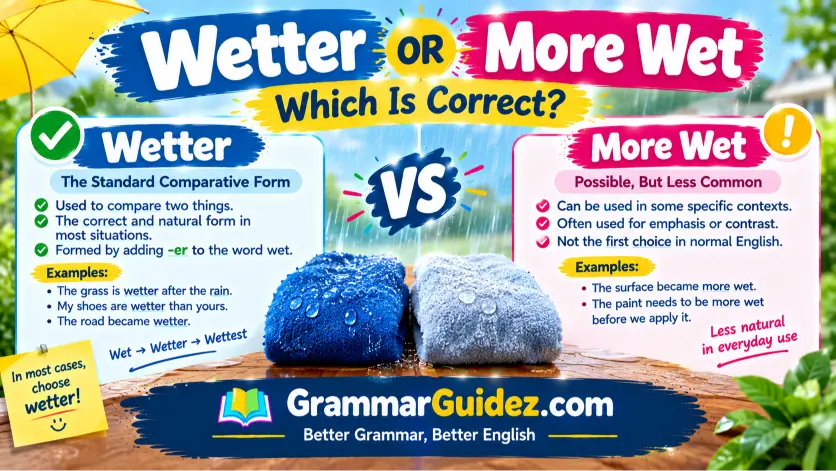
“Wetter” and “More wet” are both grammatically possible, but “wetter” is the normal and more natural form. Wetter the comparative form of “wet,” meaning having more water or moisture. More wet a less common alternative way to make the comparison
Are you confused about wetter or more wet?
Both wetter and more wet can be understood in English, but they are not equally common.
Wetter is the normal comparative form of the adjective wet.
For example:
The grass is wetter after the rain.
The word wet describes something that contains water or is covered with water. When we compare two things, we usually add -er:
wet → wetter
More wet can sometimes be used when a speaker wants to emphasize the word wet or make a special contrast. However, it is much less natural in ordinary English.
So, in most situations, use:
wetter ✅
In this guide, you will learn the difference between wetter and more wet, how to form the comparative of wet, common mistakes, examples, and easy grammar rules.
Quick Answer: Wetter or More Wet?
Wetter is the standard and most natural comparative form of wet.
Use wetter when comparing two things.
This towel is wetter than that one. ✅
More wet is possible in some contexts, but it is usually unnecessary in normal English.
| Form | Use | Example |
| Wet | Basic adjective | The towel is wet. |
| Wetter | Comparative | This towel is wetter. |
| Wettest | Superlative | This is the wettest towel. |
| More wet | Less common alternative | The surface became more wet. |
The easiest rule is:
Wet → Wetter → Wettest
What Does Wet Mean?
Wet is an adjective.
It describes something that has water or another liquid on it.
For example:
My clothes are wet.
The floor is wet.
The grass is wet.
Her hair is wet.
When you want to compare the amount of wetness between two things, use wetter.
My clothes are wetter than yours.
What Does Wetter Mean?
Wetter is the comparative form of wet.
It means that something has more water or is more soaked than another thing.
For example:
The ground is wetter today than yesterday.
Here, we compare the ground today with the ground yesterday.
Another example:
This towel is wetter than the other towel.
The first towel contains more water.
What Does More Wet Mean?
More wet uses the word more before the adjective wet.
It can be understood, but it is not normally the first choice when forming the comparative of wet.
For example:
The floor became more wet.
This sentence is understandable, but most speakers would normally say:
The floor became wetter.
The second sentence sounds more natural in everyday English.
Why Is “Wetter” Usually Correct?
English often forms the comparative of short adjectives by adding -er.
Examples include:
- tall → taller
- small → smaller
- fast → faster
- cold → colder
- warm → warmer
- wet → wetter
Because wet is a short adjective, wetter follows the normal comparative pattern.
So:
wet + er = wetter
The Spelling Rule for Wet → Wetter
There is a small spelling change when we add -er to wet.
The word wet ends in a consonant-vowel-consonant pattern:
w-e-t
When a short adjective has this pattern, the final consonant is often doubled before adding -er.
Therefore:
wet → wetter
Not:
weter ❌
The correct spelling has two t’s:
wetter ✅
Wet, Wetter, and Wettest
There are three common forms.
Wet
Use wet for the basic form.
The shirt is wet.
Wetter
Use wetter when comparing two things.
The shirt is wetter than the jacket.
Wettest
Use wettest when comparing three or more things and identifying the one with the greatest degree of wetness.
This is the wettest shirt in the basket.
So remember:
Wet → Wetter → Wettest
Wetter vs More Wet
Here is the main difference.
Wetter is the regular comparative form.
More wet is a phrase using more + adjective.
| Form | Naturalness | Example |
| Wet | Natural | The clothes are wet. |
| Wetter | Very natural | These clothes are wetter. |
| More wet | Less common | These clothes are more wet. |
| Wettest | Natural | These are the wettest clothes. |
In most normal sentences, wetter is the better choice.
When Should You Use Wetter?
Use wetter when making a simple comparison.
For example:
The grass is wetter than the soil.
My shoes are wetter than yours.
The towel became wetter after the rain.
The ground is wetter near the river.
Today is wetter than yesterday.
These sentences compare two conditions.
When Can “More Wet” Appear?
Although wetter is normally preferred, more wet can appear in certain situations.
A writer or speaker may use more wet to create emphasis or to make a particular contrast.
For example:
The surface was more wet than muddy.
Here, the speaker is contrasting wet with muddy.
Another possible use is when the adjective is being treated as a particular quality:
The paint needs to be more wet before we apply it.
This can be understood, although wetter may still sound more natural depending on the context.
The important point is that more wet is not the normal comparative form learners should choose first.
Is “More Wetter” Correct?
No.
Do not normally use more with wetter.
Incorrect:
This towel is more wetter than mine. ❌
Correct:
This towel is wetter than mine. ✅
Wetter already contains the comparative ending -er.
Using more with it creates a double comparative.
The same rule applies to words such as:
- taller
- smaller
- faster
- colder
- warmer
You would not normally say:
more taller ❌
So do not say:
more wetter ❌
Is “Weter” Correct?
No.
The correct spelling is:
wetter ✅
It has two t’s.
Incorrect:
The ground is weter today. ❌
Correct:
The ground is wetter today. ✅
Remember:
wet → wetter
The final t doubles.
Wetter in Everyday English
Wetter is common in daily conversations.
For example:
My shoes are wetter than yours.
The grass is wetter in the morning.
This towel feels wetter.
The road is wetter after the storm.
The ground gets wetter during the rainy season.
These sentences sound natural because wetter is the normal comparative form.
Wetter in Weather Descriptions
The word wetter is also common when talking about weather.
For example:
This year has been wetter than last year.
The northern region is usually wetter in winter.
The weather became wetter and cooler.
Here, wetter means that there is more rain or moisture.
Wet Weather vs Wetter Weather
Wet weather describes rainy or moist weather.
We had wet weather all week.
Wetter weather compares one period or place with another.
This month has brought wetter weather than usual.
Wetter in Science and Nature
The word wetter can describe soil, plants, surfaces, and other natural materials.
For example:
The soil near the lake is wetter.
The leaves are wetter after the rain.
The lower part of the forest is wetter than the hill.
In these cases, wetter compares the amount of moisture.
Wetter in Cooking and Food
Wetter can also describe food or mixtures.
For example:
This cake mixture is wetter than the other one.
Add less water if you want a less wet mixture.
However, depending on the food, another word such as moister, softer, or more liquid may sound more natural.
The best word depends on what you are describing.
Wetter vs Moister
Wetter and moister can have similar meanings, but they are not always interchangeable.
Moister often describes something that is pleasantly or appropriately moist rather than simply covered with water.
For example:
The ground is wetter after the rain.
But:
The cake is moister than the old recipe.
For cakes, bread, and similar foods, moister is often a better choice.
Common Mistakes With Wetter and More Wet
Mistake 1: Using More Wetter
Incorrect:
The floor is more wetter today. ❌
Correct:
The floor is wetter today. ✅
Do not use more before wetter.
Mistake 2: Spelling Wetter as Weter
Incorrect:
My clothes are weter than yours. ❌
Correct:
My clothes are wetter than yours. ✅
Remember the double t.
Mistake 3: Always Using More Wet
Incorrect or unnatural in many ordinary contexts:
The grass is more wet after the rain.
More natural:
The grass is wetter after the rain.
Mistake 4: Forgetting Than
When making a direct comparison, wetter than is very common.
For example:
The ground is wetter than yesterday.
Not:
The ground is wetter yesterday. ❌
Wetter or More Wet in Formal Writing
In formal writing, wetter is usually the better choice when making a normal comparison.
For example:
The western region is wetter than the eastern region.
This is clear and natural.
However, more wet may appear when the writer is making a specific contrast or wants to emphasize the adjective.
The context determines the best wording.
Wetter or More Wet in American and British English
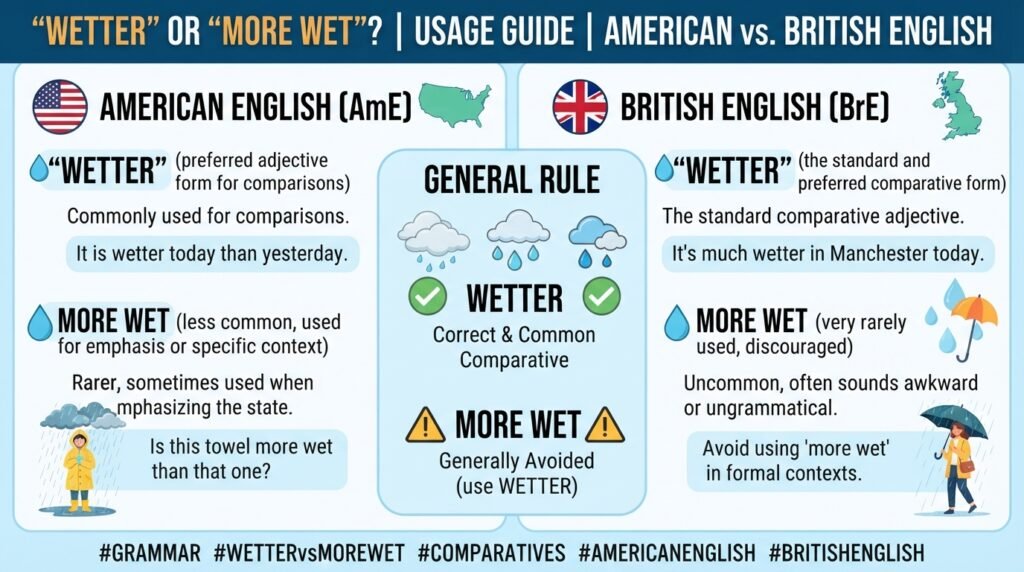
There is no major American-versus-British spelling difference here.
Both American and British English normally use:
wet → wetter → wettest
Examples:
🇺🇸 American English:
The grass is wetter after the rain.
🇬🇧 British English:
The grass is wetter after the rain.
The comparative form remains the same.
Wetter With Than
The word wetter is often followed by than when comparing two things.
Examples:
This towel is wetter than that towel.
The road is wetter than the sidewalk.
Today is wetter than yesterday.
The soil is wetter than the sand.
The basic pattern is:
A + is + wetter + than + B
For example:
The grass is wetter than the pavement.
Wetter Without Than
You do not always need than.
If the comparison is clear from the context, you can simply use wetter.
For example:
The ground is getting wetter.
My clothes are getting wetter.
The weather is becoming wetter.
Here, the listener can understand that the condition is increasing.
Easy Memory Trick
Use this simple pattern:
Wet → Wetter → Wettest
Think:
One T becomes two T’s.
So:
wet + er = wetter
And:
wet + est = wettest
For most comparisons, choose wetter, not more wet.
Quick Examples
Correct
The grass is wetter after the rain. ✅
My shoes are wetter than yours. ✅
The road became wetter. ✅
This towel is wetter than that one. ✅
Less Natural in Ordinary Comparison
The grass is more wet after the rain. ⚠️
My shoes are more wet than yours. ⚠️
These sentences can be understood, but wetter is normally the more natural choice.
Incorrect
My shoes are more wetter than yours. ❌
The towel is weter than mine. ❌
Quick Comparison Table
| Sentence | Status |
| The floor is wet. | ✅ Correct |
| The floor is wetter. | ✅ Correct |
| The floor is wetter than the wall. | ✅ Correct |
| The floor is wettest. | ✅ Correct with suitable context |
| The floor is more wet. | ⚠️ Possible but less common |
| The floor is more wetter. | ❌ Incorrect |
| The floor is weter. | ❌ Incorrect spelling |
Quick Quiz: Wetter or More Wet?
Choose the more natural form.
1. The grass is ______ after the rain.
Answer: wetter
2. My shoes are ______ than yours.
Answer: wetter
3. The road became ______ during the storm.
Answer: wetter
4. This towel is ______ than that one.
Answer: wetter
5. The soil is ______ near the river.
Answer: wetter
6. Do not write “more ______” with the comparative “wetter.”
Answer: wetter
7. The correct spelling is “wetter,” not “______.”
Answer: weter
8. The superlative form of wet is ______.
Answer: wettest
Fill in the Blanks
Use wet, wetter, wettest, or more wet where appropriate.
- My clothes are ______ after the rain.
- This towel is ______ than that one.
- The ground is very ______.
- This is the ______ area of the field.
- The road became ______ after the storm.
- The grass is ______ than it was this morning.
- The shirt is still ______.
- The lake area is usually ______ than the desert.
- The floor is ______ than the carpet.
- The rainy season makes the soil ______.
Answers
- wet
- wetter
- wet
- wettest
- wetter
- wetter
- wet
- wetter
- wetter
- wetter
FAQs
Is it wetter or more wet?
Wetter is the normal and more natural comparative form of wet.
Is “more wet” grammatically correct?
More wet can occur in some contexts, especially for emphasis or contrast, but wetter is normally preferred for a simple comparison.
Is “more wetter” correct?
No. More wetter is a double comparative and should normally be avoided.
Use wetter instead.
What is the comparative form of wet?
The comparative form of wet is wetter.
wet → wetter
What is the superlative form of wet?
The superlative form is wettest.
wet → wetter → wettest
Why is wetter spelled with two t’s?
Because wet is a short adjective ending in a consonant-vowel-consonant pattern. The final consonant is doubled before adding -er.
So:
wet → wetter
Is “weter” correct?
No. The standard spelling is wetter, with two t’s.
Do Americans and British people use “wetter”?
Yes. Wetter is used in both American and British English.
Can I say “more wet”?
You can encounter more wet, especially when a writer wants a particular contrast or emphasis. But for normal comparisons, wetter is the natural choice.
Final Verdict: Wetter or More Wet?
When you want to compare the wetness of two things, wetter is the standard and most natural choice.
Use:
wet → wetter → wettest
For example:
The grass is wetter after the rain.
More wet can sometimes appear in English, especially in special contexts where the writer wants to emphasize or contrast the word wet. However, it is not the usual comparative form that English learners should choose.
Also remember the spelling:
wetter has two t’s.
So, if you are unsure, use:
Wetter ✅
Read More Articles:

I am Elliot Hartwell, an English language writer and the author at GrammarGuidez.com. For the 6 years I have been working with English grammar, vocabulary, spelling and everyday language usage with a focus on making confusing topics easier to understand.
I started GrammarGuidez.com with a goal: to give readers clear and practical answers to common English questions. English can sometimes be confusing especially when two words look or sound similar but have meanings or uses. I enjoy breaking down these differences in a way that’s simple and easy to remember.
I believe learning English should feel simple not overwhelming. My goal is to make every article on GrammarGuidez.com useful, for students, writers, bloggers, teachers and anyone who wants to communicate clearly in English.