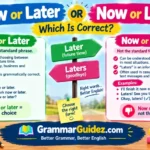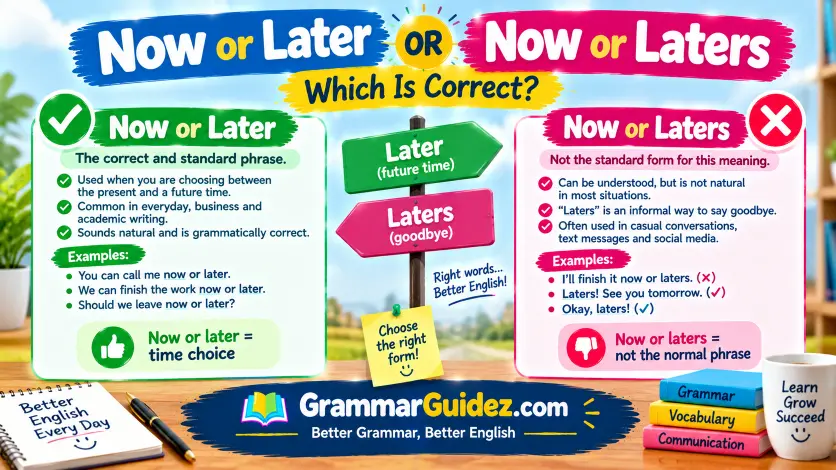
“Now” and “Laters” are both words, but they have different uses. Now = at the present time or at this moment. Laters = an informal way to say “see you later”. It is mainly used in casual speech, texting, and social media
Are you confused about now or laters?
The correct standard phrase is now or later.
The word later means at a time after now or at a future time. It works naturally in phrases such as:
You can do it now or later.
We can talk now or later.
Should I call you now or later?
Now or laters is not the standard form for this meaning.
However, laters is a real informal expression. Dictionaries list laters as a casual or humorous way to say goodbye, especially in British English. For example:
Laters, Mike!
So, the important difference is the context.
Now or later = now or at some future time.
Laters! = an informal way to say goodbye.
Quick Answer: Now or Laters?
Use now or later when you are choosing between doing something now and doing it at a future time.
You can finish the work now or later. ✅
Do not normally write:
You can finish the work now or laters. ❌
Laters can be used separately as an informal goodbye:
Laters! 👋
So the simple rule is:
Now or later = correct standard phrase
Laters = informal goodbye
| Expression | Meaning | Usage |
| Now or later | Now or at a future time | Standard |
| Now or laters | Nonstandard form of the phrase | Avoid |
| Later | At a future time | Standard |
| Laters! | Goodbye | Informal/slang |
What Does “Now or Later” Mean?
Now or later means that something can happen either at the present time or at a future time.
For example:
You can pay now or later.
This means you have two choices: pay immediately or pay at a later time.
Another example:
We can discuss the problem now or later.
This means the discussion can happen immediately or at some future point.
The phrase is useful in everyday English, business communication, emails, and general writing.
What Does “Later” Mean?
Later is normally used to talk about a time after now or after another time.
Cambridge Dictionary defines later as referring to a time in the future or after a time already mentioned.
Examples include:
I’ll call you later.
She will arrive later.
We can finish this later.
Let’s talk about it later.
The word does not need an s when it is used this way.
Why Is “Now or Later” Correct?
The phrase uses two normal time words:
Now = at this moment.
Later = at a future time.
Together:
now or later
The word later is already the correct form for talking about future time.
For example:
Should we leave now or later?
This sentence gives two time choices.
You do not need to turn later into laters.
What Does “Laters” Mean?
Laters is an informal way to say goodbye.
Cambridge lists laters as an informal way of saying goodbye, while Oxford describes Laters! as an informal goodbye used by young people.
For example:
Laters, Sam!
This has a meaning similar to:
See you later, Sam!
Another example:
Laters! I have to go.
This is casual speech.
It is not the normal form for talking about a future time.
“Later” vs “Laters”
The difference becomes easy when you look at their jobs in a sentence.
Later
Later is normally used as an adverb or adjective.
Examples:
I’ll see you later.
We can do it later.
She arrived later than expected.
Laters
Laters is an informal farewell.
Example:
Laters!
So:
later = future time
laters = informal goodbye
Is “Now or Laters” Correct?
In standard English, now or later is the form to use for a choice between the present and the future.
For example:
You can answer now or later. ✅
Not:
You can answer now or laters. ❌
The extra s changes the word into an informal farewell expression rather than the normal time expression.
Why Do People Write “Now or Laters”?
There are several possible reasons for this confusion.
One reason is that people hear or see laters as an informal version of later.
For example:
Laters!
Because this form exists in casual speech, some people may assume that laters can also be used after now or.
But these are different uses.
Compare:
I’ll do it now or later. ✅
and:
Laters! See you tomorrow. ✅
The first sentence talks about time.
The second uses laters as a goodbye.
Now or Later in Everyday English
Here are some natural examples.
Should we eat now or later?
You can call me now or later.
Do you want to leave now or later?
We can finish the project now or later.
Should I send the message now or later?
You can pay now or later.
We can discuss the details now or later.
All of these use later, not laters.
Now or Later in Emails
In professional emails, use now or later.
For example:
You can review the document now or later.
We can discuss the proposal now or later this week.
Please let me know if you would like to make the changes now or later.
Avoid:
Please review the document now or laters. ❌
The standard form is clearer and more professional.
Now or Later in Business Writing
Business writing should normally use now or later.
Examples:
Customers can complete the registration now or later.
The payment can be made now or later.
We can schedule the meeting now or later.
You can submit the application now or later.
These examples describe a choice between two points in time.
Now or Later in Academic Writing
Academic writing should also use later.
For example:
Students may complete the exercise now or later.
The researchers can examine this issue now or later.
The topic can be discussed now or later in the course.
Now or laters would not be the normal choice in formal academic writing.
Can “Laters” Be Used in a Sentence?
Yes, but it has a different function.
Laters can be used as an informal farewell.
For example:
Laters!
Laters, everyone!
Okay, laters!
Laters, see you tomorrow!
Oxford and Cambridge both recognize this informal use.
It is casual language, so it is not appropriate for every situation.
Is “Laters” Formal English?
No. Laters is informal.
It may work in:
- text messages
- casual chats
- social media
- friendly conversations
- informal dialogue
It is usually better to avoid it in:
- academic papers
- formal reports
- professional documents
- formal business emails
- official applications
For formal writing, use:
Goodbye
See you later
Talk to you later
or another suitable closing.
Now or Later vs Sooner or Later
Do not confuse now or later with sooner or later.
Now or Later
This means now or at some future time.
We can discuss it now or later.
Sooner or Later
This means at some time in the future, often suggesting that something will eventually happen.
Sooner or later, you will need to make a decision.
Both are standard expressions, but they have different meanings.
Now or Later vs Later On
You can also say:
now or later
or:
now or later on
For example:
We can discuss it now or later.
We can discuss it now or later on.
Later on is a common expression meaning at a later time.
However, now or later is usually shorter and simpler.
Is “Now or Laters” a British or American Spelling?
No.
This is not a British-versus-American spelling difference.
Both British and American English use later for the standard time expression.
The informal farewell laters is also recognized in English, with Oxford and Cambridge noting its informal use.
So you should not treat now or laters as an American or British spelling variant of now or later.
Now or Laters and Social Media
You may see laters in social media, text messages, and casual online conversations.
For example:
Laters!
This is informal and conversational.
But if someone writes:
I’ll finish it now or laters.
the standard form is:
I’ll finish it now or later.
The informal word laters does not normally replace later inside this time-choice expression.
“Now and Later” Is Different
There is another phrase that can cause confusion:
Now and Later
This is the name of a candy brand.
The official brand website currently uses the name Now and Later® and describes its products as long-lasting chewy candy.
So do not confuse:
now or later → a normal English time expression
Now and Later® → a candy brand
They are different expressions.
For example:
You can finish the work now or later.
But:
Now and Later® is a candy brand.
The word and in the brand name is important.
Common Mistakes With Now or Laters
Mistake 1: Adding “S” to Later
Incorrect:
I’ll call you now or laters. ❌
Correct:
I’ll call you now or later. ✅
Mistake 2: Treating Laters as a Plural
Later is not normally made plural when you are talking about future time.
Incorrect:
We can decide now or laters. ❌
Correct:
We can decide now or later. ✅
Mistake 3: Using Informal Slang in Formal Writing
Incorrect for a formal email:
Laters!
Better:
See you later.
Or:
Best regards,
depending on the context.
Mistake 4: Confusing Now or Later With Now and Later
These phrases have different structures.
Now or later = one choice between two times.
Now and later = both times.
For example:
You can do it now or later.
This means you can choose one.
But:
We discussed the issue now and later.
This means the discussion happened at both times.
Now or Later vs Now and Later
| Phrase | Meaning |
| Now or later | One of two possible times |
| Now and later | Both now and at a later time |
| Later | At a future time |
| Laters | Informal goodbye |
Examples:
Do it now or later.
= Choose one time.
We will discuss it now and later.
= Both times are included.
I’ll call you later.
= At a future time.
Laters!
= Goodbye.
How to Remember Now or Later
Use this simple memory trick:
Time choice = later
If you are choosing between two times, write:
now or later
If you are saying goodbye casually, you can use:
laters
So remember:
Choose a time → later
Say goodbye → laters
Quick Comparison Table
| Expression | Correct? | Meaning |
| Now or later | ✅ | Now or at a future time |
| Now or laters | ❌ in standard usage | Nonstandard version of the time phrase |
| Later | ✅ | At a future time |
| Laters! | ✅ Informal | Goodbye |
| Now and later | ✅ | Both now and later |
| Sooner or later | ✅ | Eventually |
Quick Quiz: Now or Later?
Choose the correct word.
1. You can call me now or ______.
Answer: later
2. I’ll finish the work now or ______.
Answer: later
3. ______! I have to leave.
Answer: Laters
4. We can discuss it now or ______ this evening.
Answer: later
5. She said she would come ______.
Answer: later
6. Which is the standard phrase?
Answer: now or later
7. Which form can be used as an informal goodbye?
Answer: laters
8. Should I send the email now or ______?
Answer: later
Fill in the Blanks
Use later or laters.
- I will call you ______.
- You can finish the work now or ______.
- ______! See you tomorrow.
- We can talk about it ______.
- Should we leave now or ______?
- She said she would return ______.
- ______, everyone!
- You can make the decision now or ______.
- I will explain the details ______.
- ______! I need to go home.
Answers
- later
- later
- Laters
- later
- later
- later
- Laters
- later
- later
- Laters
FAQs
Is “now or laters” correct?
In standard English, use now or later. Laters is an informal goodbye expression, not the normal form for this time-choice phrase.
Is “laters” a real word?
Yes. Dictionaries recognize laters as an informal or humorous way to say goodbye.
Can I say “laters” in a text?
Yes. Laters can be used in casual messages and conversations as a friendly goodbye.
Should I use “laters” in a formal email?
Usually no. Use see you later, goodbye, or another appropriate professional closing.
Is “now or later” correct?
Yes. Now or later is the standard phrase for choosing between the present and a future time.
Is “now or later” American or British English?
It is used in both American and British English. It is not a regional spelling difference.
What does “now or later” mean?
It means something can happen either at the present time or at a future time.
What is the difference between later and laters?
Later normally refers to a future time. Laters is an informal way to say goodbye.
Is Now and Later the same as now or later?
No. Now or later is a normal time-choice phrase. Now and Later® is also the name of a candy brand.
Conclusion
The rule is simple:
Now or later is the correct standard phrase when you are talking about a choice between doing something now and doing it at a future time.
You can finish the work now or later. ✅
Laters is different. It is an informal way to say goodbye.
Laters!
So, do not write now or laters when you mean now or at a later time.
Remember:
Now or later = time choice
Laters = informal goodbye
And if you are referring to the candy brand, the name is Now and Later®, not Now or Laters.
Read More Articles:

I am Elliot Hartwell, an English language writer and the author at GrammarGuidez.com. For the 6 years I have been working with English grammar, vocabulary, spelling and everyday language usage with a focus on making confusing topics easier to understand.
I started GrammarGuidez.com with a goal: to give readers clear and practical answers to common English questions. English can sometimes be confusing especially when two words look or sound similar but have meanings or uses. I enjoy breaking down these differences in a way that’s simple and easy to remember.
I believe learning English should feel simple not overwhelming. My goal is to make every article on GrammarGuidez.com useful, for students, writers, bloggers, teachers and anyone who wants to communicate clearly in English.