“Prove” and “proof” are both correct words, but they have different meanings and grammatical uses. “Prove” is a verb meaning to show that something is true, while “proof” is a noun meaning evidence or facts that show something is true.
Prove or proof? These two English words are closely related, so it is easy to confuse them.
However, they usually do different jobs in a sentence.
The simplest rule is:
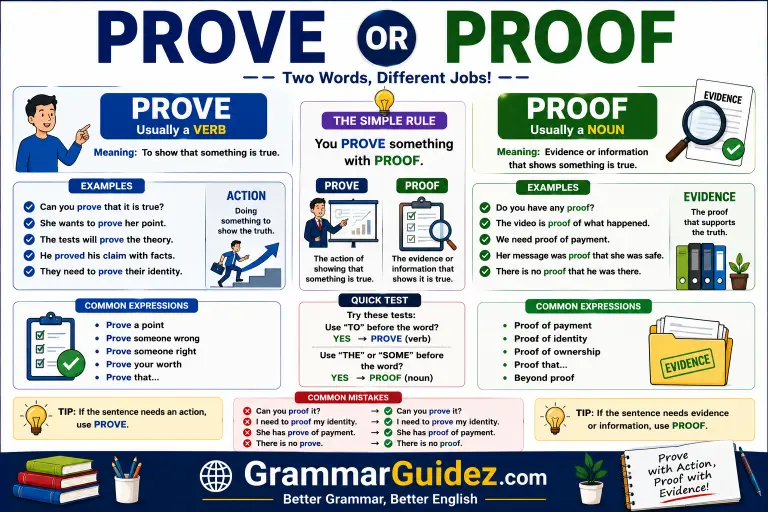
Prove is usually a verb. It means to show that something is true.
Proof is usually a noun. It means evidence or information that shows something is true.
For example:
Can you prove that the statement is true?
Here, prove describes an action.
Now look at this:
Do you have proof that the statement is true?
Here, proof is the evidence itself.
A simple way to remember the difference is:
You prove something by using proof.
For example:
The lawyer tried to prove his case with strong proof.
This article explains the difference between prove and proof, with simple rules, examples, common mistakes, useful expressions, and an easy method to help you choose the correct word.
Prove vs Proof: The Quick Answer
Here is the main difference:
| Word | Grammar Role | Main Meaning |
| Prove | Usually a verb | To show that something is true |
| Proof | Usually a noun | Evidence that shows something is true |
Example
Scientists must prove their ideas.
Prove is an action.
Now:
Scientists need proof.
Proof is a thing or evidence.
The easiest formula is:
Prove = the action
Proof = the evidence
Start by Asking: Is It an Action or a Thing?
When choosing between prove or proof, ask yourself:
Am I describing an action?
If yes, use prove.
I want to prove that I am right.
Am I talking about evidence or information?
If yes, use proof.
I have proof that I am right.
This simple action-versus-thing test works in most sentences.
What Does Prove Mean?
Prove usually means:
To show that something is true, correct, or real.
It is a verb.
That means it describes an action.
Examples
Can you prove your answer?
The experiment may prove the theory.
She wants to prove that she can do the job.
The evidence helped prove his claim.
In each sentence, someone or something is doing the action of showing that something is true.
What Does Proof Mean?
Proof usually means:
Evidence or information that shows something is true.
It is usually a noun.
Examples
Do you have proof?
The police found proof of the crime.
There is no proof that the story is true.
Her message was proof that she was safe.
In these sentences, proof is the evidence itself.
The Most Useful Sentence Pattern
A very easy way to understand the difference is this:
Someone proves something with proof.
For example:
The lawyer proved the claim with strong proof.
The scientist proved the idea using scientific proof.
She tried to prove her point but did not have enough proof.
This relationship makes the difference easier to remember.
Prove Is an Action Word
Think about what someone is doing.
Are they:
- showing something is true?
- demonstrating something?
- confirming an idea?
- establishing a fact?
If yes, you probably need prove.
Examples
He wants to prove his skills.
They need to prove their identity.
The results prove that the method works.
Can this test prove the answer?
In all of these examples, prove describes an action or process.
Proof Is Evidence
Now think about the thing that supports a claim.
Is it:
- evidence?
- information?
- a document?
- a fact?
- a result?
- something that confirms an idea?
If yes, proof may be the correct word.
Examples
The video is proof of what happened.
She showed proof of payment.
There was enough proof to support the claim.
The results provided proof that the method worked.
Here, proof is something that exists or is presented.
Prove or Proof in Real Sentences
Look at these pairs.
Pair One
I can prove that I paid.
The speaker will perform an action to show the claim is true.
Now:
I have proof that I paid.
The speaker already has evidence.
Pair Two
The test will prove if the product works.
The test may show the truth.
Now:
The test results are proof that the product works.
The results are the evidence.
Pair Three
She wants to prove that she is qualified.
She wants to demonstrate something.
Now:
Her certificate is proof that she is qualified.
The certificate is evidence.
A Simple Grammar Test
Here is a quick way to check which word belongs in your sentence.
Test for Prove
Try putting to before the word.
I want to prove my point.
This sounds correct.
Why?
Because prove is a verb.
Other examples:
They need to prove their claim.
She hopes to prove her idea.
Test for Proof
Try putting the or some before the word.
I have the proof.
I need some proof.
This works because proof is usually a noun.
Compare:
❌ I have the prove.
This is incorrect in ordinary usage.
Prove and Proof: A Word Family
These words are connected.
You may see several related forms.
| Word | Role | Example |
| Prove | Verb | I can prove it. |
| Proves | Verb | She proves her point. |
| Proved | Past tense | He proved the claim. |
| Proven | Past participle/adjective | It is a proven method. |
| Proof | Noun | We need proof. |
Understanding the word family can make the difference easier.
Prove, Proved, and Proven
The verb prove can change form depending on the sentence.
Present
I prove my point with facts.
She proves that the system works.
Past
He proved his claim yesterday.
The results proved the idea was correct.
Present Perfect
They have proved that the method works.
You may also see proven in some contexts.
The method has been proven effective.
It is a proven strategy.
Both proved and proven can appear in different grammatical contexts, especially in British and American English usage.
The key point for this article is simple:
Prove is the verb family.
Proof is generally the noun.
Common Expressions With Prove
Prove Someone Wrong
She worked hard to prove them wrong.
This means showing that another person’s belief or opinion was incorrect.
Prove Someone Right
The results proved him right.
This means events showed that the person was correct.
Prove a Point
He tried to prove a point.
This means showing that an opinion or argument is correct.
Prove Yourself
She wants to prove herself at her new job.
This means showing that you have the necessary ability or value.
Prove That
The evidence may prove that the claim is true.
This structure is very common.
Common Expressions With Proof
Proof of Something
Do you have proof of identity?
She provided proof of payment.
The report is proof of success.
Proof That
There is no proof that the story is true.
The results are proof that the method works.
Proof of Concept
This phrase is often used in business, science, and technology.
The team created a proof of concept.
It usually means an early demonstration showing that an idea can work.
Beyond Proof
In some contexts, people use expressions such as:
The case was difficult to prove beyond doubt.
The exact wording may depend on the context, but the central idea is evidence that strongly supports a conclusion.
Common Mistake: Using Proof as a Verb
One common mistake is using proof when an action word is needed.
❌ I need to proof that I am correct.
✅ I need to prove that I am correct.
Why?
After to, we normally need the base form of a verb.
to prove
Another example:
❌ Can you proof your answer?
✅ Can you prove your answer?
The sentence needs an action.
Therefore, use prove.
Common Mistake: Using Prove as a Noun
Now look at the opposite mistake.
❌ Do you have prove?
✅ Do you have proof?
The sentence needs a thing or evidence.
Therefore, use proof.
Another example:
❌ There is no prove.
✅ There is no proof.
Prove or Proof in Professional Writing
These words are common in professional communication.
When You Mean Demonstrate
Use prove.
The company must prove that the product is safe.
Applicants may need to prove their qualifications.
When You Mean Evidence
Use proof.
Please provide proof of payment.
We need proof of identity.
The document is proof of ownership.
A useful shortcut is:
Provide proof.
Prove something.
Prove or Proof in Academic Writing
Academic and research writing often uses both words.
Prove
The study aims to prove the hypothesis.
However, academic writing may sometimes prefer words such as:
- demonstrate
- support
- suggest
- establish
depending on how strong the evidence is.
Proof
The researchers found proof supporting the theory.
The word proof refers to evidence.
In mathematics, science, and logic, proof can also have a more specific meaning involving a formal demonstration that something is true.
The Difference in Mathematics
The word proof is especially common in mathematics.
A mathematical proof is a logical explanation showing why a statement is true.
For example:
The student wrote a mathematical proof.
Here, proof is a noun.
You can also say:
The student tried to prove the statement.
Here, prove is the action.
Again:
Proof = the completed explanation or evidence
Prove = the action of demonstrating
A Context-Based Decision Chart
Use this chart when you are unsure.
Your sentence needs an action.
Use:
Prove
Examples:
prove the claim
prove the answer
Your sentence needs evidence.
Use:
Proof
Examples:
proof of payment
proof of identity
Everyday Examples
At Work
The employee must prove that the work was completed.
The employee provided proof that the work was completed.
At School
The student tried to prove the answer.
The student showed proof of the answer.
While Shopping
Can you prove that you bought the product here?
Please show proof of purchase.
In Daily Life
He wants to prove that he is telling the truth.
His message is proof that he is telling the truth.
The “Can You” Test
A useful trick is to look at the words before the blank.
If the sentence says:
Can you ?
You usually need a verb.
Therefore:
Can you prove it?
Not:
❌ Can you proof it?
If the sentence says:
Do you have ?
You usually need a noun.
Therefore:
Do you have proof?
Not:
❌ Do you have prove?
This is not a rule that works for every English word, but it is very useful for this pair.
The “Evidence” Replacement Test
Try replacing the word with evidence.
Example:
Do you have proof?
Becomes:
Do you have evidence?
The meaning works.
Therefore, proof is correct.
Now:
Can you prove it?
You cannot naturally replace prove with evidence.
That is because prove is an action.
Common Mistakes With Prove and Proof
Mistake 1: “Proof It”
❌ Can you proof it?
✅ Can you prove it?
Mistake 2: “Have Prove”
❌ I have prove.
✅ I have proof.
Mistake 3: “To Proof”
❌ She wants to proof her point.
✅ She wants to prove her point.
Mistake 4: “The Prove”
❌ Where is the prove?
✅ Where is the proof?
Mistake 5: Confusing the Action With the Evidence
❌ The document proved of payment.
✅ The document is proof of payment.
The document is evidence.
Therefore, use proof.
Prove vs Proof: Quick Comparison Table
| Question | Prove | Proof |
| Is it usually a verb? | Yes | No |
| Is it usually a noun? | No | Yes |
| Does it describe an action? | Yes | No |
| Does it mean evidence? | No | Yes |
| Can it follow “to”? | Yes | Usually no |
| Can it follow “have”? | Usually not in this meaning | Yes |
Easy Memory Trick
Remember this sentence:
You PROVE something with PROOF.
Or think:
Prove = Do
Proof = Evidence
For example:
Detectives prove a case using proof.
This is the easiest relationship to remember.
Quick Quiz: Prove or Proof?
Choose the correct word.
1. Can you ___ that the story is true?
A. Prove
B. Proof
2. Do you have any ___?
A. Prove
B. Proof
3. She wants to ___ that she can succeed.
A. Prove
B. Proof
4. The video is ___ of what happened.
A. Prove
B. Proof
5. Scientists must ___ their results.
A. Prove
B. Proof
6. We need ___ of payment.
A. Prove
B. Proof
7. He tried to ___ his point.
A. Prove
B. Proof
8. The document provided strong ___.
A. Prove
B. Proof
Answers
- Prove
- Proof
- Prove
- Proof
- Prove
- Proof
- Prove
- Proof
Fill in the Blanks
Choose prove or proof.
- Can you ______ your identity?
- Please provide ______ of payment.
- The results may ______ the theory.
- There is no ______ that the claim is true.
- She wants to ______ that she is qualified.
- The certificate is ______ of her qualifications.
- They tried to ______ their argument.
- We need more ______ before making a decision.
Answers
- prove
- proof
- prove
- proof
- prove
- proof
- prove
- proof
FAQs
What is the main difference between prove and proof?
Prove is usually a verb meaning to show that something is true. Proof is usually a noun meaning evidence that shows something is true.
Is it “prove it” or “proof it”?
In standard everyday usage, the correct phrase is:
Prove it
Because prove is the verb.
Is proof a verb?
Proof is most commonly used as a noun meaning evidence. In some specialized contexts, such as publishing and printing, proof can also be used as a verb with a different technical meaning. However, for the usual meaning of showing that something is true, use prove as the verb.
Can I say “I have proof”?
Yes.
I have proof.
This means you have evidence.
Can I say “I want to prove”?
Yes.
I want to prove that I am correct.
This means you want to show that something is true.
What is the past tense of prove?
The common past form is:
proved
Example:
She proved her point.
You may also see proven as a past participle or adjective in certain contexts.
It is a proven method.
What is “proof of payment”?
Proof of payment means evidence showing that a payment was made.
Examples can include a receipt, bank record, or payment confirmation.
How can I remember prove vs proof?
Remember:
Prove = the action
Proof = the evidence
Or:
You prove something with proof.
Conclusion
The difference between prove and proof is mainly about the job each word does.
Use prove when you mean:
to show that something is true.
Use proof when you mean:
evidence that something is true.
For example:
She wants to prove her claim.
But:
She has proof to support her claim.
The easiest way to remember the difference is:
Prove is something you do.
Proof is something you have.
So, when you are unsure, ask yourself if your sentence needs an action or evidence.
If it needs an action, choose prove.
If it needs evidence, choose proof.
Once you understand this simple difference, choosing between prove or proof becomes much easier.
Read More Article
- Then or Than: Difference and Correct Usage
- Layed or Laid: Which Spelling Is Correct?
- Lead or Led: What’s the Difference?

I am Elliot Hartwell, an English language writer and the author at GrammarGuidez.com. For the 6 years I have been working with English grammar, vocabulary, spelling and everyday language usage with a focus on making confusing topics easier to understand.
I started GrammarGuidez.com with a goal: to give readers clear and practical answers to common English questions. English can sometimes be confusing especially when two words look or sound similar but have meanings or uses. I enjoy breaking down these differences in a way that’s simple and easy to remember.
I believe learning English should feel simple not overwhelming. My goal is to make every article on GrammarGuidez.com useful, for students, writers, bloggers, teachers and anyone who wants to communicate clearly in English.