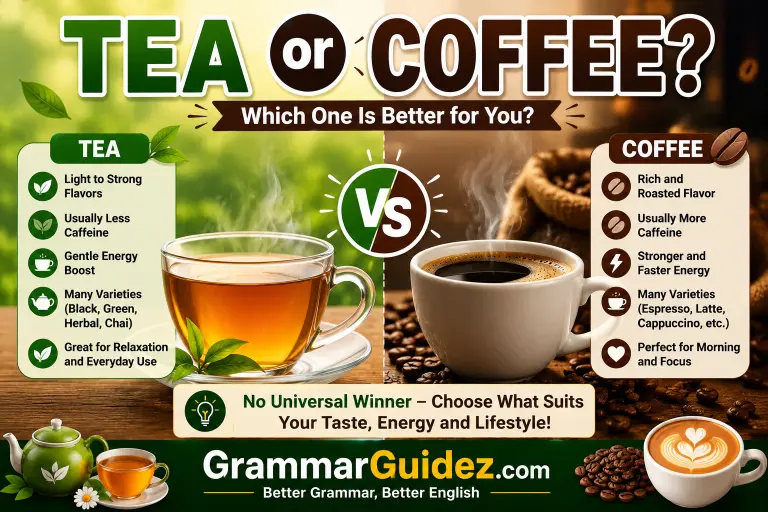
“Tea” and “Coffee” are both correct words, but they refer to different beverages.
- Tea is a drink usually made by steeping tea leaves in hot water. It can be served hot or cold.
- Coffee is a drink made from roasted and ground coffee beans, usually prepared with hot water.
Tea or coffee? It is a simple question, but the answer depends on what you want from your drink.
Some people start the day with a strong cup of coffee. Others prefer a warm cup of tea. Both drinks are popular around the world. They also come in many forms, from black tea and green tea to espresso and cappuccino.
If you are choosing between tea or coffee, taste is only one thing to consider. Caffeine, energy, daily habits, cost, and even the time of day can affect your choice.
Tea and coffee also have different flavors. Tea can taste light, fresh, floral, grassy, or strong. Coffee often has a deeper roasted taste. The amount of caffeine can also vary based on the type and how the drink is prepared.
So, which is better?
There is no single answer. Tea may be better for someone who wants a lighter drink, while coffee may be better for someone who wants a stronger caffeine boost.
Let us compare them in simple terms.
Tea or Coffee: Quick Answer
If you want a quick guide, use this table:
| Feature | Tea | Coffee |
| Taste | Light to strong | Rich and roasted |
| Caffeine | Usually lower | Usually higher |
| Energy boost | More gentle for many people | Often stronger and faster |
| Variety | Very wide | Very wide |
| Morning drink | Excellent choice | Excellent choice |
| With milk | Yes | Yes |
| With sugar | Yes | Yes |
| Best for | Relaxed drinking and variety | Strong flavor and alertness |
| Cost | Can be inexpensive | Can range from cheap to expensive |
There is no universal winner. Your personal taste and routine matter most.
What Is Tea?
Tea is a drink made by using leaves from the tea plant or, in everyday use, other plants and ingredients prepared as tea-like drinks.
Common types include:
- Black tea
- Green tea
- White tea
- Oolong tea
- Herbal tea
- Chai
- Iced tea
A basic cup of tea can be served plain or with milk, lemon, or sugar. Cambridge gives “tea” as a hot drink made by putting dried leaves in water and also notes that people commonly ask, “Would you like a cup of tea or coffee?”
Tea can have a mild or strong taste depending on the type, amount used, water temperature, and brewing time.
This makes tea a very flexible drink.
What Is Coffee?
Coffee is a drink made from roasted coffee beans. It can be prepared in many different ways.
Popular coffee drinks include:
- Black coffee
- Espresso
- Americano
- Cappuccino
- Latte
- Mocha
- Iced coffee
- Cold brew
Coffee usually has a stronger roasted flavor than many types of tea. However, its taste can change greatly depending on the beans, roast, and brewing method.
Coffee is also commonly served with milk, cream, sugar, or other additions.
Oxford describes coffee as a hot drink made from coffee powder and boiling water and gives everyday examples such as “a cup of coffee” and “tea or coffee.”
Tea vs Coffee: The Biggest Difference
The biggest practical difference is often caffeine and flavor.
Coffee generally provides more caffeine per normal serving than tea, although the exact amount depends on the drink and how it is prepared. A current comparison source notes that coffee commonly provides roughly twice the caffeine of standard black tea per cup, while brewing choices can change the amount.
Tea usually has a broader range of flavors. Black tea can be strong and malty, while green tea may taste fresh or grassy. Other teas can be floral, fruity, or delicate.
Coffee often has a roasted, deep, bitter, nutty, or chocolate-like flavor.
In simple words:
Tea: lighter, varied, and easy to drink throughout the day.
Coffee: stronger, richer, and often chosen for its stronger caffeine effect.
Which Has More Caffeine: Tea or Coffee?
In most normal servings, coffee has more caffeine than tea.
However, this is not a fixed rule for every cup. The amount depends on:
- Type of tea
- Type of coffee
- Serving size
- Brewing method
- Brewing time
- Amount of tea or coffee used
For example, a large, strong coffee can contain much more caffeine than a small cup of tea.
This is why it is better to compare actual serving sizes instead of assuming every cup contains the same amount.
Simple rule
Coffee usually has more caffeine than tea.
If caffeine is your main reason for choosing a drink, coffee may be the stronger choice.
Tea or Coffee in the Morning
Both can work well in the morning.
Choose tea if:
- You prefer a lighter flavor.
- You do not want a very strong drink.
- You enjoy drinking your beverage slowly.
- You like milk or lemon in your drink.
- You want more variety in flavors.
Choose coffee if:
- You enjoy a strong roasted taste.
- You want more caffeine.
- You like espresso-based drinks.
- You enjoy coffee with milk or cream.
- Coffee is already part of your morning routine.
Many people simply choose the drink they enjoy most.
The British Council’s English-learning material also uses tea or coffee as a common everyday preference question, showing how natural the phrase is in ordinary conversation.
Tea or Coffee for Energy
If your main goal is an energy boost, coffee is often the obvious choice because it generally contains more caffeine per serving.
But “more caffeine” does not always mean “better.”
Some people prefer the feeling they get from tea. Others like the stronger effect of coffee.
Your response can also depend on:
- How much caffeine you normally drink
- The size of your serving
- When you drink it
- How sensitive you are to caffeine
- What else you have eaten or drunk
A simple way to think about it is:
Coffee = stronger caffeine option for many servings
Tea = often a gentler caffeine option
Neither is automatically better for everyone.
Which Tastes Better: Tea or Coffee?
This is completely personal.
Tea may be better for you if you like:
- Fresh flavors
- Floral notes
- Light drinks
- Herbal flavors
- Lemon
- Milk tea
- Different tea varieties
Tea is not just one flavor. Its range can be very broad, from malty black tea to grassy green tea and delicate white tea.
Coffee may be better if you like:
- Roasted flavors
- Rich drinks
- Bitter notes
- Chocolate-like flavors
- Nutty flavors
- Creamy milk drinks
- Strong aromas
If you dislike one type of tea or coffee, try another style before deciding that you dislike the whole category.
Tea or Coffee With Milk?
Both work well with milk.
Tea with milk is common in many cultures. Strong black teas often pair especially well with milk.
Coffee also works with milk in drinks such as:
- Latte
- Cappuccino
- Flat white
- Macchiato
- Mocha
The choice comes down to taste.
If you want a lighter milk drink, tea may appeal to you. If you want a rich and creamy drink with a roasted flavor, coffee may be a better choice.
Tea or Coffee With Sugar?
Both drinks can be sweetened.
You can add sugar to tea or coffee. Some people also use honey, syrups, or other sweeteners.
However, the amount you add can change the drink considerably.
For example:
I drink tea without sugar.
She likes coffee with two teaspoons of sugar.
He prefers black coffee with no sugar.
They drink tea with milk and sugar.
If you are trying to reduce added sugar, the easiest step is to gradually use less.
Is Tea Better Than Coffee for Sleep?
The most important factor here is often caffeine and timing.
Both tea and coffee can contain caffeine. Drinking caffeinated beverages late in the day may affect sleep for some people.
Coffee usually contains more caffeine per normal serving, so people who are sensitive to caffeine may prefer to avoid it later in the day.
Tea is not automatically caffeine-free. Black tea and green tea contain caffeine, while many herbal teas are naturally caffeine-free.
So, if sleep is important to you, consider:
- What type of drink you choose
- How much you drink
- What time you drink it
- Your personal sensitivity to caffeine
Tea or Coffee: Which Is Healthier?
There is no simple winner.
Both tea and coffee contain naturally occurring compounds, and research has studied both beverages extensively. But your overall diet and lifestyle matter much more than simply choosing one drink.
Also, the way you prepare your drink matters.
A plain cup of tea and a large sweetened coffee drink are very different beverages.
The same is true for tea.
A simple unsweetened drink is different from a beverage loaded with sugar, syrups, or high-calorie additions.
So instead of asking only:
Is tea healthier than coffee?
It can be more useful to ask:
How do I prepare and drink my tea or coffee?
Tea vs Coffee: Cost
Cost depends heavily on how you prepare your drink.
Making tea at home can be inexpensive. Coffee made at home can also be affordable.
However, café drinks can cost much more.
For example:
- Tea bag + hot water = usually inexpensive
- Loose-leaf tea = varies by quality
- Instant coffee = usually inexpensive
- Ground coffee = varies by quality
- Espresso from a café = often more expensive
- Specialty coffee = can be much more expensive
If you drink several cups every day, making your drink at home can make a noticeable difference to your spending.
Tea or Coffee: Which Is Better at Work?
Both are popular workplace drinks.
Tea can be a good choice when you want something warm and easy to drink during a break.
Coffee may be preferred when you want a stronger caffeine boost or enjoy its bold flavor.
The best choice depends on your workplace, personal preference, and daily routine.
You can also use tea or coffee as a natural small-talk question:
Would you like tea or coffee?
A natural answer is:
Tea, please.
or:
Coffee, please.
Cambridge explains that short alternative questions such as “Tea or coffee?” are common in informal speech.
How to Ask “Tea or Coffee?” Correctly
Tea or coffee? is perfectly natural in casual conversation.
You can also ask:
Would you like tea or coffee?
Would you like a cup of tea or coffee?
Do you prefer tea or coffee?
Which do you prefer, tea or coffee?
These questions can ask about either a choice or a general preference.
How should you answer?
If someone asks:
Would you like tea or coffee?
You should normally name your choice:
Tea, please.
or:
Coffee, please.
You can also say:
Either is fine.
Neither, thank you.
Both, please.
Cambridge notes that alternative questions are normally answered by choosing one of the alternatives, or saying “both” or “neither” when appropriate.
Tea or Coffee: Pros and Cons
Tea
Pros:
- Many varieties
- Wide range of flavors
- Usually less caffeine than coffee per typical serving
- Can be served hot or cold
- Works well with milk or lemon
- Easy to prepare
Cons:
- Some types can taste bitter
- Caffeine is still present in many teas
- Very weak tea may not satisfy people who want a strong drink
Coffee
Pros:
- Strong roasted flavor
- Usually more caffeine per serving
- Many preparation methods
- Works well with milk
- Popular hot and cold
- Excellent for people who enjoy bold flavors
Cons:
- Can taste too bitter for some people
- May contain more caffeine than desired
- Café drinks can become expensive
- Some people may find caffeine affects their sleep
Tea or Coffee: Which One Should You Choose?
Use this simple decision guide.
Choose tea if you:
Want variety → Tea offers many styles and flavors.
Prefer a lighter drink → Tea may suit your taste.
Like milk or lemon → Tea works well with both.
Want less caffeine per typical serving → Tea is often the lower-caffeine option.
Choose coffee if you:
Want more caffeine → Coffee usually provides more per serving.
Love roasted flavors → Coffee is a strong choice.
Enjoy creamy drinks → Try a latte or cappuccino.
Want a bold morning drink → Coffee may suit your routine.
Choose both if:
You do not need to pick just one.
You might enjoy coffee in the morning and tea later in the day. Your choice can change depending on your mood, meal, or schedule.
Common Questions About Tea or Coffee
Is tea better than coffee?
Not for everyone. Tea may be better for someone who prefers a lighter drink, while coffee may be better for someone who wants more caffeine and a stronger roasted flavor.
Which has more caffeine, tea or coffee?
Coffee usually has more caffeine per normal serving, although the exact amount depends on the type, serving size, and preparation method.
Can I drink tea and coffee on the same day?
Yes. Many people drink both. What matters is your total caffeine intake and how your body responds to it.
Is “tea or coffee?” correct English?
Yes. “Tea or coffee?” is a natural shortened question used in everyday English. A fuller version is “Would you like tea or coffee?”
Which is better in the morning, tea or coffee?
Both can be good choices. Coffee may suit people who want a stronger caffeine boost, while tea may suit people who prefer a lighter drink.
Which tastes better, tea or coffee?
Taste is personal. Tea offers many flavors, while coffee often has a rich roasted taste. Try different types before choosing a favorite.
Is herbal tea the same as regular tea?
Not always. Herbal teas are commonly made from herbs, flowers, fruits, or other plants rather than traditional tea leaves.
Conclusion
So, tea or coffee which one is better?
The answer depends on you.
Choose tea if you enjoy variety, lighter flavors, and a drink that can work well at different times of the day. Choose coffee if you prefer a bold roasted flavor and usually want more caffeine from your drink.
Neither drink is the universal winner.
The best choice is the one that fits your taste, routine, caffeine needs, and lifestyle.
And remember, you do not have to choose only one. You can enjoy coffee when you need a stronger morning drink and tea when you want something lighter later in the day.
In everyday English, “Tea or coffee?” is also a perfectly natural way to offer someone a choice. A simple answer is “Tea, please” or “Coffee, please.”
Tea or coffee? The right answer is simply the one you enjoy and that works well for you.

I am Evan Whitmore, an English language writer and the person who started GrammarGuidez.com. I made GrammarGuidez.com to make grammar, spelling, vocabulary and words that are often confused easier to understand.
I like taking to understand English words and grammar rules and turning them into simple and clear explanations. My aim is to help students, writers, bloggers, ESL learners and regular English speakers feel more sure when they write and talk.
At GrammarGuidez.com I work on real life examples easy to understand explanations comparing words, spelling changes and how American English is used every day.
I think learning English doesn’t need to be hard. A good explanation and some good examples can make tough grammar topics much simpler to learn