“Bourbon” and “Whiskey” are both correct terms, but they are not exactly the same.
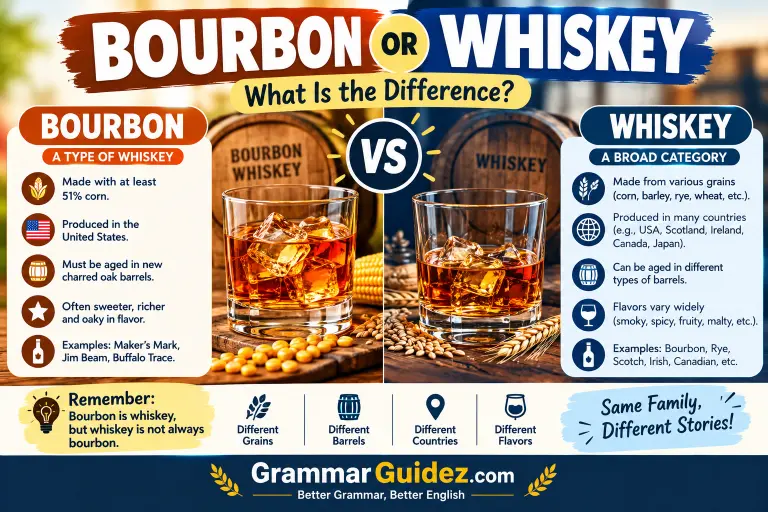
- Bourbon is a specific type of American whiskey made under certain rules, including using at least 51% corn in the grain mixture.
- Whiskey is a broad term for a distilled alcoholic drink made from fermented grains, such as corn, barley, rye, or wheat
Bourbon or whiskey? These two words are often used as if they mean the same thing. They are related, but they are not exactly the same.
The easiest way to understand the difference is this:
Bourbon is a type of whiskey.
Whiskey is the larger category. Bourbon is one specific type within that category.
This means every bourbon is whiskey, but not every whiskey is bourbon.
The difference comes from several things, including the grains used, where the spirit is produced, the type of barrels used, and the rules it must follow.
If you are confused about bourbon or whiskey, this guide will explain the difference in simple English.
Quick Answer: Bourbon vs Whiskey
| Feature | Bourbon | Whiskey |
| What is it? | A type of whiskey | A broad category of spirits |
| Main grain rule | At least 51% corn | Depends on the type |
| Production | Must be produced in the United States | Made in many countries |
| Barrel requirement | New charred oak containers | Rules vary by type |
| Flavor | Often sweet, rich, and oaky | Varies widely |
| Examples | Bourbon whiskey | Bourbon, rye, Scotch, Irish whiskey, etc. |
The most important point is:
Bourbon is whiskey, but whiskey is not always bourbon.
What Is Whiskey?
Whiskey is a distilled spirit made from a fermented grain mash.
The grains can vary depending on the type of whiskey. Common grains include:
- Corn
- Barley
- Rye
- Wheat
Different countries and styles have different rules for making whiskey.
For example, bourbon is an American whiskey. Scotch whisky comes from Scotland, while Irish whiskey comes from Ireland.
In U.S. regulations, whisky is defined as a spirit distilled from fermented grain mash and bottled at not less than 80 proof.
So, whiskey is a category, not just one specific drink.
Common types of whiskey
Whiskey can include:
- Bourbon
- Rye whiskey
- Tennessee whiskey
- Scotch whisky
- Irish whiskey
- Canadian whisky
- American single malt whisky
Each style can have its own production rules and flavor profile.
What Is Bourbon?
Bourbon is a specific type of American whiskey.
To legally be called bourbon in the United States, it must meet specific production requirements.
One major rule is that the fermented mash must contain at least 51% corn. The spirit must also be produced in the United States and stored in new charred oak containers.
The distillation proof and barrel-entry proof also have limits under U.S. regulations.
In simple terms, bourbon has a more specific recipe and production process than whiskey as a general category.
Basic bourbon requirements
Bourbon must:
- Be produced in the United States.
- Use a fermented mash containing at least 51% corn.
- Be distilled at no more than 160 proof.
- Enter the barrel at no more than 125 proof.
- Be stored in new charred oak containers.
- Be bottled at at least 80 proof.
These requirements come from the U.S. Alcohol and Tobacco Tax and Trade Bureau (TTB).
Bourbon or Whiskey: The Biggest Difference
The biggest difference is specificity.
Whiskey is a broad category.
Bourbon is one specific type of whiskey with strict rules.
Think of it like this:
Whiskey = category
Bourbon = one member of that category
This is why saying “bourbon is not whiskey” is incorrect.
Bourbon is whiskey.
But a whiskey made mainly from rye, for example, is not automatically bourbon.
Why Does Bourbon Need Corn?
Corn is one of the key parts of bourbon.
U.S. bourbon rules require the fermented mash to contain at least 51% corn.
Corn helps give bourbon its familiar character. Bourbon is often associated with sweeter notes compared with styles that use more rye or other grains.
The remaining grains can vary. A bourbon mash may also contain grains such as:
- Rye
- Wheat
- Malted barley
The exact recipe can change the final flavor.
Bourbon mash bills
A mash bill is the grain recipe used to make a whiskey.
For example, one bourbon may use more rye, while another may use more wheat.
This can create noticeable differences in taste.
That is why two bourbons can taste very different even though both follow the bourbon rules.
Bourbon vs Whiskey: Where Are They Made?
Location is another important difference.
Bourbon must be produced in the United States under the U.S. standard for bourbon. TTB rules also state that the term “bourbon” may not be used to describe whisky or whisky-based distilled spirits that were not produced in the United States.
Whiskey, however, can come from many places.
You may see:
- American whiskey
- Scotch whisky
- Irish whiskey
- Canadian whisky
- Japanese whisky
These styles can have different production rules.
So, if someone says whiskey, you still need more information to know what style they mean.
If they say bourbon, you already know it belongs to a particular American whiskey category.
Bourbon or Whiskey: Barrel Differences
Barrels play a major role in whiskey production.
For bourbon, the rules require new charred oak containers.
This is an important difference because some other whiskey styles can use different types of barrels.
The time spent in oak also affects the final spirit.
During aging, the whiskey interacts with the wood. This can influence its:
- Color
- Aroma
- Flavor
- Texture
The TTB defines the age of whisky as the period after distillation and before bottling when the spirit is stored in oak containers.
Is Bourbon Sweeter Than Whiskey?
This question is a little tricky because whiskey is a large category.
You cannot say that every bourbon is sweeter than every other whiskey.
However, bourbon often has a naturally sweet character because corn must make up at least 51% of its mash.
Other whiskey styles may have different flavor profiles.
For example, a whiskey with a high rye content may have a spicier character, while some malt-based whiskies can have more malty or fruity notes.
So the better answer is:
Bourbon often tastes sweet and rich, but whiskey flavors vary greatly by style.
Bourbon or Whiskey: Which Has More Alcohol?
There is no simple rule that says bourbon always has more alcohol than whiskey.
Alcohol content depends on the individual product.
In the United States, whiskey must generally be bottled at no less than 80 proof, which equals 40% alcohol by volume. Bourbon follows the same minimum bottling proof requirement.
Some products may be bottled at higher proof.
This means you should check the label if alcohol content matters to you.
What does proof mean?
In the United States:
Proof = 2 × alcohol by volume
For example, a spirit containing 40% alcohol by volume is 80 proof.
Bourbon vs Whiskey Flavor
Flavor depends on many factors.
These can include:
- Grain recipe
- Barrel type
- Aging time
- Distillation method
- Production location
- Bottling proof
Bourbon often has notes that people describe as:
- Vanilla
- Caramel
- Oak
- Sweet spice
- Toasted flavors
But bourbon does not have one single flavor.
Different mash bills and aging conditions can produce very different results.
Whiskey as a category has an even wider range of flavors.
Some whiskies may taste:
- Fruity
- Spicy
- Malty
- Smoky
- Sweet
- Oaky
- Rich
This is why comparing “bourbon” with “whiskey” is not exactly like comparing two equal categories.
Is Bourbon Better Than Whiskey?
There is no universal winner.
The question itself is slightly misleading because bourbon is already a type of whiskey.
A better question would be:
Which type of whiskey do you prefer?
Someone who likes sweeter, rich, and oaky flavors may enjoy bourbon.
Someone who prefers smoky, spicy, fruity, or malty flavors may prefer another whiskey style.
Taste is personal.
There is no rule saying bourbon is better than Scotch, rye whiskey, Irish whiskey, or another style.
Bourbon or Whiskey: Common Confusion
Confusion 1: Bourbon and whiskey are completely different
Not exactly.
Bourbon belongs to the whiskey family.
Confusion 2: All American whiskey is bourbon
No.
American whiskey includes several styles.
Bourbon is only one type.
Confusion 3: Bourbon must come from Kentucky
This is a common misconception.
Bourbon must be produced in the United States, but it does not have to come from Kentucky. The legal definition focuses on U.S. production and other production requirements.
Kentucky is strongly associated with bourbon, but bourbon is not legally limited to Kentucky.
Confusion 4: Bourbon is always aged for at least two years
Not all bourbon has the same age requirement.
However, straight bourbon whiskey must meet additional aging rules. TTB materials define straight bourbon as bourbon stored in charred new oak containers for two years or more.
So “bourbon” and “straight bourbon” are not exactly the same designation.
Bourbon or Whiskey: A Simple Way to Remember
Use this simple formula:
Whiskey = the big category
Bourbon = one type of whiskey
You can imagine whiskey as a large box.
Inside that box are different styles.
One of those styles is bourbon.
Other styles include rye whiskey and different regional whiskey traditions.
This makes the relationship easy to remember.
Bourbon vs Whiskey Comparison
| Question | Bourbon | Whiskey |
| Is it whiskey? | Yes | Yes |
| Is it a broad category? | No | Yes |
| Must it be American? | Yes | No |
| Must it contain corn? | At least 51% | Depends on the style |
| Must it use new charred oak? | Yes | Depends on the type |
| Can it come from Scotland? | No | Yes, if it meets Scotch rules |
| Can it come from Ireland? | No | Yes, if it meets Irish whiskey rules |
| Does it have one fixed flavor? | No | No |
Bourbon or Whiskey: Which Word Should You Use?
Use bourbon when you specifically mean bourbon.
Use whiskey when you are talking about the broader category or when the exact style is not important.
For example:
Bourbon:
Bourbon is a type of American whiskey.
Whiskey:
Whiskey can be made in several countries and styles.
A useful sentence to remember is:
Bourbon is whiskey, but whiskey is not always bourbon.
FAQs
Is bourbon whiskey?
Yes. Bourbon is a specific type of whiskey made under specific U.S. requirements.
What is the main difference between bourbon and whiskey?
Whiskey is a broad category. Bourbon is one specific type of whiskey with rules about its grain mash, U.S. production, distillation, and storage in new charred oak containers.
Is bourbon only made in Kentucky?
No. Bourbon must be produced in the United States, but it does not have to be made in Kentucky.
Does bourbon have to contain corn?
Yes. Bourbon must be made from a fermented mash containing at least 51% corn under the U.S. standard.
Is all whiskey bourbon?
No. Bourbon is only one type of whiskey.
Is bourbon sweeter than whiskey?
Bourbon often has a sweet and rich profile, but whiskey includes many styles with different flavors. So you cannot say that every bourbon is sweeter than every whiskey.
What is straight bourbon?
Straight bourbon is bourbon that has been stored in charred new oak containers for at least two years under the U.S. standard.
What does 80 proof mean?
In the United States, 80 proof equals 40% alcohol by volume. Proof is calculated as twice the alcohol percentage by volume.
Conclusion:
The difference between bourbon or whiskey becomes easy once you understand the category relationship.
Whiskey is the broad term for a family of grain-based distilled spirits.
Bourbon is one specific type of American whiskey.
Bourbon must follow specific U.S. rules. Its mash must contain at least 51% corn, and it must be stored in new charred oak containers.
The easiest rule to remember is:
All bourbon is whiskey, but not all whiskey is bourbon.
So, if you are asking if bourbon and whiskey are the same thing, the answer is no.
They are closely related, but bourbon is a more specific term.
Once you remember “whiskey is the category, bourbon is a type,” the difference becomes much easier to understand.

I am Elliot Hartwell, an English language writer and the author at GrammarGuidez.com. For the 6 years I have been working with English grammar, vocabulary, spelling and everyday language usage with a focus on making confusing topics easier to understand.
I started GrammarGuidez.com with a goal: to give readers clear and practical answers to common English questions. English can sometimes be confusing especially when two words look or sound similar but have meanings or uses. I enjoy breaking down these differences in a way that’s simple and easy to remember.
I believe learning English should feel simple not overwhelming. My goal is to make every article on GrammarGuidez.com useful, for students, writers, bloggers, teachers and anyone who wants to communicate clearly in English.