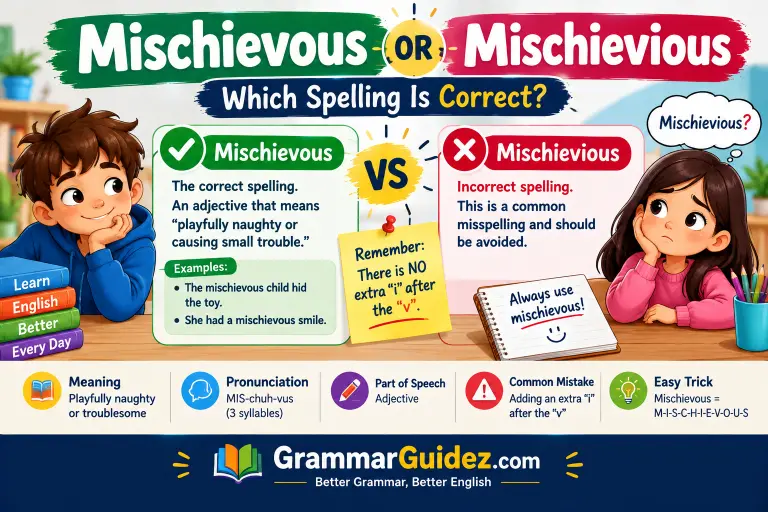
“Mischievous” is the correct spelling, while “mischievious” is a common misspelling.
- Mischievous means playful in a way that may cause minor trouble or annoyance.
- Mischievious is not the standard spelling in English
If you are unsure if to write mischievous or mischievious, you are not alone. Many English learners add an extra i and write mischievious. However, there is only one standard spelling.
The correct spelling is mischievous.
Mischievious is a common misspelling. It looks natural because of the way some people pronounce the word. But standard English uses mischievous, without the extra i after the v.
The word mischievous is an adjective. It describes someone or something that likes to cause small problems, play tricks, or behave in a playful and slightly naughty way.
In this guide, you will learn the difference between mischievous or mischievious, the correct pronunciation, meaning, spelling rule, common mistakes, and easy ways to remember the correct form.
Quick Answer: Mischievous or Mischievious?
Mischievous is the correct spelling.
Mischievious is a common misspelling and should be avoided in standard English.
| Spelling | Correct? | Meaning |
| Mischievous | ✅ Yes | Playfully troublesome or naughty |
| Mischievious | ❌ No | Common misspelling of mischievous |
Easy Rule
Remember:
Mischievous = M-I-S-C-H-I-E-V-O-U-S
There is no extra I after the V.
What Does Mischievous Mean?
Mischievous is an adjective used to describe playful behavior that causes trouble or annoyance.
A mischievous person may enjoy playing harmless tricks or breaking small rules. The word often has a playful meaning rather than a seriously negative one.
For example, a child who hides someone’s shoes as a joke may be called mischievous.
The word can also describe animals, actions, smiles, looks, or behavior.
A mischievous person is often:
- Playful
- Naughty
- Teasing
- Troublesome
- Full of tricks
The exact meaning depends on the context. In many situations, mischievous suggests harmless or playful trouble.
Why Is “Mischievious” Wrong?
The spelling mischievious is usually created by adding an extra i.
This mistake happens because English pronunciation can make the word feel as if it contains an extra syllable or vowel sound.
The correct spelling is:
mischievous
Not:
mischievious
The important part to remember is:
mischie + vous
The word ends with -vous, not -vious.
So, when spelling the word, do not insert an extra i between v and o.
Mischievous Spelling Breakdown
Here is the correct spelling:
M I S C H I E V O U S
You can divide it into simple parts:
mis + chie + vous
The key section is:
…IEV…
not:
…IEVIO…
That small difference is what causes many spelling mistakes.
How Do You Pronounce Mischievous?
The pronunciation of mischievous can also cause confusion.
It is commonly pronounced:
MIS-chuh-vus
It has three syllables:
mis-chuh-vus
The common standard pronunciation does not require an extra syllable for an imaginary i.
This is one reason learners may write mischievious. They may spell the word based on how they think it sounds.
A useful rule is:
Do not always spell an English word exactly as you hear it.
English spelling often does not perfectly match pronunciation.
Mischievous vs. Mischievious
The difference is simple.
Mischievous is the standard English spelling.
Mischievious is a misspelling.
| Feature | Mischievous | Mischievious |
| Standard spelling | ✅ Yes | ❌ No |
| Part of speech | Adjective | — |
| Meaning | Playfully troublesome | — |
| Extra “i” after “v” | No | Yes |
| Suitable for formal writing | Yes | No |
If you are writing an essay, email, article, school assignment, or professional document, always use mischievous.
Common Mistake With Mischievous
The most common error is adding an extra i.
Incorrect:
Mischievious
Correct:
Mischievous
People often make this mistake because several English words have similar-looking endings. They may expect mischievous to follow a spelling pattern that it does not actually use.
The safest approach is to memorize the correct spelling.
Examples of Mischievous
Here are some natural examples:
- The mischievous child hid his sister’s toy.
- The puppy gave me a mischievous look.
- She had a mischievous smile on her face.
- His mischievous behavior made everyone laugh.
- The students played a mischievous prank on their teacher.
- The cat was too mischievous to stay still.
These examples show that mischievous can describe people, animals, expressions, and behavior.
Is Mischievous a Negative Word?
Not always.
Mischievous often describes behavior that is naughty or troublesome but not seriously harmful.
For example, a child may be mischievous because they enjoy harmless jokes.
The word can therefore sound playful or affectionate.
The meaning can range from:
playfully naughty → troublesome → slightly disruptive
The context tells you how serious the behavior is.
Mischievous as an Adjective
Mischievous is an adjective.
An adjective describes a person, animal, thing, or behavior.
You can use mischievous before a noun:
- mischievous child
- mischievous boy
- mischievous girl
- mischievous dog
- mischievous smile
- mischievous behavior
- mischievous expression
- mischievous prank
You can also use it after a linking verb:
- The child was mischievous.
- The puppy seemed mischievous.
- His behavior became mischievous.
Mischievous vs. Naughty
These words are similar, but they are not always exactly the same.
Naughty is often used for someone who behaves badly or breaks rules.
Mischievous often suggests playful trouble or harmless tricks.
For example, a child who refuses to follow rules may be called naughty. A child who plays a harmless trick on someone may be called mischievous.
So, mischievous often has a more playful feeling.
Mischievous vs. Malicious
Do not confuse mischievous with malicious.
Mischievous usually describes playful or minor trouble.
Malicious describes an intention to cause serious harm or damage.
This is an important difference.
A mischievous prank may make people laugh.
A malicious action is intended to hurt someone or cause damage.
Therefore, mischievous does not normally mean cruel or evil.
Why Do People Spell It “Mischievious”?
There are a few reasons for this common mistake.
1. Pronunciation
People may hear the word and imagine an extra vowel sound.
2. Similar spelling patterns
English has many words with complicated endings. Writers may automatically add i where they think it belongs.
3. Visual memory
Once someone sees mischievious written incorrectly several times, the wrong spelling can start to look familiar.
4. Typing habits
Fast typing can also lead to an extra letter.
The best solution is simple: memorize the correct form mischievous.
Easy Memory Trick for Mischievous
Use this simple trick:
Mischievous has NO extra I after V.
Think:
MISCHIE + VOUS
Not:
MISCHIE + VIOUS
Another easy memory sentence is:
“Mischievous has one V, then O.”
So remember:
V → O
not:
V → I → O
This can help you avoid the most common spelling mistake.
Mischievous in American and British English
Unlike many spelling differences between American and British English, mischievous does not normally change to a different standard spelling in the US and UK.
Both American and British English use:
mischievous
The spelling mischievious is not the standard alternative British spelling.
So if you are writing for an American or British audience, use mischievous.
Common Questions About Mischievous
Is mischievous the correct spelling?
Yes. Mischievous is the correct standard spelling.
Is mischievious a word?
Mischievious is commonly seen as a misspelling of mischievous. In standard English writing, use mischievous.
How many syllables are in mischievous?
The common standard pronunciation has three syllables: mis-chuh-vus.
Does mischievous have an extra i?
No. There is no extra i after the v.
Correct:
mischievous
Incorrect:
mischievious
What does mischievous mean?
It means playful, naughty, or slightly troublesome, often involving harmless tricks or behavior.
Is mischievous a noun or adjective?
Mischievous is an adjective.
What is the opposite of mischievous?
Depending on the context, possible opposites include well-behaved, obedient, good, or harmless.
Mischievous or Mischievious: Final Verdict
When choosing between mischievous or mischievious, always choose mischievous.
Mischievous is the correct standard spelling. It is an adjective that describes someone or something that is playfully naughty, troublesome, or fond of harmless tricks.
Mischievious is a common spelling mistake. The extra i makes the spelling incorrect in standard English.
The easiest way to remember the word is:
Mischievous = M-I-S-C-H-I-E-V-O-U-S
Pay special attention to the ending:
-vous
not:
-vious
If you remember that one small spelling point, you can avoid one of the most common mistakes with this word.
Remember:
Mischievous = Correct ✅
Mischievious = Incorrect ❌
Use mischievous in your school work, professional writing, articles, emails, and everyday English.
Read More Articles:

I am Evan Whitmore, an English language writer and the person who started GrammarGuidez.com. I made GrammarGuidez.com to make grammar, spelling, vocabulary and words that are often confused easier to understand.
I like taking to understand English words and grammar rules and turning them into simple and clear explanations. My aim is to help students, writers, bloggers, ESL learners and regular English speakers feel more sure when they write and talk.
At GrammarGuidez.com I work on real life examples easy to understand explanations comparing words, spelling changes and how American English is used every day.
I think learning English doesn’t need to be hard. A good explanation and some good examples can make tough grammar topics much simpler to learn