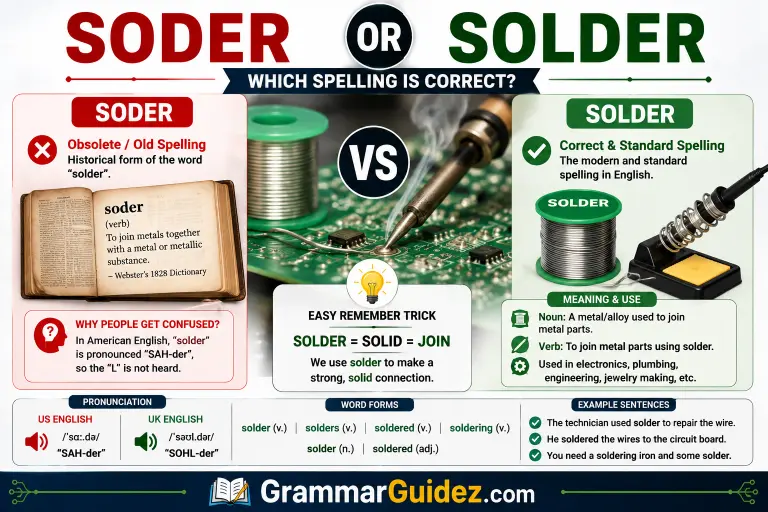
“Solder” is the correct spelling, while “soder” is a common misspelling and not the standard English spelling. “Solder” is a noun or verb referring to a metal alloy used to join metal parts, or the process of joining them, whereas “soder” has no accepted meaning in standard English.
If you have ever searched for soder or solder, you may have wondered if the extra l in solder is really necessary. The confusion makes sense because the word is often pronounced differently from how it is spelled, especially in American English.
The good news is simple: solder is the standard modern English spelling. It is the word used for the soft metal or metal alloy that is melted to join pieces of metal, wires, or electronic components. It can also be used as a verb meaning “to join with solder.”
But there is an interesting detail. Soder is not simply a meaningless spelling mistake in the history of English. Older dictionaries recorded soder as a form of the word, and historical sources show it as an older spelling. Today, however, it is obsolete or nonstandard for ordinary modern English.
So, if you are writing an email, article, school assignment, technical guide, or business document, solder is the spelling you should use.
The One-Line Answer
Solder is the correct and standard spelling in modern English.
Soder is an obsolete historical form and should generally not be used in modern writing.
| Word | Modern standard? | Meaning |
| solder | ✅ Yes | A metal/alloy used to join metal parts |
| soder | ⚠️ Obsolete | Historical form of solder |
Example
I need some solder to repair this circuit board.
Not:
I need some soder to repair this circuit board.
Why Do People Write “Soder”?
The main reason is pronunciation.
In American English, solder is commonly pronounced approximately “SAH-der”, so the l is not pronounced. Cambridge gives the US pronunciation as /ˈsɑː.dɚ/. In British English, it is commonly pronounced /ˈsəʊl.dər/, with an audible l.
This creates an obvious spelling problem for learners:
“If I don’t hear the l, why should I write it?”
That is a reasonable question.
English has many words whose spelling does not perfectly match their pronunciation. Solder is one of them.
So you may hear something like:
American English: “SAH-der”
while seeing:
solder
The spelling remains solder.
Solder: Meaning and Use
Solder has two main grammatical uses.
1. Solder as a noun
As a noun, solder refers to a metal or metallic alloy that is melted and used to join metal surfaces. Cambridge defines it as a soft metal that melts and joins pieces of metal when it cools and hardens.
For example:
The technician used solder to repair the wire.
This circuit requires a small amount of solder.
The plumber checked the solder around the joint.
2. Solder as a verb
As a verb, solder means to join pieces of metal or wire using solder.
For example:
She learned how to solder electronic components.
The technician soldered the wires together.
These wires need to be soldered to the board.
The common forms include:
- solder
- solders
- soldered
- soldering
Soder vs Solder: The Real Difference
At first glance, this looks like a normal spelling comparison.
It is not quite that simple.
Solder
This is the standard modern form.
It is used in:
- Electronics
- Plumbing
- Metalworking
- Jewelry making
- Engineering
- Manufacturing
- DIY projects
Soder
This spelling has historical evidence, but it is obsolete in modern standard English. Wiktionary records soder as an obsolete form of solder, while historical dictionaries also contain an entry for it.
Therefore, these two words should not normally be treated as two modern spelling choices like theater and theatre.
A better description is:
Solder = modern standard spelling
Soder = historical/obsolete spelling
A Closer Look at “Solder”
The word has a long history.
Oxford traces solder through Middle English and Old French to Latin solidare, meaning “fasten together,” from solidus, meaning “solid.”
This history fits the modern meaning quite well.
When you solder two pieces of metal, the melted material cools and creates a firm connection.
Merriam-Webster dates the noun solder to the 14th century and the verb to the 15th century. Its etymology also connects the word with Latin solidare.
So although the modern spelling may look unusual, it is the result of a long history of language change.
Why the “L” in Solder Causes Confusion
There are two separate issues here.
Spelling
The standard spelling contains:
s-o-l-d-e-r
Pronunciation
The l may not be pronounced in American English.
That creates this mental mismatch:
Written: solder
Heard in many US contexts: “sah-der”
English learners often spell words according to sound. That works sometimes, but not always.
For solder, remember:
The spelling has an L even when you do not hear it.
Solder in American and British English
This is one area where pronunciation differs more noticeably than spelling.
| Feature | American English | British English |
| Spelling | solder | solder |
| Common pronunciation | “SAH-der” | “SOHL-der” |
| L usually heard? | No | Yes |
| Standard spelling | solder | solder |
Cambridge lists the US pronunciation as /ˈsɑː.dɚ/ and the UK pronunciation as /ˈsəʊl.dər/. Oxford likewise gives different British and American pronunciations while retaining the same spelling.
So this is not a British-vs-American spelling difference.
Both varieties use:
solder
Common Sentences With Solder
Seeing the word in real sentences can make it easier to remember.
Electronics
The engineer used solder to connect the components.
The wire needs to be soldered to the circuit board.
Plumbing
The plumber used solder to join the copper pipes.
Jewelry
The jeweler carefully soldered the two pieces together.
DIY
You will need a soldering iron and solder for this repair.
Manufacturing
The machine automatically solders the electronic connections.
Notice that the spelling remains solder in every form.
Solder, Soldered, and Soldering
A common mistake is changing the spelling because of pronunciation.
The correct word family is:
| Form | Correct spelling | Example |
| Base verb | solder | I can solder wires. |
| Third person | solders | He solders the connection. |
| Past tense | soldered | She soldered the wire. |
| -ing form | soldering | He is soldering a circuit. |
| Noun | solder | We need more solder. |
Incorrect forms
❌ soder
❌ sodered
For modern standard English, use:
✅ solder
✅ soldered
Common “Soder or Solder” Mistakes
Mistake 1: Writing “soder” because of pronunciation
❌ I need to soder this wire.
✅ I need to solder this wire.
The pronunciation does not determine the spelling.
Mistake 2: Removing the L from “soldered”
❌ The wire was sodered to the board.
✅ The wire was soldered to the board.
The l remains in the spelling.
Mistake 3: Writing “sodering”
❌ He is sodering the circuit.
✅ He is soldering the circuit.
The correct spelling is based on solder + -ing.
Is “Soder” Ever Correct?
This question deserves a more careful answer than simply saying “no.”
Soder has been used historically as a spelling of solder. Older dictionaries contain the word, and historical examples show forms such as sodered.
For example, Webster’s 1828 dictionary included soder as a verb and noun.
However, historical existence does not make a spelling appropriate for modern writing.
If you are writing today, use:
solder
You might encounter soder in an old text, historical document, dictionary, or quotation. In that context, it can be useful to recognize it.
But don’t normally replace solder with soder in your own writing.
A Simple Memory Trick
Here is an easy way to remember the spelling.
Think: “Solid”
The history of solder is connected with Latin solidare, meaning “to make solid” or “fasten together.”
So remember:
SOLDER → SOLID → JOIN
You use solder to join things and make the connection solid.
This gives the unusual L a useful memory hook.
Which Word Should You Use?
The answer depends on your purpose.
For school or college writing
Use solder.
For technical writing
Use solder.
For a website or blog
Use solder.
For business documents
Use solder.
For electronics instructions
Use solder.
For modern conversation
The standard spelling is still solder, even if you pronounce it without the l.
When reading an old document
You may encounter soder. In that historical context, it may represent an older spelling of solder.
Quick “Choose the Right Word” Challenge
Complete each sentence with soder or solder.
- The technician used ______ to join the wires.
- I need to ______ this connection.
- The ______ melted quickly.
- The components were ______ onto the board.
- He is learning how to ______ electronics.
Answers
- solder
- solder
- solder
- soldered
- solder
If you answered solder every time, you have the modern standard usage right.
FAQs
Is “soder” a misspelling of “solder”?
In modern standard English, soder is generally not the spelling you should use for the metal or the verb. However, it has historical status as an older form of solder. So calling it simply a random misspelling misses an important part of the word’s history.
Why is solder pronounced “sodder” in American English?
American English commonly pronounces solder approximately /ˈsɑː.dɚ/, so the written l is not pronounced. British English commonly retains an /l/ sound. The difference is mainly pronunciation, not spelling.
Is solder always spelled with an L?
Yes, solder is the standard modern spelling in English. The spelling remains the same in words such as soldered and soldering. Historical texts may contain forms such as soder, but these are not the normal modern spellings.
What does solder mean?
As a noun, solder is a metal or metal alloy that is melted to join metal surfaces. As a verb, it means to join metal pieces or wires using solder.
Is “soder” an old word?
Yes. Historical dictionaries recorded soder as a form meaning to join metals using a metallic substance. Modern dictionaries and historical sources classify it as an obsolete form of solder.
Should I write “soder” if I pronounce “solder” that way?
No. Pronunciation does not change the standard spelling. In modern English writing, use solder, even when your accent pronounces it without the l.
Conclusion
If you are choosing between soder or solder for modern English writing, choose solder.
Solder is the standard spelling for the metal or alloy used to join metal parts and for the verb meaning to join those parts. Dictionaries such as Cambridge, Oxford, and Merriam-Webster all recognize solder in these modern meanings.
Soder has an interesting history. It appeared in older English and historical dictionaries, so it is not completely invented. But it is now considered an obsolete form and should not normally be used in modern writing.
The pronunciation is what causes most of the confusion. In American English, solder is commonly pronounced without an audible l, while British English commonly retains the sound.
The easiest rule is:
Write SOLDER, even when you say “sodder.”
If you remember that one rule, you will avoid the most common spelling mistake.
Read More Articles:
- Mopped or Moped: What Is the Difference?
- Focusing or Focussing: Which Spelling Should You Use?
- Formulae or Formulas: Which Plural Is Correct?

I am Elliot Hartwell, an English language writer and the author at GrammarGuidez.com. For the 6 years I have been working with English grammar, vocabulary, spelling and everyday language usage with a focus on making confusing topics easier to understand.
I started GrammarGuidez.com with a goal: to give readers clear and practical answers to common English questions. English can sometimes be confusing especially when two words look or sound similar but have meanings or uses. I enjoy breaking down these differences in a way that’s simple and easy to remember.
I believe learning English should feel simple not overwhelming. My goal is to make every article on GrammarGuidez.com useful, for students, writers, bloggers, teachers and anyone who wants to communicate clearly in English.