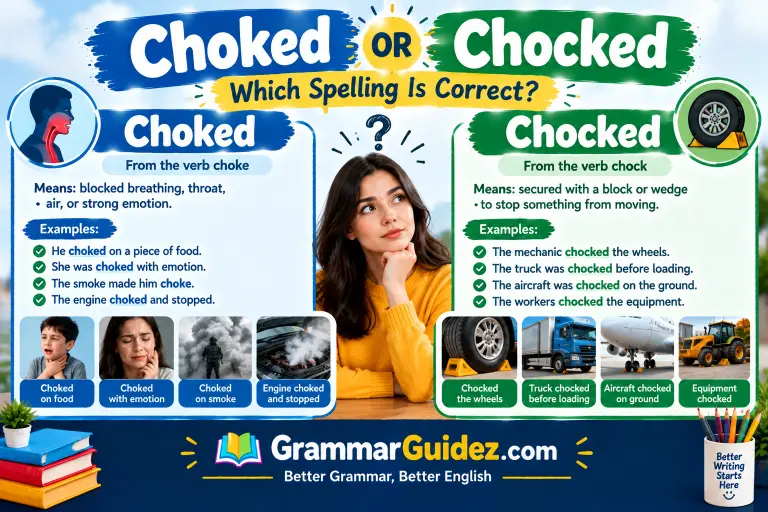
“Choked” and “Chocked” are both correct words, but they have different meanings. Choked means having difficulty breathing because something blocks the throat. It can also mean being very upset or unable to speak. Chocked means secured or blocked in place with a chock, usually to stop something from moving.
Are you confused about choked or chocked? Both words are correct, but they have different meanings.
Choked is the past tense and past participle of choke. It can mean having trouble breathing because something blocks the throat. It can also mean becoming unable to speak because of strong emotion.
Chocked is the past tense of chock. It means placing a block or wedge against something to stop it from moving. It is often used with wheels, vehicles, aircraft, and heavy equipment.
So, the simple difference is:
Choked = blocked breathing, throat, speech, or movement of air.
Chocked = stopped something from moving by using a block or wedge.
For example:
The man choked on a piece of food. ✅
He chocked the wheels of the truck. ✅
In this guide, we will explain choked or chocked, their meanings, differences, examples, common mistakes, and an easy way to remember which word to use.
Quick Answer: Choked or Chocked?
Both choked and chocked are correct English words.
Choked comes from the verb choke. It usually relates to breathing, the throat, air, speech, or strong emotion.
Chocked comes from the verb chock. It means securing something with a block or wedge so that it cannot move.
| Word | Base Verb | Main Meaning |
| Choked | choke | Block breathing, air, speech, or movement |
| Chocked | chock | Secure something with a block or wedge |
What Does Choked Mean?
Choked is the past tense and past participle of choke.
To choke can mean to have difficulty breathing because something blocks the throat.
For example:
The child choked on a piece of food.
Here, something entered the throat and made breathing difficult.
The word can also describe a person who cannot speak clearly because of strong emotion.
For example:
She choked with emotion.
In this sentence, the person is so emotional that speaking becomes difficult.
What Does Chocked Mean?
Chocked is the past tense and past participle of chock.
To chock something means to place a block, wedge, or similar object against it to stop it from moving.
This word is often used with vehicles and equipment.
For example:
The mechanic chocked the wheels.
This means the mechanic placed blocks against the wheels to keep the vehicle from moving.
Another example is:
The airplane was chocked before maintenance began.
Here, blocks were placed near the aircraft’s wheels to prevent movement.
Choked vs Chocked
The biggest difference is their meaning.
Choked is related to choke.
Chocked is related to chock.
| Feature | Choked | Chocked |
| Base word | Choke | Chock |
| Word type | Past tense/past participle | Past tense/past participle |
| Main idea | Block breathing or air | Stop movement |
| Common use | Food, throat, smoke, emotion | Wheels, vehicles, equipment |
| Example | He choked on food. | She chocked the wheels. |
Choked: Related to Breathing
One of the most common uses of choked is related to breathing.
When something blocks a person’s throat, they may choke.
For example:
He choked on a piece of bread.
The baby choked while eating.
She almost choked on her food.
In all these sentences, choked comes from choke.
Choked on Something
The phrase choked on is very common.
Use it when something causes a person to have trouble breathing or swallowing.
For example:
He choked on a piece of meat.
She choked on a small piece of candy.
The pattern is:
choked + on + something
Choked: Related to Emotion
A person may feel unable to speak because they are very sad, nervous, or emotional.
For example:
He was choked with emotion.
She became choked up during the speech.
The phrase choked up is common in everyday English.
It often means that strong feelings make it difficult for someone to speak normally.
Choked: Related to Smoke or Air
The word can also describe breathing problems caused by smoke, dust, or another substance.
For example:
The room filled with smoke, and everyone choked.
He choked because of the heavy smoke.
Here, choked is connected to breathing and air.
Choked: Related to Engines
Choke also has technical uses.
An engine can be described as choked when its air supply is restricted, depending on the type of engine and context.
You may also hear phrases such as:
The engine choked and stopped.
In everyday writing, however, the most common meanings of choked are related to breathing, swallowing, emotion, or something being blocked.
Chocked: Related to Wheels
The most common use of chocked is with wheels.
A chock is a block or wedge placed against a wheel to prevent movement.
For example:
The worker chocked the truck’s wheels.
Make sure the wheels are chocked before working under the vehicle.
Here, chocked means secured with wheel chocks.
Chocked: Vehicles and Equipment
Chocked is often used when working with vehicles or heavy equipment.
For example:
The tractor was properly chocked.
The mechanic chocked the vehicle before starting work.
The trailer wheels were chocked.
The purpose is to prevent unwanted movement.
Chocked: Aircraft
The word chocked is also common in aviation.
Aircraft can be secured with wheel chocks when they are parked or being serviced.
For example:
The aircraft was chocked before maintenance.
The crew checked that the aircraft wheels were chocked.
Again, the meaning is about preventing movement.
Choked or Chocked in a Sentence
Let’s compare the two words in simple sentences.
Choked
The boy choked on his food.
She choked with emotion.
He choked because of the smoke.
The engine choked and stopped.
She became choked up during the ceremony.
Chocked
The mechanic chocked the car wheels.
The truck was chocked before loading.
The aircraft was chocked on the ground.
The workers chocked the equipment.
Make sure the wheels are chocked.
Common Mistakes With Choked and Chocked
Because these words sound and look similar, people sometimes use them incorrectly.
Mistake 1: Using Choked for Wheels
Incorrect:
The mechanic choked the wheels. ❌
Correct:
The mechanic chocked the wheels. ✅
When you use a block or wedge to stop wheels from moving, use chocked.
Mistake 2: Using Chocked for Food
Incorrect:
He chocked on his food. ❌
Correct:
He choked on his food. ✅
When food blocks someone’s throat, use choked.
Mistake 3: Using Chocked for Emotion
Incorrect:
She was chocked with emotion. ❌
Correct:
She was choked with emotion. ✅
Strong emotion is connected with choke, not chock.
Mistake 4: Forgetting the Extra C
A useful spelling difference is:
choked = choke + d
chocked = chock + ed
The extra c in chocked comes from the base word chock.
Choke vs Chock
Understanding the base verbs makes the difference easier.
Choke
Choke means to block the throat or restrict breathing.
Examples:
Don’t talk while eating because you could choke.
Smoke can make people choke.
Chock
Chock means to secure something with a block or wedge.
Examples:
Chock the wheels before working on the vehicle.
The workers used blocks to chock the machine.
So remember:
Choke → breathing
Chock → blocking movement
Choked or Chocked: Easy Memory Trick
Here is a simple way to remember the difference.
Choked = Throat
Think of choked when you think about:
food + throat + breathing + emotion
He choked on the food.
Chocked = Chock Block
Think of chocked as using a chock or block.
They chocked the wheels.
A simple memory line is:
Choked affects breathing. Chocked stops movement.
This makes the difference much easier to remember.
Choked vs Chocked Pronunciation
The words choked and chocked are usually pronounced the same or very similarly in standard English.
They both commonly end with a /t/ sound.
This means pronunciation may not help you identify which spelling is correct.
The meaning and context are more important.
If you are writing about food or breathing, think choked.
If you are writing about wheels or securing equipment, think chocked.
Choked or Chocked in British and American English
Unlike many spelling differences such as color/colour or recognized/recognised, choked and chocked are not mainly British-versus-American spelling differences.
Both forms are used in standard English.
The important difference is their meaning, not the country where the English is used.
So you should not choose one based on American or British English.
Instead, choose the word that matches your meaning.
When Should You Use Choked?
Use choked when the meaning comes from choke.
Common contexts include:
- food
- throat
- breathing
- smoke
- emotion
- speech
- engines
Examples:
She choked on a piece of food.
He choked with emotion.
The smoke made him choke.
The engine choked and stopped.
When Should You Use Chocked?
Use chocked when the meaning comes from chock.
Common contexts include:
- car wheels
- truck wheels
- trailers
- aircraft
- heavy equipment
- machinery
Examples:
The truck was chocked.
The workers chocked the wheels.
The aircraft was chocked before maintenance.
Quick Comparison Examples
| Sentence | Correct Word | Why? |
| He ___ on the food. | choked | Food affected his throat/breathing |
| She was ___ with emotion. | choked | Strong emotion affected speech |
| The mechanic ___ the wheels. | chocked | Blocks stopped wheel movement |
| The truck was properly ___. | chocked | It was secured against movement |
| Smoke made him ___. | choke | Breathing was affected |
| The aircraft was ___. | chocked | Wheel movement was prevented |
Choked or Chocked: Practice Quiz
Choose choked or chocked.
1. He ______ on a piece of food.
Answer: choked
2. The mechanic ______ the car wheels.
Answer: chocked
3. She became ______ with emotion.
Answer: choked
4. The truck wheels were ______ before loading.
Answer: chocked
5. He nearly ______ because of the smoke.
Answer: choked
6. The aircraft was ______ before maintenance.
Answer: chocked
7. The child ______ while eating.
Answer: choked
8. The worker ______ the trailer wheels.
Answer: chocked
FAQs About Choked or Chocked
Is choked or chocked correct?
Both are correct words. Choked comes from choke and usually relates to breathing, the throat, air, or strong emotion. Chocked comes from chock and means secured with a block or wedge.
What is the difference between choked and chocked?
Choked means affected by choking or restricted breathing. Chocked means stopped from moving by placing a block or wedge against something.
Is “chocked” a real word?
Yes. Chocked is the past tense and past participle of chock.
Is “choked” the past tense of choke?
Yes. Choked is the simple past tense and past participle of choke.
Is it choked on food or chocked on food?
The correct phrase is choked on food.
For example:
He choked on his food.
Is it choked wheels or chocked wheels?
The correct phrase is chocked wheels when blocks or wedges are used to prevent the wheels from moving.
Is “chocked with emotion” correct?
No. The usual phrase is choked with emotion or choked up with emotion.
Is chocked a British spelling of choked?
No. Chocked is not simply a British spelling of choked. They come from two different verbs and have different meanings.
How can I remember choked and chocked?
Remember:
Choked = choke = breathing or emotion.
Chocked = chock = block or wedge used to stop movement.
Final Verdict: Choked or Chocked?
So, choked or chocked which word is correct?
Both are correct, but they are not interchangeable.
Use choked when you mean that someone has difficulty breathing, something blocks the throat, or strong emotion affects speech.
Use chocked when you mean that something is secured with a block or wedge to stop it from moving.
For example:
He choked on his food. ✅
The mechanic chocked the wheels. ✅
The easiest rule is:
Choked = breathing or emotion.
Chocked = blocks or wedges.
Once you understand the difference between choke and chock, choosing between choked and chocked becomes simple.
Read More Articles:

I am Elliot Hartwell, an English language writer and the author at GrammarGuidez.com. For the 6 years I have been working with English grammar, vocabulary, spelling and everyday language usage with a focus on making confusing topics easier to understand.
I started GrammarGuidez.com with a goal: to give readers clear and practical answers to common English questions. English can sometimes be confusing especially when two words look or sound similar but have meanings or uses. I enjoy breaking down these differences in a way that’s simple and easy to remember.
I believe learning English should feel simple not overwhelming. My goal is to make every article on GrammarGuidez.com useful, for students, writers, bloggers, teachers and anyone who wants to communicate clearly in English.