“Complain” and “Complaint” are both correct words, but they have different uses.
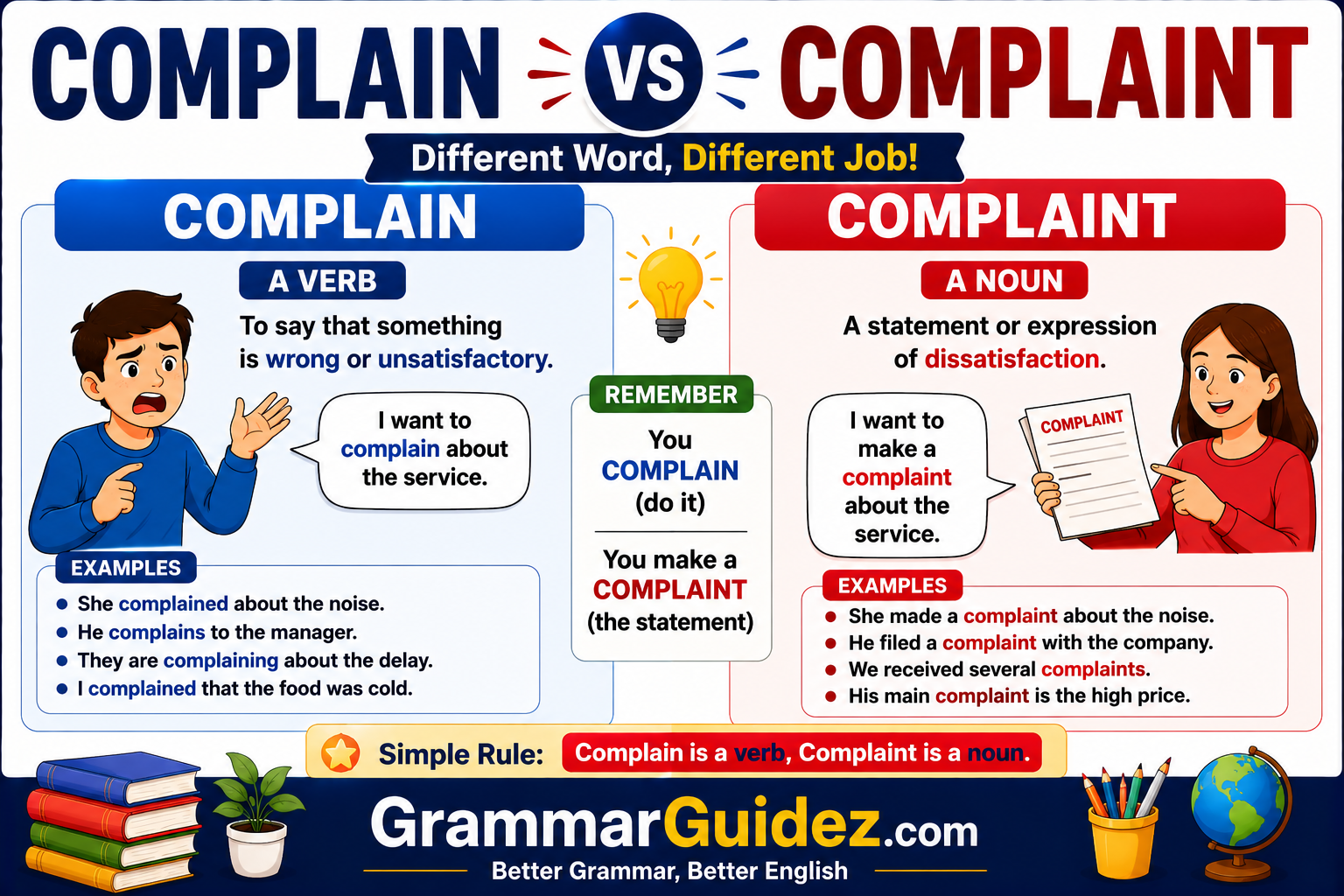
- Complain is a verb. It means to express dissatisfaction or say that something is wrong.
- Complaint is a noun. It means a statement or expression of dissatisfaction about something.
Complain and complaint look very similar, but they do different jobs in a sentence. This small difference can cause confusion for English learners, students, writers, and even native speakers.
The simple rule is:
Complain is a verb. Complaint is a noun.
You complain when you say that something is wrong, unfair, painful, annoying, or unsatisfactory. A complaint is the statement or problem that you make about that issue.
For example:
- I want to complain about the service.
- I made a complaint about the service.
Both sentences are correct, but their grammar is different.
In this guide, you will learn the difference between complain or complaint, how to use each word, common mistakes, useful examples, and an easy trick to remember the difference.
Quick Answer: Complain vs Complaint
| Word | Part of Speech | Meaning | Example |
| Complain | Verb | To say that something is wrong or unsatisfactory | She complained about the noise. |
| Complaint | Noun | A statement or expression of dissatisfaction | She made a complaint about the noise. |
So, if you need an action word, use complain.
If you need a thing, statement, or issue, use complaint.
Easy rule
You complain. You make a complaint.
That one sentence can help you remember the difference.
What Does “Complain” Mean?
Complain is a verb. It describes the action of saying that you are unhappy or dissatisfied with something.
You can complain about:
- bad service
- noise
- food
- a problem
- unfair treatment
- pain
- poor quality
- delays
- uncomfortable conditions
Examples of complain
- I often complain about the traffic.
- She complained about the cold weather.
- They complained to the manager.
- He complained that the food was cold.
- The students complained about the difficult test.
Notice that complain tells us what someone does.
Common patterns with “complain”
You will often see these structures:
complain about + noun
He complained about the noise.
complain to + person
She complained to the manager.
complain that + sentence
They complained that the room was too small.
You can also use complain of, especially when talking about pain, illness, or a problem.
The patient complained of severe pain.
What Does “Complaint” Mean?
Complaint is a noun.
It means a statement that says you are unhappy or dissatisfied with something. It can also mean the problem or issue itself.
For example:
The customer made a complaint about the service.
Here, complaint is the thing the customer made.
More examples:
- We received a complaint from a customer.
- She filed a complaint with the company.
- His complaint was about the poor service.
- The manager handled the complaint quickly.
- I have a complaint about this product.
Because complaint is a noun, it can come after words such as a, the, my, his, her, their, this, and that.
For example:
- a complaint
- the complaint
- my complaint
- her complaint
- their complaint
The Main Difference Between Complain and Complaint
The biggest difference is their part of speech.
Complain = verb
Complaint = noun
Compare these two sentences:
She complained about the food.
She made a complaint about the food.
In the first sentence, complained describes an action.
In the second sentence, complaint names the statement or issue.
This is similar to other verb-and-noun pairs in English.
| Verb | Noun |
| complain | complaint |
| explain | explanation |
| inform | information |
| discuss | discussion |
| decide | decision |
This pattern can help English learners understand why complain and complaint cannot always replace each other.
Complain or Complaint: Which One Should You Use?
Ask yourself one simple question:
Am I talking about an action or a thing?
If it is an action, use complain.
I want to complain about this problem.
If it is a thing, statement, or formal issue, use complaint.
I want to make a complaint about this problem.
Both sentences can express a similar idea, but their structures are different.
More examples
Verb:
Customers often complain about long waiting times.
Noun:
Customers often make complaints about long waiting times.
Verb:
He complained to the manager.
Noun:
He made a complaint to the manager.
Verb:
She is complaining about her job.
Noun:
Her main complaint is the long working hours.
“Complain” in Different Forms
Because complain is a verb, it can change according to tense.
| Form | Example |
| Complain | I complain when the service is poor. |
| Complains | She complains about everything. |
| Complained | He complained yesterday. |
| Complaining | They are complaining about the delay. |
The noun has its own forms:
| Form | Example |
| Complaint | I have a complaint. |
| Complaints | We received several complaints. |
Remember
Complain changes with tense.
Complaint changes mainly between singular and plural.
Common Mistakes With Complain and Complaint
English learners often make a few predictable mistakes with these words.
Mistake 1: Using “complaint” as a verb
❌ I will complaint about the service.
✅ I will complain about the service.
Complaint is a noun, so it cannot normally be used as the verb here.
Mistake 2: Using “complain” after “make”
❌ I want to make complain.
✅ I want to make a complaint.
The common expression is:
make a complaint
Because complaint is a noun, it works after make.
Mistake 3: Using “complain” after “a”
❌ I have a complain.
✅ I have a complaint.
After a, you need a noun.
I have a complaint.
Mistake 4: Forgetting “about”
❌ She complained the noise.
✅ She complained about the noise.
When you identify the thing causing dissatisfaction, complain about is very common.
He complained about the food.
Complain About or Complain To?
These two structures have different meanings.
Complain about
Use complain about for the problem or thing that makes you unhappy.
She complained about the service.
He complained about the noise.
Complain to
Use complain to for the person or organization that receives the complaint.
She complained to the manager.
He complained to the company.
You can use both together:
She complained to the manager about the service.
This sentence clearly tells us both who received the complaint and what the complaint was about.
Formal and Informal Examples
The word complain works in both everyday and formal English.
Everyday English
My brother always complains about the weather.
Stop complaining about everything.
She complained about the noisy neighbors.
Formal English
The customer complained about the poor service.
Several residents complained to the local authority.
The company received a formal complaint.
In formal situations, complaint is especially common when talking about an official report or written statement.
For example:
Please submit your complaint in writing.
Complain vs Complaint in Everyday English
Here are some natural examples that show the difference clearly.
At a restaurant
The customer complained about the cold food.
The restaurant received a complaint about the cold food.
At work
The employees complained about the long hours.
The manager received several complaints about the long hours.
At school
The students complained about the difficult homework.
The teacher listened to their complaints.
About a product
I want to complain about this product.
I want to make a complaint about this product.
A Simple Memory Trick
Here is an easy way to remember complain or complaint:
Complain = Do
Complain is something you do.
I complain.
She complained.
They are complaining.
Complaint = Thing
A complaint is something you make, file, receive, or submit.
make a complaint
file a complaint
receive a complaint
submit a complaint
So remember:
You complain, but you make a complaint.
This rule works in many everyday sentences.
Complain or Complaint: Comparison Chart
| Feature | Complain | Complaint |
| Part of speech | Verb | Noun |
| Main idea | The action of expressing dissatisfaction | The expression or issue |
| Can use “a”? | Usually no | Yes |
| Example | I complain about the food. | I made a complaint. |
| Past form | complained | complaint |
| Plural | — | complaints |
| Common pattern | complain about | make a complaint |
| Common formal use | complain to someone | file/submit a complaint |
Can “Complaint” Be Plural?
Yes.
The plural form of complaint is complaints.
Examples:
We received three complaints.
The company is dealing with several complaints.
Customer complaints increased last month.
Do not confuse complaints with complains.
- complaints = plural noun
- complains = third-person singular verb
Compare:
She complains about the food.
Her complaints are about the food.
This is an important spelling difference.
Complain vs Complaints vs Complains
These three forms can look confusing.
Complain
Base verb:
I complain about the noise.
Complains
Third-person singular verb:
He complains about the noise.
Complaint
Singular noun:
He made a complaint.
Complaints
Plural noun:
He made several complaints.
Quick comparison
I complain.
She complains.
She made a complaint.
Short Quiz: Choose the Correct Word
Choose complain, complains, complaint, or complaints.
- I want to ______ about the poor service.
- She always ______ about her job.
- We received a formal ______.
- The customers made several ______.
- He decided to ______ to the manager.
- Her main ______ was the high price.
Answers
- complain
- complains
- complaint
- complaints
- complain
- complaint
Why?
Remember:
Complain/complains = verbs
Complaint/complaints = nouns
FAQs
Is “complain” a noun or a verb?
Complain is a verb. It means to express dissatisfaction or say that something is wrong.
She complained about the service.
Is “complaint” a noun or a verb?
Complaint is a noun.
I made a complaint about the service.
Is it “make a complain” or “make a complaint”?
The correct phrase is make a complaint.
I want to make a complaint.
Is it “I complaint” or “I complain”?
The correct sentence is:
I complain.
Complain is the verb.
What is the difference between “complain” and “complaint”?
Complain is a verb that describes the action of expressing dissatisfaction. Complaint is a noun that refers to the statement, issue, or expression of dissatisfaction.
Can I say “complain about”?
Yes. Complain about is a very common structure.
She complained about the noise.
Can I say “complain to”?
Yes. Use complain to when you identify the person or organization you speak to.
He complained to the manager.
Conclusion
The difference between complain or complaint is simple once you understand their grammar roles.
Complain is a verb. It describes the action of expressing dissatisfaction.
I complained about the service.
Complaint is a noun. It refers to the statement, issue, or expression of dissatisfaction.
I made a complaint about the service.
The easiest rule is:
You complain. You make a complaint.
Also remember the related forms:
- complain = verb
- complains = verb
- complained = past-tense verb
- complaining = -ing form
- complaint = singular noun
- complaints = plural noun
Once you remember “complain = action” and “complaint = thing,” choosing the correct word becomes much easier. This small grammar rule can help you write clearer emails, conversations, school assignments, and formal requests.

I am Evan Whitmore, an English language writer and the person who started GrammarGuidez.com. I made GrammarGuidez.com to make grammar, spelling, vocabulary and words that are often confused easier to understand.
I like taking to understand English words and grammar rules and turning them into simple and clear explanations. My aim is to help students, writers, bloggers, ESL learners and regular English speakers feel more sure when they write and talk.
At GrammarGuidez.com I work on real life examples easy to understand explanations comparing words, spelling changes and how American English is used every day.
I think learning English doesn’t need to be hard. A good explanation and some good examples can make tough grammar topics much simpler to learn