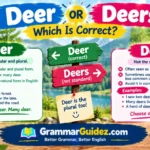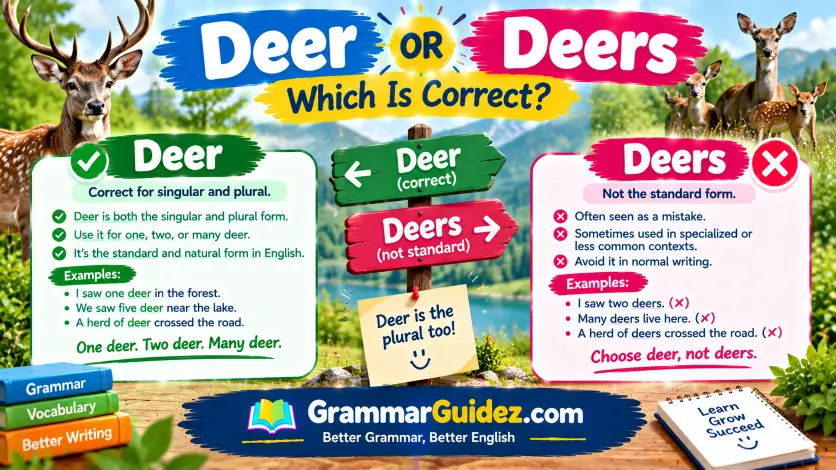
“Deer” is the standard word, while “deers” is generally not used in standard English. Deer a hoofed animal. It is used for both one deer and more than one deer. Deers generally incorrect when you mean the plural of “deer.”
Deer or deers? If you want to talk about more than one deer, which word should you use?
The answer is simple:
Deer is the standard plural form of deer.
You can say:
I saw one deer in the forest.
and:
I saw five deer in the forest.
The noun does not change.
This may seem unusual because many English nouns form their plural by adding -s or -es. For example:
- one dog → two dogs
- one tree → two trees
- one horse → two horses
But:
- one deer → two deer
Deers is sometimes found in specialized or uncommon usage, including references to different species, but it is not the normal plural form for everyday English. For ordinary writing, use deer.
Quick Answer: Deer or Deers?
Deer is the standard plural of deer.
| Form | Usage | Example |
| deer | Singular | I saw a deer. |
| deer | Plural | I saw five deer. |
| deers | Rare/specialized usage | Usually avoid it in ordinary writing. |
So:
✅ One deer
✅ Two deer
✅ Many deer
❌ Two deers
The safest rule is:
Deer is both singular and plural.
Why Is the Plural of Deer “Deer”?
The word deer is an example of an unchanged plural, also called a zero plural.
This means the noun keeps the same form when it changes from singular to plural.
Look at the pattern:
one deer → many deer
The spelling stays exactly the same.
Other familiar examples include:
- one sheep → two sheep
- one moose → two moose
- one aircraft → two aircraft
This is one of the unusual but established patterns in English grammar.
The important thing is not to add -s just because most English nouns use it.
How Can You Tell if “Deer” Is Singular or Plural?
The word itself does not tell you.
You need to look at the words around it.
Singular
A deer is standing near the road.
The word a and the verb is show that we mean one animal.
Plural
Three deer are standing near the road.
The number three and the verb are show that we mean more than one.
Compare:
| Singular | Plural |
| a deer | three deer |
| one deer | many deer |
| this deer | these deer |
| that deer | those deer |
| the deer is | the deer are |
This is one of the easiest ways to understand the grammar.
“Deer Is” or “Deer Are”?
Both can be correct.
It depends on if deer is singular or plural in the sentence.
Use “deer is” for one animal
The deer is eating grass.
A deer is standing outside.
That deer is very young.
Use “deer are” for multiple animals
The deer are eating grass.
Several deer are crossing the road.
Those deer are moving toward the forest.
The noun remains deer, but the verb changes.
Easy rule
One deer → is
More than one deer → are
Is “Deers” Ever Correct?
This is where the answer needs a little more detail.
For normal modern English, deer is the form you should use for both singular and plural.
However, deers does appear occasionally in English, especially in specialized contexts or when writers are referring to different types or species. Some English usage sources also record it as a rare alternative plural.
That does not mean you should normally write:
I saw five deers.
For ordinary English, write:
I saw five deer.
If your meaning is specifically about different kinds or species, a clearer phrase is usually:
several species of deer
or:
different types of deer
This is clearer than using deers in most situations.
Deer or Deers for Different Species?
Suppose you are talking about different kinds of deer.
You may see deers in specialized writing, but everyday English normally uses deer with a phrase such as species of.
For example:
There are several species of deer in the region.
This is clear and natural.
You can also say:
The zoo has several types of deer.
Instead of forcing the plural form:
different deers
For general readers, species of deer is usually the clearer choice.
Deer in American and British English
There is no important American-versus-British spelling difference here.
Both varieties normally use:
deer → deer
Cambridge’s British and American dictionary entries both list deer as the plural.
Comparison
| English variety | Singular | Plural |
| American English | deer | deer |
| British English | deer | deer |
| Canadian English | deer | deer |
| Australian English | deer | deer |
So deers is not an American spelling and deer is not a British spelling.
The standard form remains deer.
Deer as a General Animal Name
Sometimes deer is used to talk about the animal generally, rather than one particular animal.
For example:
Deer live in many different habitats.
Here, deer refers to deer as a group or animal type.
Another example:
Deer often feed on grass, leaves, and other plants.
The word does not need an -s even though the sentence discusses animals generally.
A Herd of Deer
A common collective phrase is:
a herd of deer
Examples:
We saw a herd of deer near the forest.
A large herd of deer crossed the road.
The park is home to a herd of deer.
Notice that we do not say:
❌ a herd of deers
We say:
✅ a herd of deer
The word herd already tells us that we are talking about a group.
Common Deer Vocabulary
Knowing related deer words can make your writing more accurate.
Doe
A doe is a female deer.
The doe moved quietly through the forest.
Buck
A buck is commonly used for a male deer.
A large buck stood near the trees.
Stag
A stag is commonly used for an adult male deer, especially in certain varieties of English and contexts.
The stag had large antlers.
Fawn
A fawn is a young deer.
We saw a fawn beside its mother.
Herd
A herd is a group of deer.
A herd of deer crossed the field.
These words can help you be more specific without trying to create unusual plurals.
Deer and Reindeer
Another interesting point is reindeer.
The plural of reindeer is also:
reindeer
For example:
One reindeer was standing outside.
Ten reindeer were pulling the sleigh.
Cambridge lists reindeer as both the singular and plural form.
So:
one reindeer → two reindeer
not:
❌ two reindeers
This follows a similar unchanged-plural pattern.
Deer and Compound Expressions
You will often see deer before another noun.
Examples include:
- deer population
- deer habitat
- deer hunting
- deer season
- deer meat
- deer antlers
- deer park
- deer tracks
- deer crossing
- deer management
Examples
The deer population has increased.
We studied the local deer habitat.
The road has a deer crossing sign.
Notice that deer does not become deers when it modifies another noun.
Common Mistake: “Two Deers”
This is probably the most common mistake with this word.
❌ We saw two deers.
✅ We saw two deer.
Why?
Because deer already has an unchanged plural form.
The number two tells us that more than one animal is meant.
More examples
❌ Three deers were running.
✅ Three deer were running.
❌ Many deers live in this forest.
✅ Many deer live in this forest.
❌ Several deers crossed the road.
✅ Several deer crossed the road.
Common Mistake: “Many Deer Is”
Another mistake is using the singular verb with a plural meaning.
❌ Many deer is grazing in the field.
✅ Many deer are grazing in the field.
Why?
Many indicates more than one.
Therefore:
Many deer are…
not:
Many deer is…
Common Mistake: “A Deer Are”
The opposite mistake also happens.
❌ A deer are standing near the road.
✅ A deer is standing near the road.
The word a means one.
Therefore:
A deer is…
Common Mistake: “These Deer Is”
The word these is plural.
So it needs a plural verb.
❌ These deer is beautiful.
✅ These deer are beautiful.
Compare:
This deer is beautiful.
These deer are beautiful.
The noun stays the same, but the demonstrative and verb change.
Deer Possessive Forms
Possessives can create another small area of confusion.
One deer
For one deer, use:
deer’s
Example:
The deer’s antlers were large.
This means the antlers belong to one deer.
More than one deer
Because the plural is deer, the plural possessive is:
deer’
Example:
The deer’ habitat was protected.
However, this form can look unusual, and writers often choose a clearer construction such as:
The habitat of the deer was protected.
When precision matters, rewriting the sentence can make the meaning easier to understand.
Deer or Deers: Which One Should Students Use?
For school, college, exams, articles, emails, and normal English writing, use:
deer
Examples
We saw five deer in the park.
Several deer live in the forest.
The deer were moving toward the river.
A deer was standing beside the road.
This is the standard form learners should remember.
Deer or Deers in Formal Writing
In formal writing, deer is the safest choice for both singular and plural.
Academic example
Researchers observed several deer in the study area.
Report example
The number of deer in the region has increased.
News example
Several deer were spotted near the highway.
Business or public notice
Drivers should watch for deer crossing the road.
The word remains unchanged.
Deer or Deers in Everyday Conversation
The same rule applies in everyday English.
You would normally say:
Look! There are three deer!
Not:
Look! There are three deers!
You might also hear:
We saw a lot of deer today.
There were deer everywhere.
That deer is huge!
These are natural examples of the unchanged plural.
Why Does English Have Words Like Deer?
English does not use one single plural rule for every noun.
Although -s is very common, English has several other plural patterns.
For example:
| Singular | Plural |
| deer | deer |
| sheep | sheep |
| moose | moose |
| child | children |
| mouse | mice |
| person | people |
| tooth | teeth |
Deer belongs to the group where the plural form remains unchanged.
This is why:
one deer → many deer
is not a mistake or missing letter.
It is the normal grammatical pattern.
A Simple Decision Test
If you are unsure if to write deer or deers, ask yourself:
Am I talking about one animal?
Use:
deer
I saw a deer.
Am I talking about several animals?
Still use:
deer
I saw five deer.
Am I talking about different species?
Use a clearer phrase such as:
species of deer
Several species of deer live in the area.
For normal writing, this three-step test makes the answer easy.
Deer vs. Deers: Side-by-Side Examples
| Incorrect or Unusual | Better Standard English |
| I saw two deers. | I saw two deer. |
| Many deers live here. | Many deer live here. |
| Several deers crossed the road. | Several deer crossed the road. |
| The deers are grazing. | The deer are grazing. |
| One deers was nearby. | One deer was nearby. |
| These deers are young. | These deer are young. |
| A herd of deers appeared. | A herd of deer appeared. |
| Five deers were in the field. | Five deer were in the field. |
Quick Grammar Patterns to Memorize
Singular
a + deer + is
A deer is nearby.
Plural
number + deer + are
Five deer are nearby.
Quantity
many/several/few + deer
Several deer were grazing.
Group
a herd of + deer
A herd of deer crossed the road.
General meaning
deer + plural verb
Deer are common in this region.
Once you learn these patterns, you will rarely need to think about deers again.
Quick Quiz: Deer or Deers?
Choose the correct form.
1. I saw three ___ near the lake.
A. deer
B. deers
2. A ___ was standing near the road.
A. deer
B. deers
3. Several ___ crossed the field.
A. deer
B. deers
4. The ___ are eating grass.
A. deer
B. deers
5. There is a herd of ___ in the forest.
A. deer
B. deers
Answers
- deer ✅
- deer ✅
- deer ✅
- deer ✅
- deer ✅
The answer does not change.
Deer is used for both singular and plural.
Fill in the Blanks
Complete each sentence with deer or deers.
- We saw five ______ in the forest.
- A ______ was standing beside the road.
- Many ______ live in this area.
- The ______ were moving toward the trees.
- A herd of ______ crossed the road.
- This ______ is very young.
- Those ______ are running quickly.
- Several species of ______ live in the region.
Answers
- deer
- deer
- deer
- deer
- deer
- deer
- deer
- deer
FAQs
Is “deer” singular or plural?
Deer can be both singular and plural.
One deer.
Five deer.
The form does not change.
Is “deers” correct?
For ordinary modern English, deer is the standard plural and is the form you should normally use. Deers can appear in rare or specialized usage, but it is not the normal choice for everyday writing.
What is the plural of deer?
The standard plural of deer is deer. Cambridge lists deer as the plural in both British and American English.
Is it “two deer” or “two deers”?
The standard form is:
two deer
Not:
two deers
Is it “many deer” or “many deers”?
Use:
many deer
Is “deer are” correct?
Yes, when deer refers to more than one animal.
The deer are running.
Is “deer is” correct?
Yes, when deer refers to one animal.
The deer is eating.
What is a group of deer called?
A group of deer is commonly called a herd of deer.
What is a female deer called?
A female deer may be called a doe or hind, depending on the species and context.
What is a male deer called?
A male deer may be called a buck or stag, depending on the species and context.
What is a baby deer called?
A young deer is commonly called a fawn.
Is “deers” American or British?
It is not a standard American-versus-British spelling difference. Both British and American English normally use deer as the plural.
What is the plural of reindeer?
The plural of reindeer is reindeer.
One reindeer → several reindeer.
Final Verdict: Deer or Deers?
If you are talking about more than one animal, the standard answer is:
✅ deer
The word stays the same:
one deer → two deer → many deer
Do not add -s simply because most English nouns use -s for their plural.
The word deers can be encountered in rare or specialized contexts, but it is not the normal plural you should choose in everyday English.
Remember This Rule
Deer = singular and plural
So:
- One deer ✅
- Two deer ✅
- Many deer ✅
- Several deer ✅
- A herd of deer ✅
- Two deers ❌
- Many deers ❌
Once you remember that deer is an unchanged plural, this common grammar question becomes very easy.
Read More Articles:

I am Evan Whitmore, an English language writer and the person who started GrammarGuidez.com. I made GrammarGuidez.com to make grammar, spelling, vocabulary and words that are often confused easier to understand.
I like taking to understand English words and grammar rules and turning them into simple and clear explanations. My aim is to help students, writers, bloggers, ESL learners and regular English speakers feel more sure when they write and talk.
At GrammarGuidez.com I work on real life examples easy to understand explanations comparing words, spelling changes and how American English is used every day.
I think learning English doesn’t need to be hard. A good explanation and some good examples can make tough grammar topics much simpler to learn