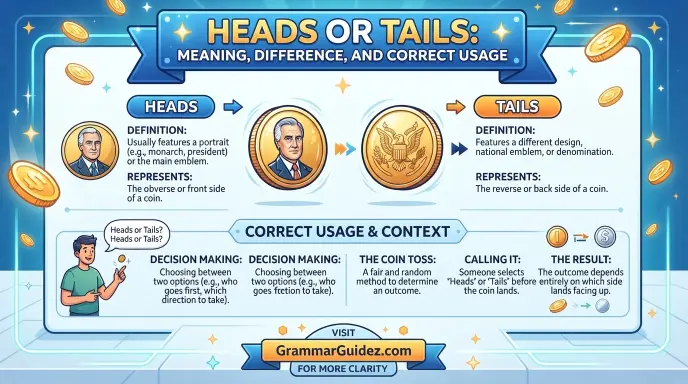
“Heads” and “tails” are both correct words, but they have different meanings when referring to a coin. “Heads” is the side of a coin that usually shows a person’s head or symbol, while “tails” refers to the opposite side of the coin.
Heads or tails? This is a very common English phrase connected with coins, decisions, and chance.
When a coin is tossed into the air, it can land on one of two sides:
Heads = the side of the coin showing a person’s head or portrait
Tails = the other side of the coin
People often toss a coin when they need to make a simple decision between two choices.
For example:
Let’s toss a coin. Heads, we go to the park. Tails, we stay home.
The phrase heads or tails can also appear in everyday English expressions. For example, someone may say:
I can’t make heads or tails of this report.
This does not mean they are talking about a coin. It means they cannot understand something.
In this guide, you will learn the difference between heads and tails, how coins use these terms, common expressions, examples, common mistakes, and easy ways to remember them.
Heads or Tails: Quick Answer
The simplest difference is:
| Word | Meaning on a Coin |
| Heads | The side showing a head or portrait |
| Tails | The opposite side of the coin |
Example
The coin landed on heads.
This means it landed on the side with the head or portrait.
The coin landed on tails.
This means it landed on the opposite side.
The two words are commonly used when tossing a coin.
What Does Heads Mean?
Heads is the side of a coin that usually shows:
- a person’s head
- a portrait
- a face
- an important national figure
For example:
He called heads before the coin was tossed.
The coin landed on heads.
I choose heads.
The exact design depends on the country and the coin.
However, heads generally refers to the side traditionally associated with a portrait or head.
What Does Tails Mean?
Tails refers to the opposite side of a coin.
It is the side that is not called heads.
The tails side may show:
- a symbol
- an animal
- a building
- a national design
- a number
- another image
Examples
The coin landed on tails.
She chose tails.
It was heads on the first toss and tails on the second.
The design of the tails side can vary from one coin to another.
Heads vs. Tails: The Main Difference
The main difference is simply which side of a coin you are talking about.
| Heads | Tails |
| Usually shows a portrait or head | The opposite side |
| One side of a coin | The other side |
| Often chosen during a coin toss | Often chosen during a coin toss |
| Example: “I choose heads” | Example: “I choose tails” |
The easiest way to remember is:
Heads = head side
Tails = the other side
Why Do People Say “Heads or Tails”?
People say heads or tails before tossing a coin.
Usually, two people have two different choices.
One person chooses:
Heads
The other person gets:
Tails
Then the coin is tossed.
The result can help make a random decision.
Example
Person 1: Heads or tails?
Person 2: Heads.
Person 1 tosses the coin.
The coin lands on heads.
Person 2 wins the toss.
Heads or Tails for Making Decisions
A coin toss is often used when two choices seem equally acceptable.
Examples
Heads, we order pizza. Tails, we cook at home.
Heads, you drive. Tails, I drive.
Heads, we watch a movie. Tails, we play a game.
This method uses chance to make a decision.
What Does “Call Heads or Tails” Mean?
To call heads or tails means to choose one side before the coin lands.
Examples
She called heads.
He called tails.
The captain called heads before the toss.
The word call here means:
To announce your choice.
For example:
I call heads!
means:
My choice is heads.
What Does “Heads or Tails” Mean in Sports?
A coin toss is often used before sporting events.
It may help decide things such as:
- which team starts first
- which team chooses a side
- which team receives first
- who gets the first choice
One captain may choose:
Heads
or:
Tails
Then the coin is tossed.
The result determines the winner of the toss.
Heads or Tails: A Simple Example
Imagine that Ali and Ahmed cannot decide who will go first.
Ali says:
I choose heads.
Ahmed automatically gets:
Tails.
They toss a coin.
If the coin lands on heads:
Ali wins.
If the coin lands on tails:
Ahmed wins.
This is one of the simplest uses of heads or tails.
Can a Coin Land on Its Edge?
In theory, a coin can land on its edge.
However, this is extremely unusual compared with landing on one of its two main sides.
In everyday conversation, a coin toss normally has two expected results:
Heads
or:
Tails
That is why the phrase heads or tails is strongly associated with two possible choices.
“Heads or Tails” as an Expression
The words heads or tails can also appear in an English idiom.
The common expression is:
Make heads or tails of something
This means:
To understand something.
It is often used in negative sentences.
Examples
I can’t make heads or tails of these instructions.
This means:
I cannot understand these instructions.
Another example:
Can you make heads or tails of this report?
Meaning:
Can you understand this report?
“Can’t Make Heads or Tails of It” Meaning
This phrase is very common.
I can’t make heads or tails of it.
It means:
I cannot understand it.
Examples
This map is confusing. I can’t make heads or tails of it.
I can’t make heads or tails of his explanation.
The document was so unclear that nobody could make heads or tails of it.
Here, the phrase has nothing to do with actually tossing a coin.
It is an idiomatic expression.
Heads and Tails Are Not Always About Coins
The words head and tail have other meanings in English.
Head
Head can mean:
- a body part
- a leader
- the top part of something
- the beginning of something
Example
She hurt her head.
Tail
Tail can mean:
- the rear part of an animal
- the end part of something
- the final part of a line or object
Example
The dog wagged its tail.
However, when discussing a coin, heads and tails have specific meanings.
Common Mistake
Common Mistake 1: Writing “Tials” Instead of “Tails”
The correct spelling is:
Tails
Incorrect:
❌ Tials
Correct:
✅ Tails
The word comes from:
tail
The plural form is:
tails
So the correct phrase is:
Heads or tails
Common Mistake 2: Saying “Head or Tail” During a Coin Toss
You may hear the singular words head and tail in other contexts.
However, the traditional phrase for a coin toss is:
Heads or tails
Examples:
Correct: Heads or tails?
Correct: I choose heads.
Correct: The coin landed on tails.
Common Mistake 3: Using “Heads and Tails” When You Mean a Choice
When asking someone to choose before a coin toss, English normally uses:
Heads or tails?
The word or is important because the person chooses one option.
Heads or tails?
However, heads and tails may be used when discussing both sides of a coin.
Example
The coin has heads and tails.
Heads or Tails vs. Heads and Tails
These phrases have slightly different uses.
Heads or Tails
Use this when asking someone to choose.
Heads or tails?
Which do you choose: heads or tails?
Heads and Tails
Use this when referring to both sides together.
A coin has heads and tails.
This is a small but useful difference.
Is It Heads or Tails or Heads or Tails?
The correct phrase is:
Heads or tails
Both words are normally written in lowercase unless they begin a sentence or appear in a title.
Normal sentence
He chose heads or tails before the toss.
Beginning of a sentence
Heads or tails is a common coin-toss question.
Heads or Tails: Which One Should You Choose?
There is no guaranteed best choice in a normal coin toss.
You can choose:
Heads
or:
Tails
The choice is generally random.
Many people have a personal preference.
For example:
I always choose heads.
Another person may say:
I prefer tails.
Both choices are normal.
Heads or Tails in Everyday Sentences
Example 1
Let’s toss a coin. Heads or tails?
This asks someone to choose one side.
Example 2
I call heads.
This means:
I choose the heads side.
Example 3
She called tails.
This means:
She chose tails before the toss.
Example 4
The coin landed on heads.
The portrait side won the toss.
Example 5
The coin landed on tails.
The opposite side won the toss.
Example 6
I can’t make heads or tails of this message.
This means:
I cannot understand this message.
Common Expressions Related to Heads and Tails
Call Heads
I call heads.
Meaning:
I choose heads before the coin is tossed.
Call Tails
He called tails.
Meaning:
He chose tails.
Toss a Coin
Let’s toss a coin.
Meaning:
Let’s use a coin to make a random decision.
Land on Heads
The coin landed on heads.
Meaning:
Heads was the result.
Land on Tails
It landed on tails.
Meaning:
Tails was the result.
Make Heads or Tails of Something
I can’t make heads or tails of this.
Meaning:
I cannot understand this.
The Context Test
When using heads or tails, ask what you mean.
Are You Tossing a Coin?
Use:
Heads or tails
Example:
Heads or tails?
Are You Choosing One Option?
Use:
Heads or tails
Example:
Choose heads or tails.
Are You Talking About Both Sides?
Use:
Heads and tails
Example:
The coin has heads and tails.
Are You Talking About Understanding Something?
Use:
Make heads or tails of
Example:
I can’t make heads or tails of this report.
Heads or Tails: Quick Comparison Table
| Situation | Correct Expression |
| Asking someone to choose | Heads or tails? |
| Choosing the first side | I call heads |
| Choosing the second side | I call tails |
| Talking about both sides | Heads and tails |
| Tossing a coin | Toss a coin |
| Unable to understand | Can’t make heads or tails of it |
Easy Memory Trick
Remember:
Head = the head or portrait side
Tail = the opposite side
For the spelling:
Tail → Tails
So the correct phrase is:
Heads or tails
Not:
❌ Heads or tials
Quick Quiz: Heads or Tails?
Choose the correct answer.
1. The side with a portrait is usually called:
A. Heads
B. Tails
Answer: Heads
2. The opposite side is called:
A. Heads
B. Tails
Answer: Tails
3. Before tossing a coin, you can ask:
A. Heads or tails?
B. Heads or tials?
Answer: Heads or tails?
4. “I can’t make heads or tails of it” means:
A. I cannot understand it.
B. I cannot find a coin.
Answer: I cannot understand it.
Fill in the Blanks
Choose the correct word.
- I choose ______ before the coin is tossed.
- The coin landed on ______.
- Do you want heads or ______?
- I can’t make heads or ______ of this explanation.
- Let’s ______ a coin to decide.
Answers
- heads
- heads or tails
- tails
- tails
- toss
FAQs
What does heads or tails mean?
Heads or tails refers to the two main sides of a coin. It is commonly used when tossing a coin to make a random decision.
Is it heads or tails or heads or tials?
The correct spelling is:
Heads or tails
Tials is not the correct spelling in this phrase.
What does heads mean on a coin?
Heads usually refers to the side of a coin showing a person’s head, portrait, or similar design.
What does tails mean on a coin?
Tails refers to the side opposite the heads side.
Why do people toss a coin?
People toss a coin to make a random choice between two options.
One person may choose heads, while the other gets tails.
What does “I call heads” mean?
It means:
I choose heads before the coin is tossed.
What does “make heads or tails of it” mean?
It means:
To understand something.
For example:
I can’t make heads or tails of these instructions.
means:
I cannot understand these instructions.
Is it heads and tails or heads or tails?
Both can be correct, depending on the meaning.
Use heads or tails when asking someone to choose.
Use heads and tails when talking about both sides of a coin.
Conclusion
Heads and tails are the names commonly used for the two sides of a coin.
Use:
Heads
for the side traditionally associated with a head or portrait.
Use:
Tails
for the opposite side.
Before tossing a coin, people commonly ask:
Heads or tails?
This allows someone to choose one of two possible outcomes.
Remember that the correct spelling is:
✅ Heads or tails
Not:
❌ Heads or tials
The phrase also appears in the idiom:
Make heads or tails of something
which means:
To understand something.
So if you are talking about a coin toss or a confusing situation, understanding the context will help you use heads or tails correctly.
Read More Articles:
- To or Too: Difference and Usage
- Then or Than: Which Is Correct?
- Wane or Wain: What’s the Difference?

I am Evan Whitmore, an English language writer and the person who started GrammarGuidez.com. I made GrammarGuidez.com to make grammar, spelling, vocabulary and words that are often confused easier to understand.
I like taking to understand English words and grammar rules and turning them into simple and clear explanations. My aim is to help students, writers, bloggers, ESL learners and regular English speakers feel more sure when they write and talk.
At GrammarGuidez.com I work on real life examples easy to understand explanations comparing words, spelling changes and how American English is used every day.
I think learning English doesn’t need to be hard. A good explanation and some good examples can make tough grammar topics much simpler to learn