Wane or wain? These two English words look very similar, but they have completely different meanings and uses.
The main difference is simple:
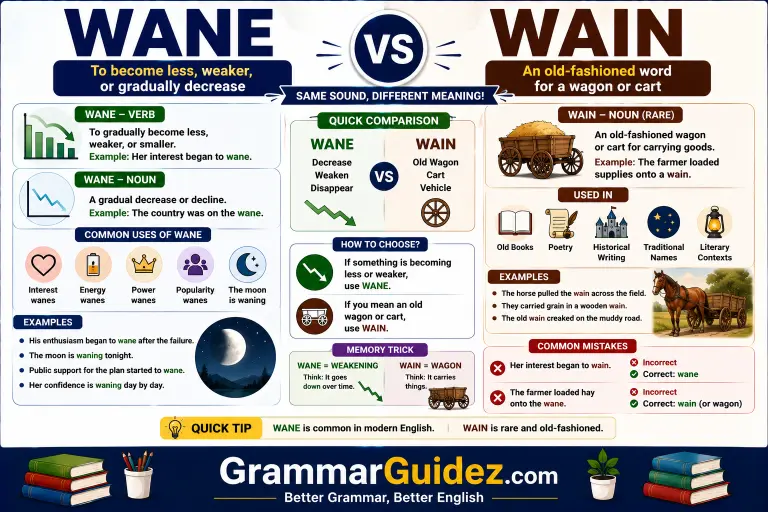
Wane = to become smaller, weaker, or less important
Wain = an old-fashioned word for a wagon or cart
For example:
Her interest in the project began to wane.
Here, wane means to gradually become weaker or less.
Now look at this:
The farmer loaded the supplies onto a wain.
Here, wain means a wagon or cart.
Although these words differ by only one letter, they are not interchangeable. Wane is much more common in modern English, while wain is now rare and usually appears in historical, literary, or traditional contexts.
This guide explains the difference between wane or wain, including meanings, pronunciation, examples, grammar, common expressions, mistakes, and easy memory tricks.
Wane or Wain: Quick Answer
| Word | Meaning | Common Use |
| Wane | To decrease or become weaker | Modern English |
| Wane | A gradual decrease | Common |
| Wain | An old-fashioned wagon or cart | Rare and literary |
Examples
His energy began to wane.
The moon is waning.
The old wain carried supplies across the field.
The easiest rule is:
Decrease or become weaker → Wane
Old wagon or cart → Wain
What Does Wane Mean?
Wane usually means:
To gradually become less, weaker, smaller, or less important.
It can describe many things, including:
- interest
- energy
- power
- influence
- confidence
- popularity
- light
Examples
Her interest began to wane.
Public support started to wane.
His energy was waning.
Their influence continued to wane.
In all of these examples, something gradually becomes less strong or less noticeable.
Wane as a Verb
The most common use of wane is as a verb.
Examples
My excitement began to wane.
The company’s popularity may wane over time.
His confidence started to wane.
The pain gradually waned.
The word often describes a slow change rather than something that happens immediately.
For example:
His interest disappeared.
This suggests the interest may have ended completely.
But:
His interest waned.
This suggests the interest gradually became weaker.
Wane as a Noun
Wane can also be used as a noun.
As a noun, it refers to:
A gradual decrease or decline.
This use is less common than the verb form.
Example
The country was on the wane.
This means its power or influence was decreasing.
The opposite expression is:
On the wane = decreasing
On the increase = increasing
What Does Wain Mean?
Wain is an old-fashioned word for:
A wagon or cart.
It usually refers to a large vehicle used to carry goods, especially in older agricultural or rural settings.
Examples
The farmer drove the wain through the field.
The old wain carried hay.
Supplies were loaded onto a wooden wain.
In modern everyday English, people usually say:
wagon
or:
cart
instead of wain.
Is Wain Common in Modern English?
No. Wain is relatively rare in modern everyday English.
You are more likely to see it in:
- old books
- poetry
- historical writing
- traditional stories
- names
- astronomical expressions
For normal modern writing, use wagon if you mean a vehicle for carrying goods.
For example, instead of:
The farmer loaded hay onto a wain.
Modern everyday English would usually say:
The farmer loaded hay onto a wagon.
Wane vs. Wain: The Main Difference
The biggest difference is their meaning.
Wane
Think about something becoming:
- weaker
- smaller
- less important
- less powerful
Example:
Her enthusiasm began to wane.
Wain
Think about:
- a wagon
- a cart
- an old vehicle
Example:
The farmer’s wain was full of hay.
The Moon and Wane
One of the most common uses of wane is when talking about the moon.
When the visible part of the moon gradually becomes smaller, the moon is described as:
Waning
Example
The moon is waning.
The opposite is:
Waxing
A waxing moon appears to become larger.
A waning moon appears to become smaller.
Easy Comparison
Waxing = increasing
Waning = decreasing
Wane and the Moon: An Easy Example
Imagine the moon becoming less visible each night.
You can say:
The moon begins to wane.
This is one of the clearest ways to remember the meaning of wane.
Think:
Wane = gradually becoming less
Wane in Everyday English
Although wane is often associated with the moon, it can describe many other things.
Interest
His interest in the game began to wane.
Meaning:
He gradually became less interested.
Energy
My energy started to wane after a long day.
Meaning:
I gradually became more tired.
Popularity
The singer’s popularity began to wane.
Meaning:
The singer gradually became less popular.
Confidence
Her confidence started to wane.
Meaning:
She gradually became less confident.
Power
The leader’s influence continued to wane.
Meaning:
The leader gradually became less powerful or influential.
Wain in Historical English
A wain was traditionally a large wagon used for carrying heavy materials.
It could carry things such as:
- hay
- crops
- wood
- supplies
Example
The farmer loaded the harvest onto the wain.
Because modern vehicles and transportation have changed, wain is now rarely used in everyday conversation.
Today, people would normally say:
truck
wagon
cart
depending on the vehicle.
Wain in Names and Traditional Expressions
The word wain can still appear in traditional names.
For example:
Charles’s Wain
is an old name associated with a group of stars commonly known as the Big Dipper.
This is one reason you may still encounter the word wain in literature or traditional English.
However, this is a special usage and does not mean that wain is a common modern word.
Are Wane and Wain Pronounced the Same?
In many English accents, wane and wain are pronounced the same.
They are commonly pronounced like:
/weɪn/
Because they sound alike, they can be considered homophones.
This makes spelling important.
When you hear the sound:
wane / wain
you need to understand the context.
Ask:
Is someone talking about something becoming weaker?
Use:
wane
Or:
Is someone talking about an old wagon?
Use:
wain
Wane or Wain: Use the Context Test
When you are unsure, look at the meaning of the sentence.
Question 1: Is Something Becoming Less?
Examples:
- interest is decreasing
- energy is decreasing
- power is decreasing
- light is decreasing
Use:
Wane
Example:
His enthusiasm began to wane.
Question 2: Is the Sentence About an Old Wagon?
Use:
Wain
Example:
The horse pulled the wain.
Common Mistake
Common Mistake 1: Using Wain for Decreasing
Incorrect:
❌ Her interest began to wain.
Correct:
✅ Her interest began to wane.
Why?
Because her interest is gradually becoming less.
Common Mistake 2: Using Wane for a Wagon
Incorrect:
❌ The farmer loaded hay onto the wane.
Correct:
✅ The farmer loaded hay onto the wain.
However, in modern English, wagon is usually the better word.
Common Mistake 3: Thinking Wane Means Completely End
Wane usually means:
To gradually become less.
It does not always mean something has completely disappeared.
Example
Her interest waned.
This means her interest became weaker.
It does not necessarily mean she completely lost interest.
Compare:
Her interest disappeared completely.
This is stronger.
Wane vs. Decline
Wane and decline can sometimes have similar meanings.
His influence began to wane.
Decline
His influence began to decline.
Both suggest a gradual decrease.
However, wane often has a more descriptive or literary feeling.
Decline is more common in formal and everyday contexts involving numbers, business, health, or performance.
Wane vs. Fade
These words can also have similar meanings in some situations.
Wane
Her enthusiasm began to wane.
Fade
Her enthusiasm began to fade.
Both can suggest something gradually becoming weaker.
However:
Fade often suggests becoming less visible or less noticeable.
Wane often suggests becoming less strong, less important, or less powerful.
Wane vs. Wax
These words are traditional opposites.
| Word | Meaning |
| Wax | To become larger or stronger |
| Wane | To become smaller or weaker |
Example
The moon is waxing.
The visible part is increasing.
Now compare:
The moon is waning.
The visible part is decreasing.
Wane vs. Wain in Sentences
Here are some side-by-side examples.
Wane
Her energy began to wane.
The moon continued to wane.
Public interest started to wane.
His influence gradually waned.
Wain
The horse pulled a wain.
The farmer loaded the wain.
The old wooden wain carried hay.
The difference becomes clear when you look at the meaning.
Verb Forms of Wane
Because wane is a regular verb, its forms are simple.
| Verb Form | Word |
| Base form | Wane |
| Present tense | Wanes |
| Past tense | Waned |
| Present participle | Waning |
Examples
Interest wanes over time.
Her confidence waned.
The moon is waning.
The “ING” Difference
One spelling pattern is important.
The correct form is:
waning
Not:
❌ waneing
When adding -ing, the final silent e is removed.
wane → waning
The same pattern appears in words such as:
make → making
take → taking
fade → fading
Common Expressions With Wane
On the Wane
This expression means:
Becoming less strong, important, or popular.
Example
Interest in the old trend is on the wane.
Meaning:
Interest is decreasing.
Wax and Wane
This phrase refers to something increasing and decreasing over time.
Example
Popularity can wax and wane.
Meaning:
Popularity can increase and decrease.
The phrase is also commonly connected with the changing appearance of the moon.
Modern English Alternatives to Wain
Because wain is old-fashioned, you may prefer another word.
| Modern Word | Meaning |
| Wagon | A vehicle with wheels |
| Cart | A small vehicle for carrying things |
| Truck | A motor vehicle for carrying goods |
Example
Old-fashioned:
The farmer loaded hay onto the wain.
Modern:
The farmer loaded hay onto the wagon.
Easy Memory Trick
Here is a simple way to remember the difference.
Wane = Weakening
Both words begin with:
W
Think:
Wane = weakening
If something becomes weaker or less, use:
wane
Wain = Wagon
Both words are connected in meaning through the idea of an old vehicle.
Think:
Wain = old wagon
So remember:
Wane = becoming less
Wain = old wagon
Wane or Wain: Quick Comparison Table
| Feature | Wane | Wain |
| Meaning | Become less or weaker | Old wagon or cart |
| Word Type | Verb and noun | Noun |
| Common Today? | Yes | Rare |
| Example | Interest began to wane | The horse pulled a wain |
| Related Idea | Decrease | Transportation |
Quick Quiz: Wane or Wain?
Choose the correct answer.
1. Her interest began to ______.
A. Wane
B. Wain
2. The farmer loaded hay onto the ______.
A. Wane
B. Wain
3. The moon is ______.
A. Wane
B. Waning
4. His influence started to ______.
A. Wane
B. Wain
5. The horse pulled the old ______.
A. Wane
B. Wain
Answers
- Wane
- Wain
- Waning
- Wane
- Wain
Fill in the Blanks
Choose the correct word.
- Her excitement began to ______.
- The moon is ______ tonight.
- The farmer used a wooden ______.
- Public interest started to ______.
- The horse pulled the ______ across the field.
- His energy gradually ______.
Answers
- wane
- waning
- wain
- wane
- wain
- waned
FAQs
What is the difference between wane and wain?
Wane means to gradually become less, weaker, or smaller. Wain is an old-fashioned word for a wagon or cart.
Is wain a real word?
Yes. Wain is a real English word, but it is now uncommon in everyday English.
It traditionally means a wagon or cart.
What does wane mean?
Wane means to gradually decrease or become weaker.
Example:
His interest began to wane.
What is the opposite of wane?
The traditional opposite of wane is:
Wax
To wax means to increase or become larger or stronger.
What does a waning moon mean?
A waning moon means the visible illuminated part of the moon appears to become smaller.
Is wain still used today?
Wain is rarely used in everyday modern English.
You are more likely to find it in historical writing, poetry, literature, or traditional names.
Are wane and wain homophones?
Yes. In many English accents, wane and wain are pronounced the same.
How do I remember wane vs. wain?
Remember:
Wane = weakening or decreasing
Wain = an old wagon
Conclusion
Both wane and wain are correct English words, but they have completely different meanings.
Use wane when something:
- becomes weaker
- becomes smaller
- loses importance
- gradually decreases
For example:
Her interest began to wane.
The moon is waning.
Use wain when referring to:
- an old wagon
- a cart used to carry goods
For example:
The horse pulled the wain.
However, remember that wain is rare in modern English. In most everyday situations, wagon is the more natural word.
The easiest memory trick is:
Wane = becoming weaker
Wain = old wagon
So, when choosing between wane or wain, first look at the meaning of your sentence. If something is gradually decreasing, choose wane. If you are talking about an old wagon or cart, choose wain.
Read More Article:
- Dam or Damn: Meaning and Usage
- Bit or Bite: Which Is Correct?
- Right or Wrong: What’s the Difference?

I am Elliot Hartwell, an English language writer and the author at GrammarGuidez.com. For the 6 years I have been working with English grammar, vocabulary, spelling and everyday language usage with a focus on making confusing topics easier to understand.
I started GrammarGuidez.com with a goal: to give readers clear and practical answers to common English questions. English can sometimes be confusing especially when two words look or sound similar but have meanings or uses. I enjoy breaking down these differences in a way that’s simple and easy to remember.
I believe learning English should feel simple not overwhelming. My goal is to make every article on GrammarGuidez.com useful, for students, writers, bloggers, teachers and anyone who wants to communicate clearly in English.