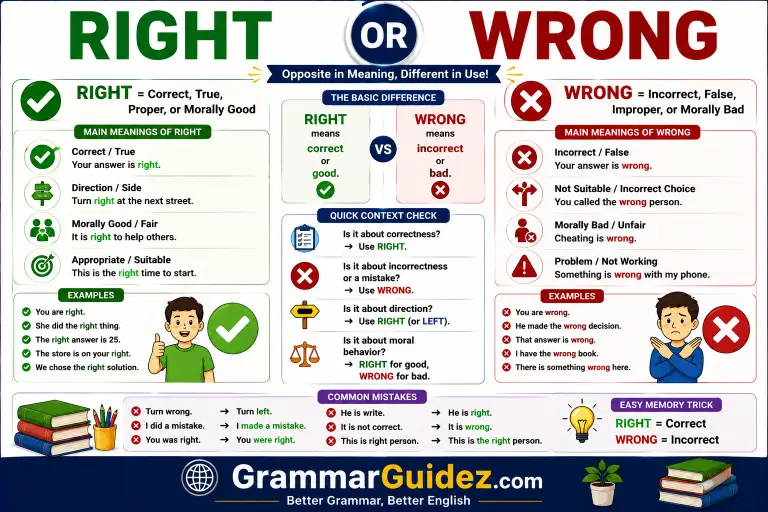
“Right” and “wrong” are both correct words, but they have opposite meanings. “Right” means correct, true, or morally acceptable, while “wrong” means incorrect, false, or not morally acceptable.
Right or wrong? These two common English words have opposite meanings, but they can be used in several different ways.
In the simplest sense:
Right = correct, true, proper, or morally acceptable
Wrong = incorrect, false, improper, or morally unacceptable
For example:
Your answer is right.
This means your answer is correct.
But:
Your answer is wrong.
This means your answer is not correct.
However, right and wrong are not used only when checking answers. They can also describe:
- directions
- opinions
- behavior
- decisions
- moral choices
- facts
- actions
For example:
Turn right at the next street.
Here, right refers to direction.
And:
It is wrong to blame someone without proof.
Here, wrong describes behavior that is considered unfair or morally unacceptable.
Because these words have several meanings, learners often need to understand the context before choosing the correct one.
This guide explains the difference between right or wrong, their meanings, grammar, common expressions, examples, common mistakes, and easy ways to remember how to use them.
Right or Wrong: Quick Answer
The basic difference is simple:
| Word | Main Meaning |
| Right | Correct, true, proper, or morally good |
| Wrong | Incorrect, false, improper, or morally bad |
Examples
You got the answer right.
You got the answer wrong.
She made the right decision.
He made the wrong decision.
The easiest rule is:
Correct = Right
Incorrect = Wrong
But context can change the meaning of right, especially when talking about direction or legal and moral rights.
What Does “Right” Mean?
The word right has several meanings.
Its meaning depends on the sentence.
1. Right Means Correct
This is one of the most common meanings.
Your answer is right.
You were right about the weather.
The teacher said my answer was right.
In these examples, right means:
Correct or true.
2. Right Can Mean a Direction
Right can also refer to one side or direction.
Turn right at the traffic light.
The bank is on your right.
Raise your right hand.
Here, right does not mean correct.
It refers to a direction or side.
3. Right Can Mean Morally Correct
Sometimes right describes something that is fair, good, or morally acceptable.
It is right to help people.
She did the right thing.
You should stand up for what is right.
In these sentences, right means:
Morally good or fair.
4. Right Can Mean Appropriate
This is the right time.
She is the right person for the job.
We chose the right place.
Here, right means:
Suitable or appropriate.
What Does “Wrong” Mean?
Like right, the word wrong can also have different uses.
1. Wrong Means Incorrect
Your answer is wrong.
The number is wrong.
I think you have the wrong address.
Here, wrong means:
Not correct.
2. Wrong Can Mean Morally Bad
It is wrong to lie to people.
Cheating is wrong.
They knew their actions were wrong.
Here, wrong means:
Morally unacceptable or unfair.
3. Wrong Can Mean Not Suitable
You called the wrong person.
I wore the wrong shoes.
This is the wrong place.
In these examples, wrong means:
Not the correct or suitable choice.
Right vs. Wrong: The Main Difference
The easiest comparison is:
| Right | Wrong |
| Correct | Incorrect |
| True | False |
| Suitable | Unsuitable |
| Proper | Improper |
| Fair | Unfair |
| Good | Bad in a moral sense |
| Correct direction | Incorrect choice or position |
Example
You chose the right answer.
This means:
You chose the correct answer.
Now compare:
You chose the wrong answer.
This means:
You chose an incorrect answer.
The Answer Test
One easy way to understand right or wrong is to think about questions and answers.
Question:
What is 5 + 5?
Correct Answer:
10
You can say:
Your answer is right.
If someone says:
11
You can say:
Your answer is wrong.
This is the most basic use of the two words.
Right or Wrong in Everyday Decisions
These words are also common when talking about decisions.
Was that the right decision?
This means:
Was that the best or correct decision?
Now compare:
That was the wrong decision.
This means:
The decision was not correct or suitable.
Examples
Choosing to save money was the right decision.
Taking that road was the wrong choice.
I hope I am doing the right thing.
Right or Wrong in Moral Situations
Right and wrong are often used to discuss behavior.
Helping someone in need is the right thing to do.
Wrong
Taking something that belongs to another person is wrong.
In this type of sentence, the words are not simply about factual correctness.
They describe:
- ethics
- fairness
- behavior
- personal values
Right or Wrong as Adjectives
Both words are commonly used as adjectives.
An adjective describes a person, thing, idea, or situation.
Right as an Adjective
You gave the right answer.
This is the right book.
She made the right choice.
Wrong as an Adjective
You gave the wrong answer.
This is the wrong book.
She made the wrong choice.
Right or Wrong After “Be”
Both words can also come after forms of the verb be.
Right
You are right.
She was right.
They were right.
Wrong
You are wrong.
He was wrong.
We were wrong.
This pattern is extremely common in English.
“You Are Right” vs. “You Are Wrong”
These two expressions are often used during conversations or disagreements.
You Are Right
You are right. I forgot about that.
This means:
Your opinion, statement, or information is correct.
You Are Wrong
You are wrong about the date.
This means:
Your information is not correct.
Be careful with tone.
Saying:
You are wrong.
can sometimes sound direct or rude.
A softer alternative is:
I think there may be a mistake.
Or:
I am not sure that is correct.
Right or Wrong: Direction vs. Correctness
One important point is that right has a meaning that wrong does not directly share.
Right as a Direction
Turn right.
The store is on the right.
My right hand is injured.
Here, right means a direction or side.
You cannot normally replace it with wrong.
For example:
❌ Turn wrong.
This is not the normal opposite of:
Turn right.
The opposite direction is usually:
Turn left.
This is an important difference.
Right, Wrong, Left, and Correct
These words are often confused because they have different relationships.
| Word | Opposite |
| Right (correct) | Wrong |
| Right (direction) | Left |
| Correct | Incorrect |
| True | False |
For example:
You are right.
Opposite:
You are wrong.
But:
Turn right.
Opposite:
Turn left.
The meaning depends on context.
Right or Wrong in Questions
You can use these words when asking if something is correct.
Examples
Is this right or wrong?
Did I do it right?
Is my answer wrong?
Which answer is right?
How do I know if I am wrong?
These are common questions for students and English learners.
“Right or Wrong” as a Fixed Expression
The phrase:
Right or wrong
is sometimes used together to show two opposite possibilities.
Example
I need to know if I am right or wrong.
This means:
I need to know if I am correct or incorrect.
Another example:
Right or wrong, we have to make a decision.
Here, the phrase can mean:
if the decision is correct or not.
However, the exact meaning depends on context.
Common Expressions With “Right”
That’s Right
That’s right!
This means:
That is correct.
Right Now
I need it right now.
This means:
Immediately or at this moment.
All Right
Everything is all right.
This can mean:
Everything is okay.
Right Away
I will do it right away.
This means:
Immediately.
Right Here
Your keys are right here.
This adds emphasis to the location.
The Right Thing
She did the right thing.
This means she made a morally or practically good decision.
Common Expressions With “Wrong”
Something Is Wrong
Something is wrong with my computer.
This means:
There is a problem.
Get Something Wrong
I got the answer wrong.
This means:
I answered incorrectly.
Go Wrong
Everything went wrong.
This means:
Many things did not happen as planned.
Nothing Wrong With
There is nothing wrong with asking questions.
This means:
There is no problem with it.
In the Wrong Place
You are in the wrong room.
This means:
You are not in the correct room.
Common Mistake
Common Mistake 1: Using “Wrong” as the Opposite of Directional Right
Incorrect:
❌ Turn wrong at the next street.
Correct:
✅ Turn left at the next street.
When right means direction, its opposite is:
Left
When right means correct, its opposite is:
Wrong
Common Mistake 2: Confusing Right and Correct
In many situations, right and correct have similar meanings.
Your answer is right.
Your answer is correct.
Both can work.
However, right has additional meanings.
For example:
Turn right.
You cannot say:
❌ Turn correct.
So, the two words are not always interchangeable.
Common Mistake 3: Confusing Wrong and Bad
Wrong and bad can sometimes be similar, but they are not always the same.
It is wrong to cheat.
This refers to behavior.
But:
The food tastes bad.
This refers to poor quality or an unpleasant taste.
You would not normally say:
❌ The food tastes wrong.
unless you mean something is unusual or incorrect about it.
Common Mistake 4: Saying “I Did a Mistake”
When discussing right and wrong, learners sometimes use an incorrect phrase.
Instead of:
❌ I did a mistake.
Say:
✅ I made a mistake.
You can also say:
I was wrong.
Common Mistake 5: Using “Right” When You Mean “Write”
Right and write are homophones in English.
They sound the same in standard pronunciation but have different meanings.
Right
You are right.
Meaning:
Correct.
Write
Please write your name.
Meaning:
Put words on paper or type them.
This is a common spelling mistake.
Right vs. Write
| Word | Meaning | Example |
| Right | Correct or direction | Your answer is right. |
| Write | To produce words | Write your name here. |
Easy memory trick:
Write has W because writing starts with words.
Wrong vs. Incorrect
These words often have similar meanings.
Wrong
Your answer is wrong.
Incorrect
Your answer is incorrect.
Incorrect often sounds more formal.
Wrong is more common in everyday conversation.
Can a Person Be Right or Wrong?
Yes.
You are right.
means:
Your statement or opinion is correct.
And:
You are wrong.
means:
Your statement, belief, or information is incorrect.
Example
I thought the meeting was today, but I was wrong.
This is a very common use.
Can Both People Be Right?
Sometimes, yes.
Two people can have different opinions.
For example:
Person A prefers working in the morning.
Person B prefers working at night.
Neither person may be factually wrong.
In some situations, right or wrong depends on:
- facts
- evidence
- rules
- personal values
- context
This is why not every disagreement has one simple right answer.
A Simple Context Test
When choosing between right or wrong, ask these questions.
Question 1: Is Something Correct?
Use:
Right
Example:
Is this answer right?
Question 2: Is Something Incorrect?
Use:
Wrong
Example:
Is this answer wrong?
Question 3: Are You Talking About Direction?
Use:
Right or left
Example:
Turn right.
Question 4: Are You Talking About Morality?
Use:
Right for good or fair behavior.
Wrong for bad or unfair behavior.
Example:
It is wrong to cheat.
Right or Wrong Examples
Example 1
Your answer is right.
Meaning:
Your answer is correct.
Example 2
Your answer is wrong.
Meaning:
Your answer is incorrect.
Example 3
Turn right after the bridge.
Meaning:
Turn in a direction.
Example 4
He made the wrong choice.
Meaning:
He made an unsuitable or incorrect choice.
Example 5
She did the right thing.
Meaning:
She acted correctly or morally.
Example 6
Something is wrong with the car.
Meaning:
There is a problem.
Right or Wrong: Quick Comparison Table
| Situation | Correct Word |
| Correct answer | Right |
| Incorrect answer | Wrong |
| Correct decision | Right |
| Incorrect choice | Wrong |
| Direction | Right or left |
| Morally good | Right |
| Morally bad | Wrong |
| A problem exists | Wrong |
| Something is okay | Right / all right |
Easy Memory Trick
Remember:
Right = Correct
Wrong = Incorrect
For direction:
Right ↔ Left
A simple sentence can help:
The right answer is correct, but the wrong answer is incorrect.
And remember:
When right means direction, its opposite is left.
Quick Quiz: Right or Wrong?
Choose the correct word.
1. Your answer is ______.
A. Right
B. Wrong
If the answer is correct:
Answer: Right
2. You have the ______ phone number.
A. Right
B. Wrong
If the number is not correct:
Answer: Wrong
3. Turn ______ at the traffic light.
A. Right
B. Wrong
If talking about direction:
Answer: Right
4. Cheating is ______.
A. Right
B. Wrong
Answer: Wrong
5. She made the ______ decision.
A. Right
B. Wrong
If it was the correct decision:
Answer: Right
Fill in the Blanks
Choose right or wrong.
- Your answer is ______.
- I think I chose the ______ address.
- She did the ______ thing.
- Something is ______ with my computer.
- You were ______ about the date.
- He made the ______ choice.
Answers
- right
- wrong
- right
- wrong
- right
- wrong
FAQs
What is the difference between right and wrong?
Right usually means correct, true, suitable, or morally good. Wrong usually means incorrect, false, unsuitable, or morally bad.
Is right the opposite of wrong?
Yes, when right means correct.
Right answer ↔ Wrong answer
However, when right means direction, the opposite is:
Left
Is it “right answer” or “correct answer”?
Both are correct.
You gave the right answer.
You gave the correct answer.
What does “you are right” mean?
It means:
Your statement, idea, or opinion is correct.
What does “you are wrong” mean?
It means:
Your statement, belief, or information is incorrect.
Is “wrong” the opposite of “correct”?
Yes.
Correct ↔ Incorrect or wrong
What is the difference between right and write?
Right means correct or refers to direction.
Write means producing words using a pen, keyboard, or another method.
Can “right” mean direction?
Yes.
Turn right.
My right hand.
In this meaning, the opposite is left, not wrong.
What does “something is wrong” mean?
It means:
There is a problem.
Example:
Something is wrong with my phone.
Conclusion
The words right and wrong are opposites when talking about correctness, choices, facts, and behavior.
Use right when something is:
- correct
- true
- suitable
- proper
- morally good
Use wrong when something is:
- incorrect
- false
- unsuitable
- improper
- morally unacceptable
For example:
You gave the right answer.
But:
You gave the wrong answer.
Remember one important exception:
Right can also mean a direction.
In that situation, its opposite is:
Left
So, the easiest way to choose between right or wrong is to look at the meaning of your sentence.
Correct? → Right
Incorrect? → Wrong
Direction? → Right or Left
Once you understand the context, using right and wrong becomes simple and natural.
Read More Articles:
- To or Too: Difference and Correct Usage
- Then or Than: Which One Is Correct?
- Bit or Bite: What’s the Difference?

I am Elliot Hartwell, an English language writer and the author at GrammarGuidez.com. For the 6 years I have been working with English grammar, vocabulary, spelling and everyday language usage with a focus on making confusing topics easier to understand.
I started GrammarGuidez.com with a goal: to give readers clear and practical answers to common English questions. English can sometimes be confusing especially when two words look or sound similar but have meanings or uses. I enjoy breaking down these differences in a way that’s simple and easy to remember.
I believe learning English should feel simple not overwhelming. My goal is to make every article on GrammarGuidez.com useful, for students, writers, bloggers, teachers and anyone who wants to communicate clearly in English.