“Bit” and “bite” are both correct words, but they are used differently. “Bite” is usually a verb meaning to use your teeth to cut into something, while “bit” is the past tense of “bite” and can also be a noun meaning a small piece or amount of something.
Bit or bite? Both words are correct, but they are used in different ways.
The main difference is usually about time.
Bite is usually the present or base form of the verb.
Bit is usually the simple past tense of bite.
For example:
The dog may bite.
This talks about a possible present or future action.
But:
The dog bit me yesterday.
This talks about something that already happened.
There is another important point:
Bit can also be a noun.
For example:
I ate a bit of cake.
Here, bit does not mean the past tense of bite. It means a small amount.
Because these words can have more than one grammatical role, English learners often ask if they should write bit or bite.
This guide explains the difference using timelines, sentence patterns, everyday examples, common mistakes, and simple memory tricks.
Bit or Bite: Quick Answer
The easiest rule is:
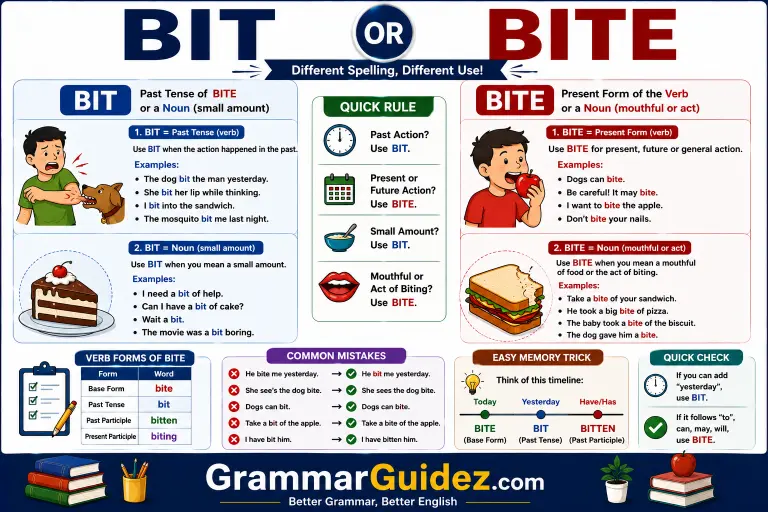
| Word | Main Use |
| Bite | Base form or present form |
| Bit | Usually the simple past tense of bite |
| Bit | Can also mean a small amount |
Examples
Present or future:
Dogs sometimes bite.
Be careful. It may bite.
Past:
The dog bit the man.
Noun:
Can I have a bit of chocolate?
The first step is to ask:
Is the action happening now, or did it happen in the past?
Use a Timeline to Choose the Correct Word
One of the easiest ways to understand bit or bite is to think about time.
Present or General Time → Bite
Dogs bite when they feel threatened.
This describes something that can happen generally.
Past Time → Bit
The dog bit the postman yesterday.
The action happened in the past.
Simple Timeline
Now / General action → Bite
Yesterday / Past action → Bit
This rule solves many sentences immediately.
What Does Bite Mean?
Bite is the base form of the verb.
It usually means:
To use your teeth to cut, hold, or hurt something.
Examples
Do not bite your nails.
Dogs can bite.
I want to bite the apple.
Be careful not to bite your tongue.
In these examples, bite is the action itself.
What Does Bit Mean?
Bit is most commonly the simple past tense of bite.
It means the biting action already happened.
Examples
The dog bit him.
She bit her lip.
I bit into the sandwich.
The child bit his finger.
The action happened before now.
Bite, Bit, and Bitten: The Full Verb Pattern
The verb bite is an irregular verb.
Its common forms are:
| Verb Form | Word |
| Base form | Bite |
| Simple past | Bit |
| Past participle | Bitten |
| Present participle | Biting |
Examples
I will bite the apple.
Yesterday, I bit the apple.
I have bitten the apple.
I am biting the apple.
This is one of the most important parts of understanding the difference.
Bit vs Bitten: An Important Detail
Many people know that:
Bite → Bit
But they sometimes forget about:
Bite → Bitten
Use bit for the simple past.
Yesterday, the dog bit me.
Use bitten in many perfect tenses and passive constructions.
The dog has bitten me.
He was bitten by a dog.
A useful pattern is:
Yesterday = bit
Has/have = bitten
The “Yesterday” Test
If you can naturally add yesterday, you will often need bit.
Example
Yesterday, the dog me.
The correct answer is:
Yesterday, the dog bit me.
Not:
❌ Yesterday, the dog bite me.
Another example:
Yesterday, I my tongue.
Correct:
Yesterday, I bit my tongue.
The “To” Test
If the word comes after to, use the base form:
bite
Examples
I want to bite the apple.
Try not to bite your nails.
The dog may try to bite.
Not:
❌ I want to bit the apple.
The word to usually needs the base verb here.
The “Can” Test
Modal verbs such as can, may, should, and will usually use the base form.
Therefore, use:
bite
Examples
Dogs can bite.
It may bite.
You should not bite your nails.
The insect might bite you.
Not:
❌ Dogs can bit.
❌ It may bit.
Bite in the Present Tense
The verb bite changes slightly depending on the subject.
| Subject | Verb |
| I | bite |
| You | bite |
| We | bite |
| They | bite |
| He | bites |
| She | bites |
| It | bites |
Examples
I bite my nails sometimes.
They bite their food carefully.
The dog bites strangers.
Notice that he, she, and it usually take:
bites
This is different from bit, which refers to the past.
Bite vs Bit in Real-Life Situations
Situation 1: A Dog
Be careful. The dog may bite.
The action has not necessarily happened.
Now compare:
The dog bit me yesterday.
The action happened in the past.
Situation 2: Food
Take a bite of the sandwich.
Here, bite is a noun meaning the amount of food taken with your teeth.
Now:
I bit the sandwich too quickly.
Here, bit is the past tense of the verb.
Situation 3: An Insect
Mosquitoes can bite.
General fact.
A mosquito bit me last night.
Past action.
Bit Can Also Be a Noun
The word bit is not always the past tense of bite.
It can also be a noun.
One common meaning is:
A small amount of something.
Examples
I need a bit of help.
Can I have a bit of cake?
Wait a bit.
The movie was a bit boring.
In these examples, bit has nothing to do with using your teeth.
Bite Can Also Be a Noun
Just like bit, bite can also be a noun.
A bite can mean:
The act of biting.
Or:
The amount of food taken in one bite.
Examples
The dog gave him a bite.
Take one bite of the apple.
She took a small bite of the cake.
So, context is very important.
Bit vs Bite: Compare the Meanings
| Word | Grammar Role | Example |
| Bite | Verb | Do not bite your nails. |
| Bit | Past-tense verb | The dog bit me. |
| Bit | Noun | I need a bit of help. |
| Bite | Noun | Take a bite of the cake. |
This is why simply memorizing:
Bit = past
is useful, but not enough.
You also need to look at the sentence.
Common Mistake: “Yesterday I Bite”
One of the most common mistakes is using the base verb for a past action.
❌ Yesterday, I bite my tongue.
Correct:
Yesterday, I bit my tongue.
Why?
Because yesterday shows that the action happened in the past.
Common Mistake: “Can Bit”
Another common mistake is using the past form after a modal verb.
❌ Dogs can bit.
Correct:
Dogs can bite.
After can, use the base verb.
Common Mistake: “Have Bit” Instead of “Have Bitten”
In standard grammar, the past participle is usually:
bitten
❌ The dog has bit me.
More standard:
The dog has bitten me.
Common Mistake: Confusing “A Bit” and “A Bite”
These expressions have different meanings.
A Bit
Means:
A small amount.
Example:
I need a bit more time.
A Bite
Usually means:
An act of biting or a mouthful of food.
Example:
Take a bite of your sandwich.
Compare:
I ate a bit of the sandwich.
This means a small amount.
I took a bite of the sandwich.
This means I used my teeth to take a mouthful.
A Sentence Diagnosis Method
When choosing between bit or bite, check the words around it.
Look for Past-Time Words
Words such as:
- yesterday
- last night
- earlier
- ago
- this morning
often suggest:
bit
Example:
Last night, the dog bit the shoe.
Look for Modal Verbs
Words such as:
- can
- could
- may
- might
- will
- should
usually need:
bite
Example:
The dog might bite.
Look for “To”
Usually use:
to bite
Example:
Try not to bite your nails.
Look for “Have” or “Has”
Often use:
bitten
Example:
She has bitten her tongue.
Everyday Examples
At the Doctor
The dog bit the patient.
Past action.
Some animals may bite when scared.
Possible action.
At Dinner
Take a bite of your food.
A noun.
I bit the apple.
Past action.
I want to bite the apple.
Base verb.
In Daily Conversation
Wait a bit.
A small amount of time.
Don’t bite your nails.
An action.
He bit his nails when he was nervous.
Past action.
Common Expressions With Bite
Bite Your Tongue
This can mean physically biting your tongue.
It can also be used figuratively to mean stopping yourself from saying something.
I wanted to complain, but I bit my tongue.
Bite Off More Than You Can Chew
This idiom means taking on more work or responsibility than you can manage.
She accepted too many projects and bit off more than she could chew.
Bite the Bullet
This idiom means facing a difficult situation bravely.
He decided to bite the bullet and have the difficult conversation.
Take a Bite
Take a bite of the pizza.
The Easy Memory Trick
Think of this simple timeline:
Today → Bite
Yesterday → Bit
Has/Had → Bitten
Example
Today, I bite the apple.
Yesterday, I bit the apple.
I have bitten the apple.
The timeline helps you remember which form belongs to which time.
Quick Comparison Table
| Situation | Correct Word |
| Base verb | Bite |
| After “to” | Bite |
| After “can” | Bite |
| Simple past | Bit |
| After “has/have” | Bitten |
| Small amount | Bit |
| Mouthful or act of biting | Bite |
Quick Quiz: Bit or Bite?
Choose the correct answer.
1. The dog ___ me yesterday.
A. Bit
B. Bite
2. Dogs can ___.
A. Bit
B. Bite
3. I want to ___ the apple.
A. Bit
B. Bite
4. The mosquito ___ me last night.
A. Bit
B. Bite
5. Take a ___ of the sandwich.
A. Bit
B. Bite
6. Wait a ___.
A. Bit
B. Bite
7. The dog has ___ him.
A. Bit
B. Bitten
Answers
- Bit
- Bite
- Bite
- Bit
- Bite
- Bit
- Bitten
Fill in the Blanks
Choose the correct word.
- The dog ______ my shoe yesterday.
- Be careful. It may ______.
- I want to ______ the apple.
- She ______ her lip during the meeting.
- Please take a ______ of the cake.
- Wait a ______.
- The dog has ______ the man.
Answers
- bit
- bite
- bite
- bit
- bite
- bit
- bitten
FAQs
What is the difference between bit and bite?
Bite is usually the base or present form of the verb. Bit is usually the simple past tense of bite.
I may bite.
Yesterday, I bit.
Is it “bit me” or “bite me”?
It depends on time.
Past:
The dog bit me yesterday.
Present command:
Don’t bite me.
Is “I was bit” correct?
You may hear bit used as a past participle in some informal varieties of English. However, bitten is the standard form in many formal contexts.
I was bitten by a dog.
What is the past tense of bite?
The simple past tense is:
Bit
Example:
The dog bit me.
What is the past participle of bite?
The standard past participle is:
Bitten
Example:
The dog has bitten me.
Can bite be a noun?
Yes.
Take a bite of the apple.
Here, bite means a mouthful or the act of biting.
Can bit be a noun?
Yes.
I need a bit of help.
Here, bit means a small amount.
Is it “a bit” or “a bite” of food?
Both can be correct, but they have different meanings.
A bit of food = a small amount of food.
A bite of food = an amount taken with your teeth.
How can I remember bit vs bite?
Use the timeline:
Bite = base form
Bit = past
Bitten = past participle
And remember:
Today, bite. Yesterday, bit. Have/has, bitten.
Conclusion
Both bit and bite are correct, but they have different jobs.
Use bite when you need:
- the base verb
- a verb after to
- a verb after can, may, should, or similar words
- a noun meaning a mouthful or the act of biting
Use bit when:
- the biting action happened in the simple past
- you mean a small amount of something
For example:
The dog may bite.
But:
The dog bit me yesterday.
And:
I need a bit of help.
The easiest way to remember the verb forms is:
Bite → Bit → Bitten
So, when choosing between bit or bite, first check the time and the job of the word in your sentence.
That simple method will help you choose the correct form every time.
Read More Article:
- Lead or Led: What’s the Difference?
- Then or Than: Meaning and Correct Usage
- Sees or See’s: Which Is Correct?

I am Elliot Hartwell, an English language writer and the author at GrammarGuidez.com. For the 6 years I have been working with English grammar, vocabulary, spelling and everyday language usage with a focus on making confusing topics easier to understand.
I started GrammarGuidez.com with a goal: to give readers clear and practical answers to common English questions. English can sometimes be confusing especially when two words look or sound similar but have meanings or uses. I enjoy breaking down these differences in a way that’s simple and easy to remember.
I believe learning English should feel simple not overwhelming. My goal is to make every article on GrammarGuidez.com useful, for students, writers, bloggers, teachers and anyone who wants to communicate clearly in English.