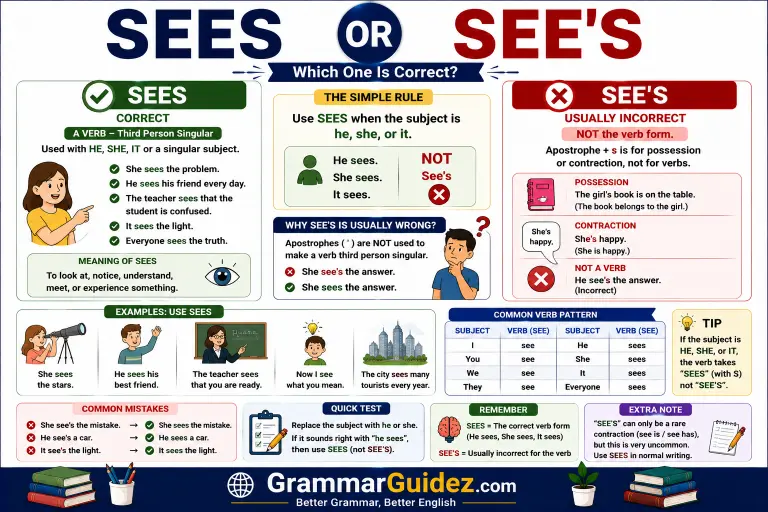
“Sees” is the correct form, while “see’s” is generally incorrect when referring to the verb see. “Sees” is the third-person singular form of the verb “see,” meaning to notice or look at something, whereas “see’s” is not a standard verb form.
Sees or see’s? In most everyday English sentences, the correct spelling is sees without an apostrophe.
Sees is a verb.
For example:
She sees the problem.
He sees his friend every day.
The teacher sees that the student is confused.
However, see’s with an apostrophe can sometimes appear as a contraction.
For example:
See’s not a word you hear often.
But this type of contraction is extremely uncommon and usually sounds unnatural. In standard writing, people almost always mean sees, not see’s.
The main problem is simple:
Sees = a verb form
See’s = usually an incorrect attempt to make “see” plural or a possessive
English learners often add an apostrophe because they think it is needed before s. But an apostrophe does not normally make a verb third-person singular.
This guide explains exactly when to use sees, why see’s is usually wrong, and how to avoid one of the most common apostrophe mistakes.
The Quick Answer
If your sentence means:
Someone looks at, notices, understands, or meets something or someone,
use:
sees
Correct
Emma sees the dog.
John sees his doctor regularly.
She sees what you mean.
Incorrect
❌ Emma see’s the dog.
❌ John see’s his doctor regularly.
The easiest rule is:
He sees.
She sees.
It sees.
No apostrophe is needed.
Start With the Subject
The fastest way to choose between sees or see’s is to look at the subject.
I See
I see the problem.
You See
You see the problem.
We See
We see the problem.
They See
They see the problem.
But:
He Sees
He sees the problem.
She Sees
She sees the problem.
It Sees
It sees the problem.
This is the normal present-tense pattern.
Why Does “Sees” Have an S?
The word sees is the third-person singular form of the verb see.
The base verb is:
see
When the subject is he, she, or it, we normally add -s.
For example:
I work → She works
I plays? ❌ → She plays
I see → She sees
The same pattern appears with many English verbs.
| Subject | Verb |
| I | see |
| You | see |
| We | see |
| They | see |
| He | sees |
| She | sees |
| It | sees |
The s is part of the verb.
It is not an apostrophe + s.
What Does “Sees” Mean?
Sees can have several meanings depending on the sentence.
1. To Notice With Your Eyes
She sees a bird in the tree.
He sees the car coming.
2. To Understand Something
She sees what you mean.
This does not mean she is physically looking at something.
It means:
She understands your point.
3. To Meet Someone
He sees his doctor every month.
She sees her friends on weekends.
Here, sees can mean meets or spends time with someone.
4. To Experience or Witness Something
The city sees many visitors every year.
This means the city experiences or receives many visitors.
Why Is “See’s” Usually Wrong?
Many people write:
❌ He see’s the answer.
This is incorrect because the apostrophe is not used to form the third-person singular of a verb.
The correct sentence is:
✅ He sees the answer.
The same mistake happens with other verbs.
Incorrect
❌ She walk’s to school.
❌ He play’s football.
Correct
✅ She walks to school.
✅ He plays football.
The same rule applies to:
sees
not:
see’s
Apostrophes Do Not Make Verbs Singular
This is the most important grammar rule in this article.
Many writers mistakenly think:
apostrophe + s = singular verb
That is incorrect.
Compare:
Verb
She sees the movie.
The s changes the verb form.
There is no apostrophe.
Possession
The girl’s book is on the table.
The apostrophe shows possession.
The book belongs to the girl.
Contraction
The girl’s happy.
Here, girl’s means:
girl is
The apostrophe replaces a missing letter.
So, ‘s and s have different jobs.
| Form | Main Job |
| sees | Verb |
| girl’s | Possessive or contraction |
| see’s | Rare contraction possibility, but not the normal verb form |
Can “See’s” Ever Be Correct?
In ordinary English, see’s is very rare.
Technically, an apostrophe can sometimes create a contraction where:
see’s = see is
or, in some contexts:
see’s = see has
However, this construction is unusual and generally avoided.
For example, instead of writing:
See’s what happens next.
Most standard writing would use:
See what happens next.
Or:
Let’s see what happens next.
Because see’s is so uncommon, writing it can confuse readers.
For normal grammar and everyday writing, if you are choosing between sees and see’s as the verb form, the answer is almost always:
sees
Sees in Everyday Sentences
Here are common examples.
At School
The teacher sees that the student needs help.
At Work
The manager sees the problem.
At Home
My mother sees the mess in my room.
In a Relationship
She sees him every weekend.
Understanding
He sees your point now.
Travel
The city sees thousands of tourists every year.
All of these use sees without an apostrophe.
The “He/She/It” Test
This is one of the easiest ways to check your spelling.
Try replacing the subject with:
he
she
or:
it
If the sentence is in the simple present tense, use:
sees
Example
Maria the problem.
Replace Maria with she:
She sees the problem.
Therefore:
Maria sees the problem.
Another example:
The child the dog.
Replace the child with they:
He sees the dog.
Therefore:
The child sees the dog.
This simple test can help you avoid writing see’s.
See, Sees, Saw, and Seen
Another reason learners get confused is that see has several forms.
| Verb Form | Example |
| See | I see the car. |
| Sees | She sees the car. |
| Saw | She saw the car yesterday. |
| Seen | She has seen the car. |
| Seeing | She is seeing the car. |
Notice:
Sees is used with he, she, or it in the present tense.
Sees vs See’s in a Sentence
Let’s compare correct and incorrect sentences.
Example 1
❌ He see’s the answer.
✅ He sees the answer.
Example 2
❌ She see’s her parents every week.
✅ She sees her parents every week.
Example 3
❌ The doctor see’s many patients.
✅ The doctor sees many patients.
Example 4
❌ Everyone see’s the difference.
✅ Everyone sees the difference.
Example 5
❌ My friend see’s what happened.
✅ My friend sees what happened.
Common Apostrophe Mistakes Similar to “See’s”
The mistake with see’s is part of a larger grammar problem.
People sometimes add apostrophes where they are not needed.
Incorrect
❌ She eat’s breakfast.
❌ He drive’s to work.
Correct
✅ She eats breakfast.
✅ He drives to work.
The rule is simple:
Do not use an apostrophe before the s of a normal verb.
When Should You Use an Apostrophe?
An apostrophe usually has two main jobs.
1. Showing Possession
Sarah’s book
The book belongs to Sarah.
The teacher’s desk
The desk belongs to the teacher.
2. Making Contractions
She’s = She is or she has
It’s = It is or it has
Don’t = Do not
Can’t = Cannot
The apostrophe usually shows that letters have been removed.
Why “Sees” Does Not Need an Apostrophe
Look at this sentence:
He sees the bird.
Nothing belongs to anyone.
No letters have been removed.
The word sees is simply the correct form of the verb see.
Therefore:
sees
is correct.
Not:
see’s
A Simple Sentence Formula
Use this formula:
He + sees
She + sees
It + sees
Examples:
He sees the train.
She sees the mistake.
It sees movement.
Now compare:
I see the train.
You see the train.
They see the train.
This difference is based on subject-verb agreement.
Sees or See’s in Formal Writing
In formal writing, using see’s instead of sees can make a grammar mistake very noticeable.
For example:
❌ The researcher see’s a connection between the results.
Correct:
✅ The researcher sees a connection between the results.
Similarly:
❌ The company see’s a future opportunity.
Correct:
✅ The company sees a future opportunity.
For professional writing, always check if the ‘s is actually needed.
The Delete-the-Apostrophe Test
When you are unsure, ask:
Is the apostrophe showing possession?
Example:
The student’s answer
Yes. The answer belongs to the student.
An apostrophe is needed.
Then ask:
Is the apostrophe forming a contraction?
Example:
She’s ready.
Yes.
She’s = she is
An apostrophe is needed.
But:
She sees the answer.
There is no possession.
There is no contraction.
Therefore:
No apostrophe.
Common Expressions Using “Sees”
Sees the Point
He finally sees the point.
This means he finally understands.
Sees the Problem
The manager sees the problem.
This can mean notices or understands the problem.
Sees Someone
She sees her doctor regularly.
This means she meets or visits her doctor.
Sees a Future
The company sees a future in the new technology.
This means the company believes there is future potential.
Sees Results
The business sees results after the campaign.
This means the business experiences results.
Quick Comparison Table
| Form | Correct? | Meaning |
| Sees | Yes | Third-person singular form of see |
| See’s | Usually not correct for the verb | Rare contraction possibility |
| See | Yes | Base verb |
| Saw | Yes | Past tense |
| Seen | Yes | Past participle |
For most everyday sentences:
He sees
is correct.
Easy Memory Trick
Remember:
He sees.
Not:
He see’s.
Think of sees as one complete verb word.
The final s belongs to the verb.
It is not an apostrophe + s.
Another easy reminder is:
Verbs get s. Possession gets ‘s.
Examples:
She sees the book. → Verb
Sarah’s book → Possession
Quick Quiz: Sees or See’s?
Choose the correct answer.
1. She ___ the problem clearly.
A. Sees
B. See’s
2. He ___ his family every weekend.
A. Sees
B. See’s
3. The teacher ___ that the student is confused.
A. Sees
B. See’s
4. My brother ___ the difference.
A. Sees
B. See’s
5. The city ___ many tourists each year.
A. Sees
B. See’s
Answers
- Sees
- Sees
- Sees
- Sees
- Sees
Find the Mistake
Correct these sentences.
1.
She see’s the answer.
Correct:
She sees the answer.
2.
He see’s his doctor every month.
Correct:
He sees his doctor every month.
3.
The manager see’s the problem.
Correct:
The manager sees the problem.
4.
My friend see’s what I mean.
Correct:
My friend sees what I mean.
5.
Everyone see’s the mistake.
Correct:
Everyone sees the mistake.
FAQs
Is it sees or see’s?
For the normal third-person singular verb form, sees is correct.
She sees the problem.
See’s is usually incorrect in this type of sentence.
Why does sees not have an apostrophe?
Because sees is a verb form. The letter s is added for third-person singular subjects such as he, she, and it.
An apostrophe is not needed.
Is “she see’s” correct?
No.
The correct form is:
She sees
Is “he sees” correct?
Yes.
He sees the car.
This is correct.
What does sees mean?
Sees is a form of the verb see. Depending on the context, it can mean:
- notices with the eyes
- understands
- meets someone
- experiences something
Can “see’s” ever be correct?
It can theoretically appear as a rare contraction in certain constructions, but it is not the normal verb form of see and is very uncommon in standard everyday writing.
When you mean the present-tense verb used with he, she, or it, use:
sees
Is sees singular or plural?
Sees is generally used with a third-person singular subject.
Examples:
He sees.
She sees.
The child sees.
Is it “everyone sees” or “everyone see’s”?
The correct sentence is:
Everyone sees
The word everyone takes a singular verb.
How can I remember sees vs see’s?
Remember:
Verb = sees
Possession or contraction may use ‘s
The sentence:
She sees the problem.
needs a verb, so use sees.
Conclusion
For almost all normal sentences involving the verb see, the correct spelling is:
Sees
Use it with:
- he
- she
- it
- a singular person
- a singular thing
Examples:
He sees the problem.
She sees her friend.
The teacher sees the mistake.
Do not write see’s simply because the word ends in an s sound.
An apostrophe is not used to create the normal third-person singular form of a verb.
The easiest rule is:
She sees. He sees. It sees.
No apostrophe.
So, when choosing between sees or see’s, remember:
Use sees for the verb.
Once you understand the difference between a simple verb ending and an apostrophe, this common grammar mistake becomes easy to avoid.
Read More Articles:
- Lasts or Last: What’s the Difference?
- Teachers or Teacher’s: Which Is Correct?
- Ms or Mrs: What’s the Difference?

I am Elliot Hartwell, an English language writer and the author at GrammarGuidez.com. For the 6 years I have been working with English grammar, vocabulary, spelling and everyday language usage with a focus on making confusing topics easier to understand.
I started GrammarGuidez.com with a goal: to give readers clear and practical answers to common English questions. English can sometimes be confusing especially when two words look or sound similar but have meanings or uses. I enjoy breaking down these differences in a way that’s simple and easy to remember.
I believe learning English should feel simple not overwhelming. My goal is to make every article on GrammarGuidez.com useful, for students, writers, bloggers, teachers and anyone who wants to communicate clearly in English.