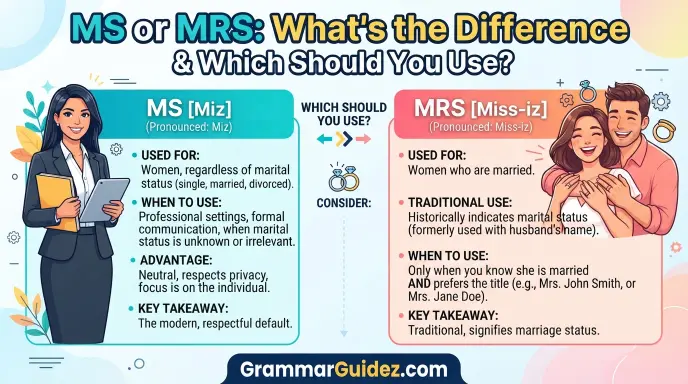
“Ms.” and “Mrs.” are both correct titles for women, but they are used differently. “Ms.” is a neutral title that does not indicate a woman’s marital status, while “Mrs.” traditionally refers to a married woman.
Ms or Mrs? Both are titles used before a woman’s name, but they do not mean the same thing.
The biggest difference is simple:
Mrs traditionally shows that a woman is married.
Ms does not tell you if a woman is married or unmarried.
For example:
Mrs Smith is traditionally used for a married woman.
Ms Smith can be used without referring to her marital status.
This difference may seem small, but choosing the wrong title can make a letter, email, form, invitation, or professional message feel awkward.
Many people also wonder:
- Is Ms only for unmarried women?
- Can a married woman use Ms?
- When should I use Mrs?
- Is Ms more professional?
- What should I write if I do not know if someone is married?
- How are Ms and Mrs pronounced?
The answer depends on context and, most importantly, on the person’s preferred title.
This guide explains the difference between Ms and Mrs in simple English, with examples, professional writing tips, pronunciation, common mistakes, and an easy method for choosing the correct title.
Ms or Mrs: The Quick Answer
Here is the fastest way to understand the difference:
| Title | General Use |
| Ms | A woman when marital status is unknown, irrelevant, or not mentioned |
| Mrs | Traditionally used for a married woman |
Examples
Ms Emma Johnson will attend the meeting.
Her marital status is not being discussed.
Mrs Emma Johnson will attend the meeting.
The title traditionally identifies her as a married woman.
In modern professional writing, Ms is often a safe choice when you do not know a woman’s preferred title.
However, if someone clearly uses Mrs, it is best to respect that preference.
The Most Important Difference: Marital Status
The main difference between Ms and Mrs is connected to marital status.
Mrs
Mrs is traditionally used by a married woman.
For example:
Mrs Brown lives next door.
Please contact Mrs Wilson.
Mrs Khan is the school principal.
Historically, Mrs was strongly connected with marriage.
Ms
Ms does not indicate if a woman is married.
A woman may use Ms if she is:
- unmarried
- married
- divorced
- widowed
For example:
Ms Taylor will lead the presentation.
The sentence does not tell us anything about Ms Taylor’s marital status.
That is one reason Ms is widely used in professional and formal communication.
The Simple Decision Method
If you are unsure if to use Ms or Mrs, ask yourself one question:
Do I know which title this person prefers?
If yes
Use the title the person prefers.
For example:
Mrs Sarah Ahmed
If she uses Mrs, use Mrs.
If no
Ask another question:
Do I need to mention her marital status?
Usually, the answer is no.
In that situation, Ms is often the safer choice.
For example:
Dear Ms Johnson,
This works well in many professional situations when you do not know the person’s marital status.
What Does “Ms” Mean?
Ms is a title for an adult woman that does not identify her marital status.
This is the key idea.
Compare these two examples:
Ms Brown is our new manager.
Mrs Brown is our new manager.
The first sentence does not tell you if Brown is married.
The second traditionally suggests that she is married.
Because Ms does not focus on marriage, it is common in:
- business emails
- job applications
- official letters
- professional documents
- schools
- workplaces
- formal communication
Can a Married Woman Use Ms?
Yes.
A married woman can use Ms.
This is one of the most common misunderstandings about the title.
Some people think:
Ms = unmarried woman
That is not correct.
A married woman may prefer Ms because she does not want her title to indicate her marital status.
For example:
Ms Olivia Carter is married.
There is no contradiction.
Ms does not mean unmarried.
It simply does not tell us if the woman is married.
What Does “Mrs” Mean?
Mrs is traditionally used as a title for a married woman.
For example:
Mrs Davis is a doctor.
Mrs Ali will speak at the event.
I received an email from Mrs Williams.
A woman may choose to use Mrs with her husband’s surname, her own surname, or according to her personal preference.
For this reason, it is best not to make assumptions about a person’s name based only on the title.
The safest approach is simple:
Use the name and title the person uses for herself.
Ms vs Mrs in Professional Emails
Professional emails are one of the most common situations where people ask if to write Ms or Mrs.
Imagine that you are writing to a woman named Anna Wilson.
You do not know if she is married.
A safe greeting is:
Dear Ms Wilson,
You do not need to know her marital status.
If You Know She Uses Mrs
Write:
Dear Mrs Wilson,
This shows respect for her preferred title.
Avoid Guessing
Do not automatically write:
Dear Mrs Wilson
just because you think she may be married.
Marriage is personal information, and guessing can lead to mistakes.
If you do not know the person’s preferred title, Ms is often more neutral.
Ms or Mrs on Forms
Forms sometimes ask people to select a title.
Common options include:
- Mr
- Mrs
- Ms
- Miss
- Dr
The correct choice depends on the title the person personally uses.
For example:
Ms
Choose Ms if you prefer a title that does not state your marital status.
Mrs
Choose Mrs if you use that title as a married woman.
There is no universal rule saying every married woman must use Mrs.
Personal preference matters.
How Do You Pronounce Ms and Mrs?
The spellings can be confusing because they are not pronounced exactly as they look.
Ms
Ms is usually pronounced:
miz
It sounds similar to:
is
with an m at the beginning.
Example:
Ms Smith
Pronounced approximately:
Miz Smith
Mrs
People usually pronounce Mrs as: Mrs (MISS-iz)
miss-iz
Example:
Mrs Smith
Pronounced approximately:
Miss-iz Smith
This pronunciation is another reason English learners sometimes confuse the two titles.
Ms, Mrs, and Miss: A Quick Comparison
People often search for Ms or Mrs, but Miss can also create confusion.
Here is a simple comparison.
| Title | Traditional Meaning |
| Miss | Traditionally used for an unmarried woman or girl |
| Ms | Does not indicate marital status |
| Mrs | Traditionally used for a married woman |
Examples
Miss Green teaches English.
Ms Green teaches English.
Mrs Green teaches English.
These titles may refer to women with different preferences and situations.
The best rule is:
Use the title the person prefers whenever you know it.
When “Ms” Is Usually the Better Choice
There are several situations where Ms is often practical.
1. You Do Not Know if She Is Married
Example:
Dear Ms Roberts,
This is a neutral and respectful choice.
2. Her Marital Status Does Not Matter
Example:
Ms Roberts will present the report.
Her role matters more than her marital status.
3. Professional Communication
In many workplaces, people commonly use Ms because it avoids unnecessary attention to marital status.
Example:
Ms Ahmed is the project manager.
4. Official Documents
Many official documents use titles based on personal preference.
If the person uses Ms, use Ms.
When Should You Use Mrs?
Use Mrs when you know that this is the woman’s preferred title.
For example:
Dear Mrs Thompson,
Mrs Thompson asked for more information.
Thank you for your message, Mrs Thompson.
Do not replace Mrs with Ms if the person clearly identifies herself as Mrs.
The same rule applies in reverse.
If someone uses Ms, do not change her title to Mrs based on an assumption about marriage.
Real-Life Examples: Ms or Mrs?
The following situations make the difference easier to understand.
Example 1: A Business Email
You are writing to:
Jennifer Adams
You cannot know whether she is married.
A good greeting is:
Dear Ms Adams,
Why?
Because Ms does not require you to know her marital status.
Example 2: A School Letter
The teacher signs a letter:
Mrs Patel
Write:
Dear Mrs Patel,
Why?
She has already shown the title she uses.
Example 3: A Conference Speaker
The event program says:
Ms Laura Brown
Use:
Ms Brown will speak at 10 a.m.
Use the title provided by the person or organization.
Example 4: A Married Professional
A married woman may introduce herself as:
Ms Sarah Khan
Use:
Ms Khan
Her marriage does not automatically mean you should call her Mrs.
Common Mistakes With Ms and Mrs
Mistake 1: Thinking Ms Means Unmarried
❌ Ms is only for unmarried women.
This is incorrect.
A woman can use Ms whether she is married or unmarried.
Mistake 2: Assuming Every Married Woman Uses Mrs
❌ She is married, so I must call her Mrs.
Not necessarily.
A married woman may prefer Ms.
The best option is to follow her stated preference.
Mistake 3: Guessing From a Name
❌ Her surname sounds traditional, so she is probably Mrs.
You cannot know someone’s preferred title from their name.
Use the title provided by the person whenever possible.
Mistake 4: Using the Wrong Title in an Email
Imagine that someone signs her email:
Ms Hannah Lee
Do not reply:
Dear Mrs Lee,
Use:
Dear Ms Lee,
Following the person’s chosen title is respectful and professional.
Mistake 5: Thinking Ms Is Less Formal
Some learners believe Mrs is formal but Ms is informal.
This is not correct.
People can use Ms in formal and professional communication.
For example:
Dear Ms Johnson,
is a professional and formal greeting.
A Practical Email Guide
Here is a quick method for writing professional emails.
Situation: You Know Her Preferred Title
Use it.
Dear Mrs Parker,
or:
Dear Ms Parker,
Situation: You Do Not Know Her Marital Status
A common neutral choice is:
Dear Ms Parker,
Situation: You Know She Has a Professional Title
Use the appropriate title.
For example:
Dear Dr Parker,
Professional titles such as Dr may be more relevant than Ms or Mrs.
Situation: You Know Her Affirming name
Follow her own usage.
This is usually the best solution.
Is Ms More Modern Than Mrs?
Ms became widely used because it gives women a title without requiring them to reveal their marital status.
Compare:
Mr John Smith
The title Mr does not normally reveal whether John Smith is married.
Historically, women’s titles were more likely to reveal marital status through:
- Miss
- Mrs
Ms provides a more neutral option.
However, this does not make Mrs old-fashioned or incorrect.
Both titles are correct.
The choice depends on:
- personal preference
- context
- the person’s own title
- if marital status is relevant
Ms or Mrs: A Fast Comparison Table
| Feature | Ms | Mrs |
| Used for women | Yes | Yes |
| Shows marital status | No | Traditionally yes |
| Can be used by a married woman | Yes | Yes |
| Common in professional writing | Yes | Yes |
| Good when marital status is unknown | Often yes | Usually not assumed |
| Based on personal preference | Yes | Yes |
The most important row is the last one.
Personal preference matters.
The “Do Not Guess” Rule
This is perhaps the easiest rule to remember.
When you see the question Ms or Mrs, do not immediately guess if the woman is married.
Instead, think:
What title does she use?
If you know the answer, use that title.
If you do not know, and marital status is not relevant, Ms is often a neutral choice in professional communication.
This approach is useful for:
- emails
- letters
- business communication
- school messages
- applications
- invitations
Quick Quiz: Ms or Mrs?
Choose the best answer.
1. You are writing to a woman whose marital status you do not know.
A. Ms
B. Mrs
2. A woman signs her email as “Mrs Taylor.”
A. Ms Taylor
B. Mrs Taylor
3. Can a married woman use Ms?
A. Yes
B. No
4. Does Ms tell you if a woman is married?
A. Yes
B. No
5. A woman’s preferred title is Mrs Khan.
A. Ms Khan
B. Mrs Khan
Answers
- A — Ms
- B — Mrs Taylor
- A — Yes
- B — No
- B — Mrs Khan
Fill in the Blanks
Choose Ms or Mrs.
- Dear ___ Wilson, thank you for your email.
(You do not know her marital status.) - The teacher introduced herself as ___ Ahmed.
- ___ Brown will lead the meeting tomorrow.
(Her marital status is not relevant.) - Please contact ___ Taylor.
(She has asked people to use Mrs.) - A married woman can choose to use ___.
Suggested Answers
- Ms
- Use the title she introduced herself with
- Ms
- Mrs
- Ms or Mrs, depending on her preference
FAQs
What is the difference between Ms and Mrs?
Ms does not indicate whether a woman is married, while Mrs traditionally identifies a married woman. However, personal preference is important, and a married woman may choose either title.
Is Ms for a married or unmarried woman?
Ms applies to both married and unmarried women. It does not identify marital status.
Can a married woman be called Ms?
Yes. A married woman can use Ms if that is her preferred title.
Should I use Ms or Mrs if I do not know if she is married?
In many professional situations, Ms is a neutral choice because it does not require you to know the person’s marital status.
Is Mrs more formal than Ms?
No. Both can be used in formal communication. Ms is common in business and professional writing.
How do you pronounce Ms?
Ms is usually pronounced miz.
How do you pronounce Mrs?
Mrs is usually pronounced approximately miss-iz.
Can I change Ms to Mrs because I know someone is married?
No. Marriage does not automatically determine which title a woman prefers. If you know that she uses Ms, continue using Ms unless she indicates otherwise.
Which title should I use in an email?
Use the person’s preferred title if you know it. If you do not know and need a neutral formal title, Ms is often a suitable choice.
Conclusion
The difference between Ms and Mrs is mainly connected to if marital status is shown.
Ms does not tell us if a woman is married.
Mrs is traditionally used for a married woman.
However, the most important rule is not simply grammar.
It is personal preference.
A married woman may prefer Ms.
Another married woman may prefer Mrs.
Therefore, when you know which title a person uses, follow that choice.
If you do not know her marital status or her preferred title, and you are writing in a professional context, Ms is often a neutral option.
The easiest rule to remember is:
Know her preference? Use it.
Do not know? Avoid guessing about marital status.
Once you understand this simple difference, choosing between Ms or Mrs becomes much easier and more respectful in everyday and professional English.
Read More Articles:
- Teachers or Teacher’s: What’s the Difference?
- Non or None: What’s the Difference?
- As or Like: How to Use Them Correctly

I am Elliot Hartwell, an English language writer and the author at GrammarGuidez.com. For the 6 years I have been working with English grammar, vocabulary, spelling and everyday language usage with a focus on making confusing topics easier to understand.
I started GrammarGuidez.com with a goal: to give readers clear and practical answers to common English questions. English can sometimes be confusing especially when two words look or sound similar but have meanings or uses. I enjoy breaking down these differences in a way that’s simple and easy to remember.
I believe learning English should feel simple not overwhelming. My goal is to make every article on GrammarGuidez.com useful, for students, writers, bloggers, teachers and anyone who wants to communicate clearly in English.