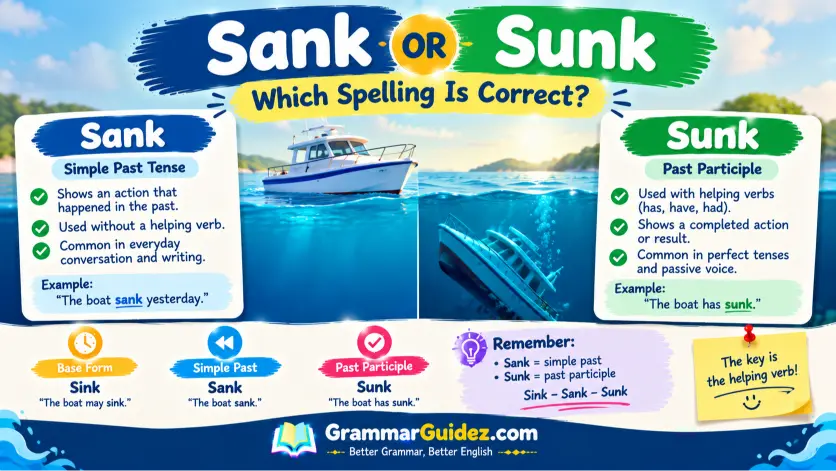
“Both words are correct forms of the verb “sink.” Sank is the simple past tense, while sunk is the past participle, usually used with “has,” “have,” or “had.”
Imagine telling a friend about a boat that went under the water yesterday. You might say, “The boat sank.” Later, you may want to explain that the boat has gone below the surface. You could say, “The boat has sunk.” Both sentences can be correct, but they use different forms of the same verb.
The difference between sank and sunk confuses many English learners because both words come from the verb sink. They describe similar actions, but their grammar is different. Using the wrong form can make a sentence sound incorrect or unclear.
In standard English, sank is usually the simple past tense of sink, while sunk is the past participle. You normally use sunk with helping verbs such as has, have, and had. Some American English usage also accepts sunk as a simple past form in certain contexts.
This guide explains the difference in simple English. You will learn the meanings, grammar rules, common mistakes, and practical ways to choose the correct word.
Read More: Wellcome or Welcome: Which Is Correct?
Quick Answer: Sank or Sunk?
Sank is the standard simple past tense of sink. Use it to describe an action that happened in the past.
Sunk is the past participle of sink. Use it with helping verbs such as has, have, and had.
Here is the basic verb pattern:
| Verb form | Word | Example |
| Base form | Sink | The boat may sink. |
| Simple past | Sank | The boat sank yesterday. |
| Past participle | Sunk | The boat has sunk. |
The easiest rule to remember is this: use sank for a simple past action and sunk after a helping verb in a perfect tense.
What Does Sank Mean?
Sank is the simple past tense of the verb sink. It describes an action that happened and finished in the past.
The word sink can mean to move below the surface of water or another substance. It can also mean to move downward, fall to a lower level, or become lower in value or strength.
When you describe one of these actions in the past, sank is usually the correct form.
Examples of Sank in Sentences
- The small boat sank during the storm.
- The sun sank below the horizon.
- The stone sank to the bottom of the lake.
- The chair sank into the soft ground.
- His heart sank when he heard the news.
- The company’s profits sank last year.
- The player sank the winning basket.
- The tired runner sank into a chair.
In each sentence, sank describes an action or change that happened in the past.
When Should You Use Sank?
Use sank when the sentence describes a completed past action without using a perfect-tense helping verb.
For example, “The ship sank last night” tells the reader when the event happened. The simple past tense is suitable because the sentence describes a past event.
You can also use sank for emotional or figurative meanings. The expression “my heart sank” describes a sudden feeling of sadness, worry, or disappointment.
The word is not limited to water. Prices, confidence, hopes, and other things can also sink in a figurative sense.
What Does Sunk Mean?
Sunk is the past participle of the verb sink. A past participle is a verb form often used with helping verbs to create perfect tenses or passive constructions.
For example, “The boat has sunk” uses has with sunk. The sentence tells us that the boat went under the water and that the result matters now.
The word sunk can also appear in passive sentences and as an adjective in certain expressions.
Examples of Sunk in Sentences
- The boat has sunk.
- The ship had sunk before help arrived.
- Several stones have sunk into the mud.
- The sun has sunk below the hills.
- The company has sunk millions into the project.
- The ship was sunk during the battle.
- The garden has a sunken seating area.
- Without more money, we are sunk.
These sentences show different uses of sunk. Most use a helping verb, such as has, had, or was. The last sentence uses sunk informally to mean being in serious trouble.
When Should You Use Sunk?
Use sunk when you need the past participle of sink.
Common patterns include:
- Has sunk: The boat has sunk.
- Have sunk: The boats have sunk.
- Had sunk: The ship had sunk before dawn.
- Was sunk: The vessel was sunk during the conflict.
- Being sunk: The ship was in danger of being sunk.
The helping verb tells you how the sentence is structured. In standard English, sunk is the form you need in these perfect-tense and passive constructions.
Sank vs. Sunk: Main Differences
The main difference is grammatical. Both words come from sink, but they perform different jobs in a sentence.
| Feature | Sank | Sunk |
| Base verb | Sink | Sink |
| Main verb form | Simple past | Past participle |
| Common pattern | Subject + sank | Subject + has/have/had + sunk |
| Example | The boat sank yesterday. | The boat has sunk. |
| Common time expression | Yesterday, last night, last year | Already, recently, before, since |
| Use in standard perfect tenses | Not normally used | Correct form |
| Use in passive constructions | Not normally used as the participle | Correct form |
Remember that time expressions are clues, not absolute rules. The most important thing is the grammatical structure of the sentence.
If the sentence says what happened at a particular time in the past, sank is often appropriate. If it uses has, have, or had to form a perfect tense, use sunk.
What Is the Past Tense of Sink?
The standard simple past tense of sink is sank.
The verb sink is irregular. This means it does not form its past tense by simply adding -ed. You should learn its three main forms together:
Sink – Sank – Sunk
These forms appear in many common sentences.
- Present: The boat may sink.
- Past: The boat sank yesterday.
- Present perfect: The boat has sunk.
Learning all three forms as a group makes it easier to remember the correct word.
Is “Sunk” Ever Used as the Past Tense?
Yes, some American English usage accepts sunk as an alternative simple past form in certain contexts. For example, a speaker might say that someone “sunk money into” a project.
However, sank remains the standard and safest choice for the simple past tense, especially for English learners, school assignments, and formal writing.
If you want to avoid confusion, write “The ship sank yesterday” rather than “The ship sunk yesterday.”
What Is the Past Participle of Sink?
The past participle of sink is sunk.
You need this form when using the present perfect, past perfect, and many passive constructions.
Present Perfect
Use has or have with sunk.
- The boat has sunk.
- The ships have sunk.
- The water level has sunk.
The present perfect connects a past action with the present in some way.
Past Perfect
Use had with sunk.
- The boat had sunk before the rescue team arrived.
- The sun had sunk below the hills before we reached home.
- The company had sunk too much money into the project.
The past perfect shows that one event happened before another past event.
Passive Voice
Use a form of be with the past participle sunk.
- The ship was sunk during the war.
- The damaged boat was sunk deliberately.
- Several vessels have been sunk in the area.
In passive sentences, the subject receives the action rather than performing it.
Why Do People Confuse Sank and Sunk?

Many learners confuse these words because they have the same base verb and similar meanings. They also appear in sentences about the same actions.
Here are the main reasons for the confusion.
1. Both Words Describe a Similar Action
Both sank and sunk can describe something going below the surface of water or moving downward.
The difference is not mainly about the action itself. It is about how the verb fits into the sentence.
For example, “The boat sank” and “The boat has sunk” describe the same general event but use different verb forms.
2. Sink Is an Irregular Verb
Regular verbs usually form the simple past and past participle by adding -ed. For example, walk becomes walked.
However, sink changes to sank in the standard simple past and sunk in the past participle.
Because these forms do not follow the regular pattern, learners need to memorize them.
3. Everyday Speech Can Be Flexible
People sometimes use sunk as a simple past form, especially in American English. This can make the standard distinction seem less clear.
However, informal usage does not remove the value of learning the standard pattern. Using sank for the simple past and sunk for the past participle is a reliable choice.
4. Helping Verbs Are Easy to Miss
A sentence such as “The boat has sunk” needs the helping verb has. Without it, the grammar changes.
Learners sometimes write “The boat has sank” because they remember sank as the past form. In standard English, the correct sentence is “The boat has sunk.”
Pay attention to the words before the main verb. They often tell you which form to use.
Sank or Sunk in American and British English
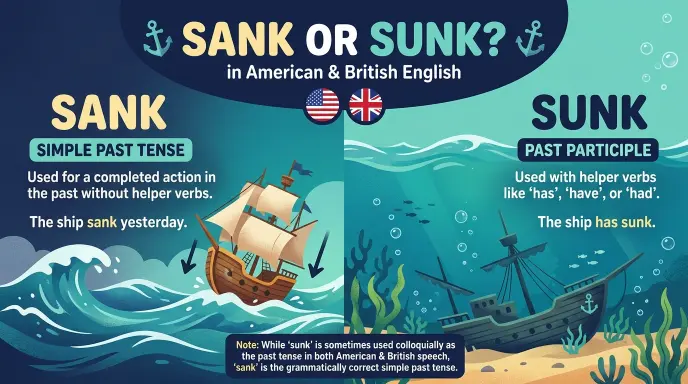
The basic rule is the same in both American and British English: sank is the standard simple past form, and sunk is the past participle.
However, American English dictionaries also record sunk as an alternative simple past form. This means you may encounter sentences using sunk in that role, particularly in American usage.
For example, “The boat sank” is the standard form in both varieties. “The boat has sunk” is also correct in both.
For learners who want a safe and consistent rule, use sank for the simple past and sunk after has, have, or had. This pattern is widely understood and suitable for formal writing.
Common Expressions With Sank and Sunk
Both words appear in expressions that do not always refer to something going underwater.
My Heart Sank
“My heart sank” describes a sudden feeling of sadness, worry, or disappointment.
The phrase is common when someone receives bad news or realizes that something has gone wrong.
Sank Into a Chair
This expression describes someone sitting down heavily, often because they are tired, upset, or relieved.
It can suggest that the person lets their body drop into the seat.
Sunk in Thought
The phrase sunk in thought means deeply occupied with thinking. Here, sunk describes a state of deep concentration.
Sunk Costs
A sunk cost is money, time, or effort that has already been spent and cannot be recovered. The term is common in business, economics, and decision-making.
For example, a company may need to decide if to continue a project even after spending money on it.
We Are Sunk
In informal English, saying “We are sunk” means that a person or group is in serious trouble or has little hope of avoiding failure.
These expressions show that sink, sank, and sunk can be used figuratively as well as literally.
Common Mistakes to Avoid
Mistake 1: Using Sank After Has
Incorrect: The boat has sank.
Correct: The boat has sunk.
Use the past participle after has, have, or had in standard perfect tenses.
Mistake 2: Using Sunk as the Simple Past in Formal Writing
Less recommended in standard writing: The ship sunk yesterday.
Preferred: The ship sank yesterday.
Although sunk appears as an alternative simple past form in some American usage, sank is the safest standard choice.
Mistake 3: Adding -Ed to Sink
Incorrect: The boat sinked.
Correct: The boat sank.
Sink is an irregular verb, so its standard past forms must be learned.
Mistake 4: Confusing the Past Tense With the Past Participle
The past tense and past participle are not always the same. With sink, they are different: sank and sunk.
Remember the full pattern: sink, sank, sunk.
Mistake 5: Assuming Both Forms Are Always Interchangeable
The words are related, but you cannot freely replace one with the other in every sentence.
In standard English, “The boat sank” and “The boat has sunk” are correct patterns. “The boat has sank” is not the standard form.
Easy Ways to Remember the Difference
You can remember the correct forms with a simple three-word pattern:
Sink – Sank – Sunk
Think of the forms as three steps.
- Sink: Something goes down now or may go down.
- Sank: Something went down in the past.
- Sunk: Something has, have, or had gone down.
Another helpful trick is to look for a helping verb. If you see has, have, or had, you will usually need sunk.
For example:
- The boat sank.
- The boat has sunk.
- The boat had sunk.
Read these sentences aloud and notice how the verb changes. Repeating the pattern can help you remember it naturally.
Fill in the Blanks
Complete each sentence with the correct form of sink.
- The boat ______ during the storm yesterday.
- The ship has ______ below the surface.
- The sun ______ behind the mountains last evening.
- The boat had ______ before the rescue team arrived.
- The company’s profits ______ last year.
Answers
- Sank
- Sunk
- Sank
- Sunk
- Sank
Mini Quiz
Choose the correct answer for each question.
1. What is the standard simple past tense of “sink”?
A. Sinked
B. Sunk
C. Sank
D. Sinking
Answer: C. Sank
2. Which sentence is correct in standard English?
A. The boat has sank.
B. The boat has sunk.
Answer: B. The boat has sunk.
3. What is the past participle of “sink”?
A. Sank
B. Sinked
C. Sunk
D. Sinks
Answer: C. Sunk
4. Choose the correct sentence for a past event.
A. The ship sank yesterday.
B. The ship has sank yesterday.
C. The ship sinked yesterday.
D. The ship sinking yesterday.
Answer: A. The ship sank yesterday.
5. Which verb pattern is correct?
A. Sink – Sunk – Sank
B. Sink – Sank – Sunk
Answer: B. Sink – Sank – Sunk
FAQs
1. Is it sank or sunk?
Both are correct forms of the verb sink. Use sank as the standard simple past tense and sunk as the past participle.
2. What is the past tense of sink?
The standard simple past tense is sank. For example, “The boat sank during the storm.”
3. What is the past participle of sink?
The past participle is sunk. For example, “The boat has sunk.”
4. Is “the boat has sank” correct?
No. In standard English, write “The boat has sunk.” The helping verb has requires the past participle in this perfect-tense construction.
5. Is “the ship sunk” correct?
In standard English, “The ship sank” is the preferred simple past form. Some American usage accepts sunk as an alternative simple past form, but sank is the safest choice for formal writing.
6. Is sunk ever a past tense?
Yes. Some American English usage accepts sunk as an alternative simple past form. However, sank remains the standard form taught to English learners.
7. What are the three forms of sink?
The three main forms are sink, sank, and sunk. They are the base form, simple past, and past participle, respectively.
8. Can sunk be used without has, have, or had?
Yes. Sunk can appear in passive constructions, such as “The ship was sunk,” and in expressions such as “sunk in thought.” It can also function as an adjective in certain contexts.
9. What does “my heart sank” mean?
It means that someone suddenly felt sad, worried, or disappointed. It is a figurative expression rather than a literal description of the heart moving downward.
10. Is sank or sunk used differently in British and American English?
The standard distinction is the same in both varieties. However, some American English usage also accepts sunk as an alternative simple past form. Using sank for the simple past and sunk for the past participle is a safe choice in either variety.
Conclusion
The difference between sank and sunk is mainly grammatical. Both words come from the verb sink, which means to move downward or go below the surface of water or another substance.
In standard English, sank is the simple past tense. Use it to describe a completed past action, such as a boat going underwater yesterday. Sunk is the past participle. Use it with helping verbs such as has, have, and had, as in “The boat has sunk.”
Some American English usage also accepts sunk as an alternative simple past form, but sank remains the safest choice for standard writing and English-learning exercises.
Remember the three forms: sink, sank, sunk. Practice them in short sentences, pay attention to helping verbs, and you will find it easier to choose the correct form in your everyday writing.
Read More: Develop or Develope: Which Spelling Is Correct?

I am Elliot Hartwell, an English language writer and the author at GrammarGuidez.com. For the 6 years I have been working with English grammar, vocabulary, spelling and everyday language usage with a focus on making confusing topics easier to understand.
I started GrammarGuidez.com with a goal: to give readers clear and practical answers to common English questions. English can sometimes be confusing especially when two words look or sound similar but have meanings or uses. I enjoy breaking down these differences in a way that’s simple and easy to remember.
I believe learning English should feel simple not overwhelming. My goal is to make every article on GrammarGuidez.com useful, for students, writers, bloggers, teachers and anyone who wants to communicate clearly in English.