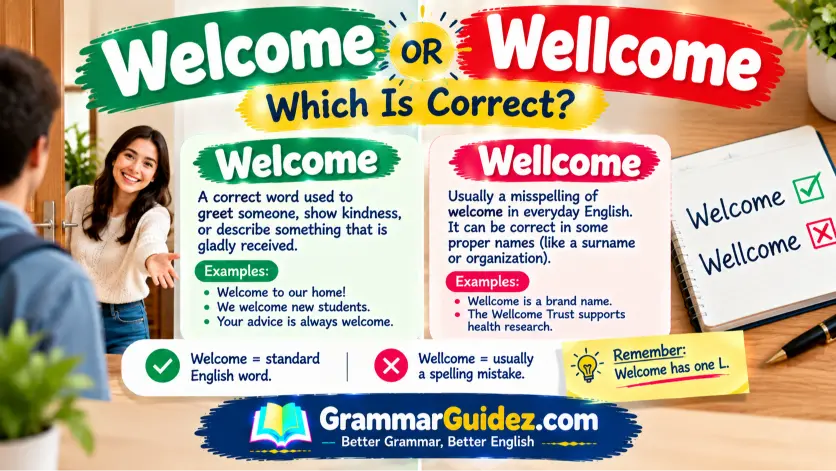
“Welcome” is the correct spelling. “Wellcome” is a misspelling. Welcome: Used to greet someone warmly or show that you are happy they have arrived. Wellcome: An incorrect spelling of welcome in standard English.
Welcome is the correct spelling in standard English. Wellcome is usually a misspelling when you want to greet someone or show that someone is welcome. The word wellcome may appear in surnames, company names, and other proper names, but it is not the standard spelling of the everyday English word.
Use welcome when greeting a guest, inviting someone in, or showing that someone is accepted. For example, you can say, “Welcome to our home!” or “You are always welcome here.”
The main difference is simple: welcome is the standard English word, while wellcome is usually a spelling mistake.
Quick Answer: Wellcome vs. Welcome
- Welcome: The correct spelling used to greet someone, show kindness, or describe something that is gladly received.
- Wellcome: Usually an incorrect spelling of welcome in everyday English. It can also be correct as part of a proper name.
Remember: Welcome has one L in the middle and one L at the end of its first syllable pattern: w-e-l-c-o-m-e. Do not add a second L after the first one.
What Does Welcome Mean?
Welcome is a common English word. It can work as a greeting, a verb, a noun, or an adjective. Its meaning depends on how you use it in a sentence.
Welcome as a Greeting
People use welcome to greet someone who arrives at a place or joins a group.
Examples:
- Welcome to our school!
- Welcome to my home.
- Welcome to the team.
- Welcome back!
In these sentences, welcome makes a person feel accepted and appreciated.
Welcome as a Verb
As a verb, welcome means to greet someone warmly or accept someone or something with pleasure.
Examples:
- We welcome every new student.
- They welcomed their guests at the door.
- The school welcomes visitors.
- She welcomed the good news.
The verb can change form depending on the sentence. For example, welcomes is used with a third-person singular subject, while welcomed is the past tense.
Welcome as an Adjective
As an adjective, welcome describes something that people are happy to receive or accept.
Examples:
- Your advice is always welcome.
- The rain was a welcome change.
- Any helpful suggestion is welcome.
- The good news was a welcome surprise.
Here, welcome describes something that is wanted or appreciated.
Welcome as a Noun
As a noun, welcome refers to the greeting or reception given to someone.
Examples:
- The guests received a warm welcome.
- Everyone gave her a friendly welcome.
- He received a hero’s welcome.
- The new teacher got a cheerful welcome.
These examples show that welcome has several uses, but its spelling stays the same.
What Does Wellcome Mean?
Wellcome is not the standard spelling of the everyday English word welcome. If you use it in a normal greeting or sentence, readers will usually consider it a spelling error.
For example, if you write “Wellcome to our website,” you should change it to “Welcome to our website.”
However, Wellcome can appear in proper names, such as surnames, organizations, or brands. A proper name may use a spelling that differs from standard everyday English.
Therefore, it is important to consider the context. If you are greeting someone, use welcome. If Wellcome is the official name of a person or organization, preserve that name’s spelling.
Wellcome vs. Welcome: Key Differences
| Feature | Welcome | Wellcome |
| Standard English word | Yes | No, not for the usual greeting |
| Used to greet people | Yes | No |
| Used as a verb | Yes | No, not in standard usage |
| Used as a noun or adjective | Yes | No, not in standard usage |
| Can appear in proper names | Yes | Yes |
| Example | Welcome to our home. | Wellcome is part of a proper name. |
The key difference is that welcome is the normal spelling in everyday English. Wellcome is usually a mistake unless it is intentionally used as a proper name.
Why Do People Confuse Wellcome and Welcome?
There are a few reasons why people misspell welcome.
1. They Add an Extra L
Some people write wellcome because they think the word needs two Ls. However, the standard spelling has only one L after the letter W.
The correct spelling is welcome, not wellcome.
2. They Type Too Quickly
When people type quickly, they may repeat a letter by accident. This can turn welcome into wellcome.
Proofreading your writing can help you catch this error before you publish a message, email, or article.
3. They Confuse It With Other Words
English has many words with double letters, such as hello, yellow, and follow. Writers may wrongly assume that welcome follows the same pattern.
However, spelling patterns do not always work the same way. It is best to learn the correct spelling of each word.
Common Mistakes With Welcome
Here are some common mistakes and their corrections.
Incorrect: Wellcome to our website.
Correct: Welcome to our website.
Use welcome when greeting visitors to a website.
Incorrect: You are always wellcome here.
Correct: You are always welcome here.
The correct adjective is welcome.
Incorrect: We wellcome all new members.
Correct: We welcome all new members.
The verb is also spelled welcome, with one L after W.
Incorrect: She gave us a warm wellcome.
Correct: She gave us a warm welcome.
The noun welcome also uses the standard spelling.
Is Wellcome Ever Correct?
Yes, but only in specific contexts. Wellcome can be correct when it is part of an official name, such as a person’s surname or an organization’s name.
A well-known example is the Wellcome name associated with the Wellcome Trust, a charitable foundation that supports health research.
In such cases, you should not change the official spelling simply because it differs from an ordinary English word.
However, when you want to greet a visitor, write a friendly message, or welcome someone to a place, use welcome.
How to Remember Welcome vs. Wellcome
Use this simple memory trick:
Welcome has only one L after W.
Break the word into letters:
W – E – L – C – O – M – E
Check the spelling before you send a message or publish a page. If you are writing a greeting, the correct choice is almost always welcome.
You can also remember this common phrase:
“Welcome to our home.”
Once you learn the spelling in a familiar phrase, it becomes easier to use it correctly in other sentences.
Fill in the Blanks: Wellcome or Welcome
Complete each sentence with the correct word: welcome or wellcome.
- ______ to our school!
- We ______ all new members to the group.
- The guests received a warm ______.
- Your help is always ______.
- The correct spelling of the greeting is not “______.”
Answers
- Welcome
- welcome
- welcome
- welcome
- wellcome
Mini Quiz: Wellcome or Welcome
Choose the correct answer for each question.
1. Which is the standard English spelling?
A. Wellcome
B. Welcome
C. Welcomme
D. Welcom
2. Which sentence is correct?
A. Wellcome to our home.
B. Welcomme to our home.
C. Welcome to our home.
D. Welcom to our home.
3. What does “welcome” mean when used as a greeting?
A. To say goodbye
B. To ask someone to leave
4. Which sentence uses “welcome” as a verb?
A. We welcome every new student.
B. They gave us a warm welcome.
C. Your advice is welcome.
D. Welcome to the office!
5. When can “Wellcome” be correct?
A. Whenever you greet a guest
B. Whenever you write an email
C. When it is an official proper name
D. Whenever you describe a friendly person
Quiz Answers and Explanations
- B Welcome. This is the standard spelling used in everyday English.
- C Welcome to our home. The word welcome has one L after W.
- C To greet someone warmly. A greeting helps a visitor or guest feel accepted.
- A We welcome every new student. Here, welcome is a verb describing an action.
- C When it is an official proper name. Proper names may use spellings that differ from ordinary English words.
FAQs
Is wellcome or welcome correct?
Welcome is the correct spelling in standard English. Wellcome is usually a misspelling when used as a greeting or in ordinary sentences.
Is wellcome a real word?
Wellcome is not the standard spelling of the everyday word welcome. However, it can be used in proper names, including surnames and organization names.
Why is welcome spelled with one L?
The standard spelling of welcome contains one L after W. Adding another L creates the nonstandard spelling wellcome.
How do you spell welcome correctly?
Spell it W-E-L-C-O-M-E. It is the standard spelling used when greeting someone or describing something that is gladly received.
What does welcome mean?
Welcome can mean to greet someone warmly, accept someone or something with pleasure, or give a friendly reception to a visitor.
Can I write “Wellcome to my home”?
No, not if you mean to greet someone. The correct sentence is “Welcome to my home.”
What is the difference between welcome and welcomed?
Welcome is the base form and can also be a noun or adjective. Welcomed is the past tense and past participle of the verb welcome.
For example, “We welcome new guests” describes a general action, while “We welcomed new guests yesterday” describes a past action.
Conclusion
Welcome is the correct spelling for everyday English. Use it to greet people, accept someone warmly, or describe something that is gladly received.
Wellcome is usually a spelling mistake in ordinary writing, although it can be correct as part of a proper name.
Remember the simple rule: write welcome, not wellcome, when greeting someone or welcoming them to a place.
Read More Articles:

I am Elliot Hartwell, an English language writer and the author at GrammarGuidez.com. For the 6 years I have been working with English grammar, vocabulary, spelling and everyday language usage with a focus on making confusing topics easier to understand.
I started GrammarGuidez.com with a goal: to give readers clear and practical answers to common English questions. English can sometimes be confusing especially when two words look or sound similar but have meanings or uses. I enjoy breaking down these differences in a way that’s simple and easy to remember.
I believe learning English should feel simple not overwhelming. My goal is to make every article on GrammarGuidez.com useful, for students, writers, bloggers, teachers and anyone who wants to communicate clearly in English.