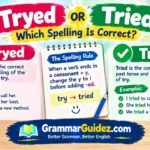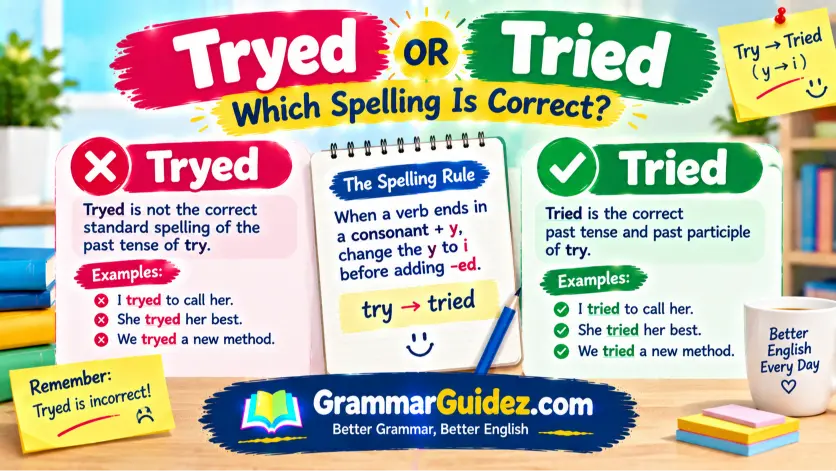
“Tried” and “Tryed” are not equally correct. Tried = the correct spelling. It is the past tense and past participle of try. Tryed = incorrect spelling in standard English.
Have you ever typed tryed and wondered if it looks right?
The correct spelling is tried.
Try is the base verb. When we change it to the past tense or past participle, the y changes to i before -ed is added:
try → tried
So:
❌ tryed
✅ tried
This small spelling change causes a lot of confusion because many English verbs simply take -ed in the past tense. However, verbs ending in a consonant + y follow a different spelling rule.
Quick Answer: Tryed or Tried?
Tried is the correct standard English spelling.
Tryed is not the standard spelling of the past tense or past participle of try.
| Word | Correct? | Use |
| try | ✅ Yes | Base verb |
| tries | ✅ Yes | Present tense, third person |
| trying | ✅ Yes | -ing form |
| tried | ✅ Yes | Past tense and past participle |
| tryed | ❌ No | Common spelling mistake |
For example:
- I tried to call you.
- She tried her best.
- We tried a new method.
- He has tried several times.
What Does Tried Mean?
Tried is the past tense and past participle of try.
The verb try can mean to make an effort, attempt something, or test something to see if it works or if you like it.
Compare these sentences:
Present:
I try to exercise every morning.
Past:
I tried to exercise yesterday.
The first sentence talks about a present or regular action. The second talks about an action that happened in the past.
You can also use tried when you test or experience something:
She tried the new restaurant.
We tried a different recipe.
He tried a new computer program.
Why Is It Tried and Not Tryed?
The answer is a simple spelling rule.
When a verb ends in a consonant + y, the y usually changes to i before -ed is added.
So:
try → tried
The same pattern appears in many other verbs:
| Base Verb | Past Form |
| try | tried |
| cry | cried |
| study | studied |
| carry | carried |
| hurry | hurried |
| worry | worried |
| reply | replied |
This is why writing tryed is incorrect in standard modern English.
A useful way to remember it is:
Consonant + y → i + ed
So:
try → tried
What Happens to the Y in Trying?
Here is where many learners get confused.
The y changes to i before -ed, but it normally stays before -ing.
So:
✅ try → tried
✅ try → trying
Not:
❌ tryed
❌ triing
Look at these examples:
I tried to help.
I am trying to help.
Both forms are correct because different endings follow different spelling rules.
This gives you an easy pattern to remember:
try → tried → trying
Tried vs Tryed in Sentences
The easiest way to see the difference is to compare the two spellings.
| Incorrect | Correct |
| I tryed to help. | I tried to help. |
| She tryed again. | She tried again. |
| He tryed his best. | He tried his best. |
| We tryed a new plan. | We tried a new plan. |
| They tryed to call me. | They tried to call me. |
| I tryed the new recipe. | I tried the new recipe. |
In every example, tried is the correct form.
Tried in Everyday English
We use tried in many normal situations.
Trying to Do Something
Use tried when someone made an effort to do something.
I tried to open the door.
She tried to solve the problem.
They tried to finish the work before lunch.
Trying Something New
Tried can also mean that someone experienced or tested something.
I tried a new coffee shop.
She tried a different shampoo.
We tried a new recipe.
Trying Your Best
The phrase tried my best is very common.
I tried my best to help.
She tried her best to win.
They tried their best to finish on time.
Remember:
❌ I tryed my best.
✅ I tried my best.
Tried or Try After “Did”?
This is another common grammar mistake.
After did, use the base form try, not tried.
Correct:
Did you try the new restaurant?
Incorrect:
Did you tried the new restaurant?
Why?
The word did already shows that the sentence is in the past. The main verb returns to its base form.
Compare:
I tried it yesterday.
But:
Did you try it yesterday?
The same rule applies to negative sentences:
I did not try it.
Not:
I did not tried it.
Tried With Have, Has, and Had
Tried is also the past participle of try, so it works with helping verbs such as have, has, and had.
Examples:
I have tried several times.
She has tried everything.
They have tried a different approach.
He had tried to contact us before.
Do not write:
❌ She has tryed everything.
Write:
✅ She has tried everything.
Tried or Tested?
Sometimes tried and tested can have similar meanings, but they are not always exactly the same.
Tried often means that someone made an attempt or experienced something.
I tried the new recipe.
Tested usually puts more focus on checking how well something works.
We tested the new software.
You can sometimes use either word, depending on the context.
For example:
We tried a new method.
This means we used or attempted the method.
We tested a new method.
This puts more focus on checking its results or performance.
Try, Tried, Tries, and Trying
Learning the whole word family can help you avoid spelling mistakes.
| Form | Example |
| try | I want to try again. |
| tries | She tries every day. |
| tried | He tried yesterday. |
| trying | They are trying again. |
Notice the spelling:
try → tries → tried → trying
The y changes before -es and -ed, but stays before -ing.
Tryed Is a Common Spelling Mistake
Why do people write tryed?
The mistake usually comes from applying the basic past-tense rule too directly.
Many verbs form the past tense by adding -ed:
- walk → walked
- clean → cleaned
- help → helped
- open → opened
Someone may therefore think:
try + ed = tryed
But English spelling does not work that way for verbs ending in consonant + y.
The correct pattern is:
try → tried
The same thing happens with:
- cry → cried
- study → studied
- carry → carried
- worry → worried
When Does the Y Stay?
The rule becomes clearer when you compare try with a word ending in a vowel + y.
For example:
try → tried
But:
play → played
Why?
In try, the letter before y is r, a consonant.
In play, the letter before y is a, a vowel.
Compare:
| Base Verb | Past Form |
| try | tried |
| cry | cried |
| study | studied |
| play | played |
| enjoy | enjoyed |
| stay | stayed |
So do not apply the y → i rule to every word ending in y.
Common Mistakes With Tried
1. Tryed
❌ She tryed to help me.
✅ She tried to help me.
2. Tryied
❌ We tryied again.
✅ We tried again.
There is no extra y or extra i.
3. Did You Tried?
❌ Did you tried it?
✅ Did you try it?
After did, use try.
4. Triing
❌ He is triing to learn.
✅ He is trying to learn.
The y stays before -ing.
5. Trys
❌ He trys every morning.
✅ He tries every morning.
For the third-person singular present form, try becomes tries.
Is Tried the Same in American and British English?
Yes.
Tried is the standard spelling in both American and British English.
This is not like spelling pairs such as:
- color / colour
- recognize / recognise
- traveled / travelled
There is no normal American-versus-British spelling difference between tried and tryed.
If you are writing for readers in the United States, United Kingdom, Canada, Australia, or elsewhere, use tried.
How Do You Spell Tried?
The correct spelling is:
T-R-I-E-D
Easy memory trick
Think:
Try → I → Ed
The y changes to i:
try → tried
You can also connect it with:
cry → cried
Both words follow the same spelling pattern.
Another useful memory line is:
Try today, tried yesterday.
For example:
I try today.
I tried yesterday.
Tried in Formal Writing
Use tried in emails, school assignments, reports, business writing, and everyday messages when you are describing a past attempt or experience.
For example:
We tried several solutions before finding the problem.
I tried to contact the customer yesterday.
The team tried a different approach.
Avoid tryed because it is not the standard spelling.
Correct spelling is especially important in professional and academic writing.
Tried and Tested
You may also see tried in the phrase tried and tested.
This phrase describes something that has been used before and shown to work successfully.
For example:
This is a tried and tested method.
She used a tried and tested recipe.
Here, tried does not simply mean “attempted.” It is part of the expression tried and tested.
You may also see tried and true, which describes something that has worked reliably over time.
A Simple Three-Step Test
If you are unsure if to write tryed or tried, use this quick test.
Step 1: Find the base verb
The base verb is:
try
Step 2: Check the ending
It ends in:
consonant + y
Step 3: Change y to i before -ed
So:
try → tried
That gives you the answer every time.
Tryed or Tried: Quick Practice
Choose the correct word.
- I ___ to call her yesterday.
Answer: tried - She ___ her best to finish the work.
Answer: tried - Did you ___ the new app?
Answer: try - They have ___ several solutions.
Answer: tried - He is ___ to learn English.
Answer: trying - She ___ every day.
Answer: tries - We ___ a different method last week.
Answer: tried - I did not ___ the new recipe.
Answer: try
FAQs About Tryed or Tried
Is tryed a word?
Tryed is not the standard modern spelling of the past tense or past participle of try. Use tried.
Is tried the past tense of try?
Yes. Tried is the past tense and past participle of try.
Why is tryed wrong?
Because try ends in a consonant followed by y. The y changes to i before -ed is added.
try → tried
How do you spell tried?
The correct spelling is T-R-I-E-D.
Is it tried or tryed my best?
The correct phrase is:
I tried my best.
Is it tried or tryed to help?
The correct form is:
She tried to help.
Is it tried or tryed again?
Use:
I tried again.
Is it trying or triing?
The correct spelling is trying.
The y stays before -ing.
Is it tries or trys?
The correct form is tries.
For example:
He tries to help everyone.
Is tried used in American and British English?
Yes. Tried is the standard spelling in both varieties.
Tryed or Tried: Final Answer
When you mean the past tense or past participle of try, use tried.
Tried = correct
Tryed = incorrect standard spelling
The main rule is easy:
consonant + y → change y to i before -ed
So:
try → tried
Remember the full pattern:
try → tries → tried → trying
Once you remember this pattern, tryed or tried becomes much easier.
Read More Articles:

I am Elliot Hartwell, an English language writer and the author at GrammarGuidez.com. For the 6 years I have been working with English grammar, vocabulary, spelling and everyday language usage with a focus on making confusing topics easier to understand.
I started GrammarGuidez.com with a goal: to give readers clear and practical answers to common English questions. English can sometimes be confusing especially when two words look or sound similar but have meanings or uses. I enjoy breaking down these differences in a way that’s simple and easy to remember.
I believe learning English should feel simple not overwhelming. My goal is to make every article on GrammarGuidez.com useful, for students, writers, bloggers, teachers and anyone who wants to communicate clearly in English.