“Ineligible” is the correct spelling, while “uneligible” is a common misspelling and is not the standard form in modern English. “Ineligible” is an adjective meaning not qualified or not allowed to do or receive something, whereas “uneligible” is generally not used in standard English.
If you have ever written “uneligible” and wondered if it is correct, you are not alone. The word looks logical: eligible means qualified or allowed, so adding un- may seem like the natural way to make it negative.
But standard modern English uses ineligible, not uneligible, for this meaning.
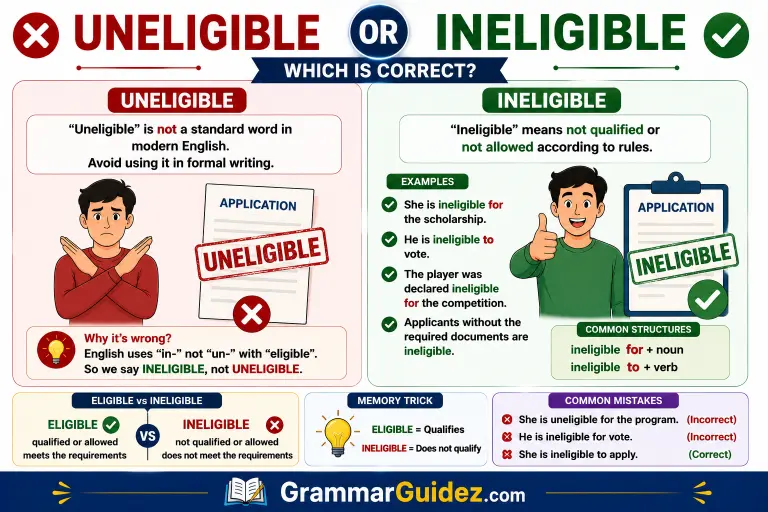
❌ uneligible
✅ ineligible
Ineligible means not qualified, not allowed, or not meeting the conditions required for something. Cambridge defines it as “not allowed to do or have something” according to particular rules.
For example:
Applicants who do not meet the age requirement are ineligible for the program.
So, although uneligible may look grammatically possible, ineligible is the standard word you should use in normal English.
The Answer in One Line
Ineligible is the correct and standard word.
Use ineligible when someone does not meet the rules, requirements, or conditions for something.
She is ineligible for the scholarship.
He is ineligible to vote.
The player was declared ineligible for the competition.
Uneligible should generally be avoided in standard English.
Why “Ineligible” Is Correct
The word ineligible is formed from:
in- + eligible = ineligible
Here, in- gives the word a negative meaning.
Eligible means:
qualified or allowed to do or receive something.
Ineligible means:
not qualified or not allowed.
Cambridge defines eligible as having the necessary qualities or satisfying the necessary conditions, while ineligible is its opposite.
Compare:
She is eligible for the grant.
She meets the requirements.
What Does “Eligible” Mean?
Before understanding ineligible, it helps to understand eligible.
Eligible is an adjective meaning that someone or something meets the necessary conditions.
For example:
Students over 18 are eligible to apply.
You may be eligible for financial assistance.
He is eligible to enter the competition.
Cambridge commonly uses two structures:
Eligible for + noun
She is eligible for a scholarship.
Eligible to + verb
She is eligible to apply for the scholarship.
When we make this meaning negative, we use ineligible.
She is ineligible for the scholarship.
She is ineligible to apply.
What Does “Ineligible” Mean?
Ineligible means that someone or something does not meet the required conditions.
It can mean:
- not qualified
- not allowed
- not entitled
- not meeting the requirements
- disqualified under particular rules
Cambridge gives examples involving aid, government funding, competitions, and other situations where rules determine who can participate or receive something.
Examples
He was ineligible for the scholarship.
She became ineligible to receive the benefit.
The player was declared ineligible for the competition.
Applicants without the required documents are ineligible.
Why Not “Uneligible”?
This is where English can be frustrating.
English has several negative prefixes, including:
- un-
- in-
- im-
- il-
- ir-
So learners naturally think:
eligible → uneligible
But English does not always create negative words by simply adding un-.
For this particular adjective, standard English uses:
eligible → ineligible
The Cambridge Dictionary lists ineligible as the standard adjective and identifies it as the opposite of eligible.
Therefore:
❌ uneligible
✅ ineligible
This is a good example of why English word formation cannot always be predicted from a simple prefix rule.
Ineligible in Real-Life Situations
The word ineligible is especially common when rules or requirements determine if someone can participate, receive something, or qualify for something.
Scholarships
Students who fail to meet the academic requirements may be ineligible for the scholarship.
Jobs
Applicants without the required certification are ineligible for the position.
Competitions
The player was declared ineligible for the competition.
Benefits
Some families may be ineligible for government assistance.
Voting
People who do not meet the legal requirements may be ineligible to vote.
Financial programs
His income made him ineligible for the program.
These uses match the standard dictionary meaning of the word.
Ineligible for vs Ineligible to
Two structures are especially useful.
Ineligible for + noun
Use ineligible for before a noun.
She is ineligible for the scholarship.
He is ineligible for the position.
They are ineligible for financial assistance.
The company is ineligible for funding.
Formula
ineligible + for + noun
Ineligible to + verb
Use ineligible to before a verb.
He is ineligible to vote.
She is ineligible to apply.
The player is ineligible to compete.
They are ineligible to receive the benefit.
Formula
ineligible + to + verb
Cambridge specifically lists ineligible to do something as a common collocation.
A Quick Meaning Test
When you see ineligible, ask:
Does this person or thing meet the requirements?
If the answer is no, ineligible may be the right word.
Example
A scholarship requires students to have a GPA of 3.5 or higher.
John has a GPA of 3.0.
Therefore:
John is ineligible for the scholarship.
He does not meet the condition.
Ineligible vs Disqualified
These words can be similar, but they are not always identical.
Ineligible
Means someone does not meet the requirements or is not allowed under the rules.
She was ineligible to enter the competition.
Disqualified
Usually means someone lost eligibility or was removed because of a rule violation or another specific reason.
The athlete was disqualified for breaking the rules.
So ineligible focuses on if someone qualifies, while disqualified often focuses on being removed or ruled out.
Collins lists terms such as unqualified, ruled out, unacceptable, and disqualified among synonyms or related words for ineligible.
Ineligible vs Unqualified
These words also overlap.
Ineligible often means:
not allowed under specific rules or conditions.
Unqualified can mean:
lacking the necessary skills, training, or qualifications.
Compare:
He is ineligible for the scholarship because he is too old.
His problem is the rule.
He is unqualified for the job because he lacks the required training.
His problem is his qualifications.
The words can sometimes overlap, but ineligible is especially useful when rules or conditions decide eligibility.
Common Mistakes With Uneligible and Ineligible
Mistake 1: Writing “uneligible”
❌ She is uneligible for the grant.
✅ She is ineligible for the grant.
Mistake 2: Using “ineligible for” incorrectly
❌ He is ineligible to the scholarship.
✅ He is ineligible for the scholarship.
Remember:
ineligible for + noun
Mistake 3: Using “ineligible for” before a verb
❌ She is ineligible for apply.
✅ She is ineligible to apply.
Remember:
ineligible to + verb
Mistake 4: Confusing eligible and ineligible
❌ He meets all the requirements, so he is ineligible.
✅ He meets all the requirements, so he is eligible.
If someone qualifies, use eligible.
If someone does not qualify, use ineligible.
A Useful Word Family
Learning the whole word family can make this easier.
| Word | Meaning |
| eligible | qualified or allowed |
| ineligible | not qualified or allowed |
| eligibility | the state of being eligible |
| ineligibility | the state of being ineligible |
For example:
The student is eligible for the program.
The student is ineligible for the program.
The school will check his eligibility.
The committee questioned his ineligibility.
Cambridge lists ineligibility as the noun meaning the fact of not being allowed to do or have something under particular rules.
Eligible vs Ineligible: Side-by-Side
| Eligible | Ineligible |
| Meets the requirements | Does not meet the requirements |
| Allowed | Not allowed |
| Qualified | Not qualified |
| Can participate | Cannot participate |
| Can receive something | Cannot receive it |
| Eligible for a grant | Ineligible for a grant |
| Eligible to vote | Ineligible to vote |
Example
Sarah is eligible for the scholarship.
She meets the requirements.
Mark is ineligible for the scholarship.
He does not meet the requirements.
Is “Uneligible” Ever Used?
You may encounter uneligible in informal writing, older material, learner writing, or places where someone has formed the word incorrectly.
However, if your goal is standard modern English, use ineligible.
For school work, professional writing, websites, applications, reports, and formal documents:
✅ ineligible
is the safe and standard choice.
You should not choose uneligible simply because un- is a common negative prefix.
Why Does English Use “In-” Here?
English has borrowed and developed many words from Latin and French. Negative prefixes do not always behave like a simple mathematical formula.
For example:
possible → impossible
legal → illegal
regular → irregular
responsible → irresponsible
And:
eligible → ineligible
This means learners often need to learn the standard form of each word rather than assuming that un- will always work.
Quick Editing Exercise
Correct each sentence.
1. She is uneligible for the program.
Correct:
She is ineligible for the program.
2. He is ineligible for vote.
Correct:
He is ineligible to vote.
3. They are eligible for receive the funds.
Correct:
They are eligible to receive the funds.
4. The player was declared uneligible.
Correct:
The player was declared ineligible.
5. She meets all the requirements, so she is ineligible.
Correct:
She meets all the requirements, so she is eligible.
Mini Quiz: Uneligible or Ineligible?
Choose the correct word.
1. He is ___ for the scholarship.
A. uneligible
B. ineligible
Answer: B. ineligible
2. She is ___ to participate.
A. uneligible
B. ineligible
Answer: B. ineligible
3. The applicant was declared ___.
A. uneligible
B. ineligible
Answer: B. ineligible
4. People who fail the age requirement are ___ to vote.
A. uneligible
B. ineligible
Answer: B. ineligible
5. Which is the standard word?
A. uneligible
B. ineligible
Answer: B. ineligible
FAQs
Is it “uneligible” or “ineligible”?
Ineligible is the standard word. It means not qualified or not allowed according to certain conditions or rules. Uneligible should generally be avoided in standard English. For example, write “She is ineligible for the scholarship,” not “She is uneligible for the scholarship.”
Why is “ineligible” correct?
English uses the negative prefix in- in ineligible. The word is the standard opposite of eligible. Cambridge defines eligible as satisfying necessary conditions and ineligible as not being allowed or not satisfying those conditions.
What does ineligible mean?
Ineligible means that a person or thing does not meet the requirements for something. It can mean not qualified, not entitled, or not allowed. For example, “He is ineligible for the grant” means he does not satisfy the conditions required to receive the grant.
Is it “ineligible for” or “ineligible to”?
Both are correct, but they are followed by different structures. Use ineligible for + noun: “She is ineligible for the scholarship.” Use ineligible to + verb: “She is ineligible to apply.” Cambridge lists both patterns.
Is “uneligible” a real English word?
You may find uneligible in some texts, but it is not the standard choice for modern general English. When you mean “not eligible,” use ineligible in formal, academic, professional, and everyday writing.
What is the opposite of ineligible?
The direct opposite is eligible. If someone meets the required conditions, they are eligible. If they do not meet them, they are ineligible. Cambridge explicitly identifies ineligible as the opposite of eligible.
What is the noun form of ineligible?
The noun is ineligibility. It means the state or fact of not being eligible. For example: “The committee reviewed his ineligibility for the position.” Cambridge lists ineligibility as an uncountable noun.
Conclusion
If you are asking “uneligible or ineligible?”, the answer is clear:
❌ Uneligible
✅ Ineligible
Use ineligible when someone does not meet the rules, requirements, or conditions for something.
Remember these two patterns:
ineligible for + noun
She is ineligible for the scholarship.
ineligible to + verb
She is ineligible to apply.
And keep the basic relationship in mind:
eligible = qualifies
ineligible = does not qualify
Although uneligible may look logical, English does not always form negative adjectives with un-. In this case, ineligible is the established standard form used by major dictionaries.
Once you remember eligible → ineligible, this commonly confused pair becomes much easier.
Read More Articles:
- Non or None: What’s the Difference and How Do You Use Them?
- As or Like: What’s the Difference and When Should You Use Each?
- Apposed or Opposed: What’s the Difference?

I am Elliot Hartwell, an English language writer and the author at GrammarGuidez.com. For the 6 years I have been working with English grammar, vocabulary, spelling and everyday language usage with a focus on making confusing topics easier to understand.
I started GrammarGuidez.com with a goal: to give readers clear and practical answers to common English questions. English can sometimes be confusing especially when two words look or sound similar but have meanings or uses. I enjoy breaking down these differences in a way that’s simple and easy to remember.
I believe learning English should feel simple not overwhelming. My goal is to make every article on GrammarGuidez.com useful, for students, writers, bloggers, teachers and anyone who wants to communicate clearly in English.