“Non” and “none” are both correct words, but they have different meanings. “Non” is a prefix meaning not or without, while “none” is a pronoun meaning not any or no one.
Non or none can be confusing because the two words look and sound similar. Yet they do very different jobs in a sentence.
If you are writing an email, school assignment, blog post, or business document, using the wrong word can change the meaning of your sentence.
The easiest rule is this:
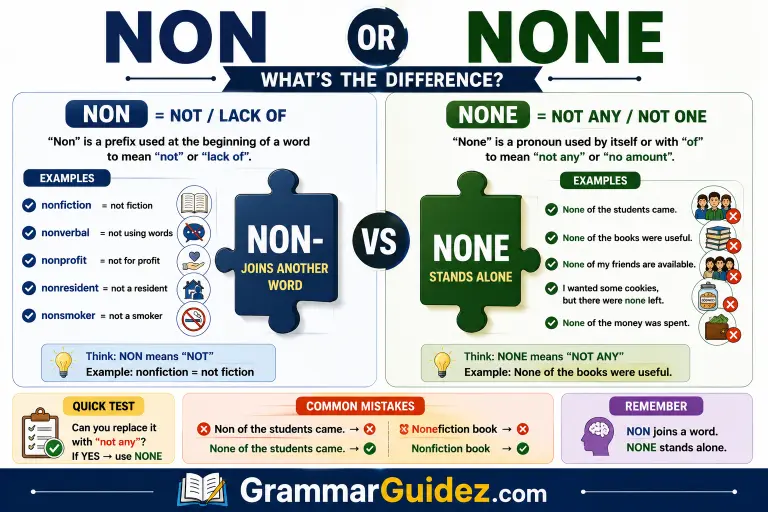
Non usually means “not” or “lack of.”
None means “not any” or “not one.”
For example:
- Non-smoker = a person who does not smoke.
- None of the students came to class. = Not any of the students came.
So, non is often used to form another word, while none usually stands on its own as a pronoun.
But there is more to this difference. In this guide, we will look at their meanings, grammar, examples, common mistakes, pronunciation, and easy ways to remember non vs none.
Non vs None: The 10-Second Answer
Use non when you mean “not” or when it forms a word with another word.
nonfiction = writing that is not fiction
nonverbal = not involving spoken words
nonpayment = failure or refusal to make a payment
Use none when you mean “not any,” “not one,” or “no amount.”
None of the answers was correct.
None of my friends were available.
The easiest test
If you can replace the word with “not any”, you probably need none.
None of the food was left.
= Not any of the food was left.
But you cannot normally do this with non:
❌ Not any-smoker
✅ non-smoker
What Does “Non” Mean?
Non is mainly used as a prefix.
A prefix is a group of letters placed at the beginning of a word to change its meaning.
Non- usually gives the idea of:
- not
- absence of
- lack of
- opposite of
- not belonging to a particular group
For example:
nonfiction
This means writing that is not fiction.
Another example:
nonverbal
This describes something that does not use spoken words.
Common words beginning with “non-”
- nonfiction
- nonprofit
- nonverbal
- nonresident
- nonpayment
- nonessential
- nonhuman
- nonsmoker
- nonstandard
- nonviolent
Notice that non usually does not work as a replacement for none.
What Does “None” Mean?
None is a pronoun.
It means not any, not one, or no amount.
For example:
None of the students answered.
This means:
Not any of the students answered.
You can use none when talking about people, things, amounts, or groups.
Examples
None of my friends called.
None of the books were useful.
I wanted some cookies, but there were none left.
The exact grammatical form can depend on what none refers to, but its core idea remains “not any.”
Non and None Do Different Jobs
One useful way to understand the difference is to look at their grammatical roles.
| Word | Main role | Basic meaning | Example |
| non | Prefix | not / absence of | nonverbal |
| none | Pronoun | not any / not one | None were available |
| non- | Word-forming element | opposite or absence | nonprofit |
| none | Stand-alone word | no amount | None of the money was spent |
This distinction solves most non or none questions.
Remember:
NON → joins another word
NONE → usually stands alone
A Simple Example That Shows the Difference
Consider these two sentences:
She is a non-smoker.
None of the smokers were inside.
The first sentence uses non- to create a word.
non + smoker = nonsmoker
The second sentence uses none to mean not any.
None of the smokers were inside.
They may look similar, but their grammar is completely different.
When Should You Use “Non-”?
Use non- when you want to describe something as not having a certain quality or not belonging to a certain category.
Example 1: Nonfiction
I prefer nonfiction books.
The word means books that are not fiction.
Example 2: Nonverbal
The patient gave a nonverbal response.
The response did not use spoken words.
Example 3: Nonprofit
She works for a nonprofit organization.
The word describes an organization that operates on a nonprofit basis.
Example 4: Nonpayment
The account was closed because of nonpayment.
The word describes a failure to make a payment.
In each case, non- is attached to another word.
When Should You Use “None”?
Use none when you mean not any, not one, or no amount.
With people
None of my friends were home.
With things
None of these shirts fit me.
With money
None of the money was missing.
With food
None of the cake remains.
With choices
None of these options looks good.
A useful question to ask is:
Can I replace none with not any?
If yes, none is probably correct.
None of vs Non-: A Common Confusion
This is where many learners make mistakes.
Compare:
None of the employees arrived.
and:
Nonemployees cannot enter this area.
These are completely different structures.
None of
None of + noun/pronoun
Non-
Non- + word
Nonemployees cannot enter.
So:
❌ Non of the students arrived.
✅ None of the students arrived.
And:
❌ Noneemployees cannot enter.
✅ Nonemployees cannot enter.
Is “Non” a Word by Itself?
Usually, non- is treated as a prefix rather than an ordinary stand-alone word.
You will most often see it attached to another word:
nonessential
nonresident
nonacademic
noncommercial
nonverbal
However, non can appear independently in some contexts, especially as an informal shortening or in specialized usage. For ordinary English learners, the safest rule is:
Use non- as part of a word.
Do not use non when you mean “not any.”
For that meaning, use none.
Can “None” Be Used With Plural Nouns?
Yes.
You will often see:
None of the students were ready.
None of the books were damaged.
The exact choice between a singular or plural verb after none of can depend on if the noun is treated as singular, plural, countable, or uncountable and on the style being followed.
For everyday English, plural nouns commonly take a plural verb:
None of the students were ready.
With an uncountable noun, a singular verb is natural:
None of the money was missing.
The important point is that none means not any.
None Can Mean “Nothing” or “No One”
The meaning of none changes slightly depending on context.
None = no one
Who called?
None of my friends.
None = nothing
How much is left?
None.
None = not any
How many tickets are available?
None.
So none can refer to people, things, or amounts.
Non or None in Everyday Sentences
Let’s compare the words side by side.
With “non-”
He is a nonresident.
With “none”
None of the residents complained.
With “non-”
This is a nonfiction book.
With “none”
None of the books are mine.
With “non-”
The company is nonprofit.
With “none”
None of the profits were distributed.
This pattern makes the difference much easier to see.
Common Mistakes to Avoid
Mistake 1: “Non of”
This is one of the most common errors.
❌ Non of my friends came.
✅ None of my friends came.
Why?
Because you mean:
Not any of my friends came.
Therefore, use none.
Mistake 2: “Nonefiction”
❌ nonefiction
✅ nonfiction
Nonfiction is a single word formed with the prefix non-.
Mistake 3: “Noneprofit”
❌ noneprofit
✅ nonprofit
The correct word is nonprofit.
Mistake 4: “Non of the money”
❌ Non of the money was spent.
✅ None of the money was spent.
Here, none means no amount.
Mistake 5: Using “none” as a prefix
❌ noneverbal
✅ nonverbal
The prefix is non-, not none-.
Non vs None in British and American English
Unlike many confusing English word pairs, non vs none is not mainly a British-versus-American spelling issue.
Both British English and American English use:
non-
and:
none
The basic meanings remain the same.
For example:
American English
None of the students were ready.
British English
None of the students were ready.
Likewise:
This is a nonprofit organization.
The main issue is not regional spelling. It is grammar and meaning.
How Do You Pronounce Non and None?
The pronunciation can add to the confusion.
In many varieties of English, non is commonly pronounced like “non” with a short vowel, while none has a pronunciation that sounds like “nuhn” or /nʌn/.
However, pronunciation can vary by accent.
For learners, spelling and grammar are more useful than trying to depend only on sound.
When writing, ask:
Am I forming a word with non-?
or:
Am I saying not any?
That will usually give you the answer.
A Better Way to Remember the Difference
Here is a simple memory trick:
NON = NOT
Think:
nonfiction = not fiction
nonverbal = not verbal
nonprofit = not-for-profit
Now remember:
NONE = NOT ANY
None of the students = not any of the students.
This gives you a very simple formula:
NON → NOT
NONE → NOT ANY
Try the “Not Any” Test
Whenever you are unsure, replace the word with not any.
Example
of the food was left.
Try:
Not any of the food was left.
That works.
So the answer is:
✅ None of the food was left.
Now try:
She is a smoker.
“Not any smoker” does not work.
You need a word meaning “not a smoker”:
✅ nonsmoker
This quick test can solve many spelling and grammar questions.
Non- Can Create Opposite Ideas
The prefix non- often creates a word that contrasts with another word.
For example:
| Original | With non- |
| fiction | nonfiction |
| verbal | nonverbal |
| resident | nonresident |
| essential | nonessential |
| violent | nonviolent |
| standard | nonstandard |
| profit | nonprofit |
| payment | nonpayment |
This is one reason non- is useful in English.
But remember that non- does not always mean a perfect opposite. Its exact meaning depends on the word it joins.
None Can Stand Alone
This is one of the easiest grammar clues.
You can write:
None were available.
None remained.
But you cannot normally use non in these sentences:
❌ Non were available.
❌ Non remained.
Why?
Because none can function as a pronoun. Non- is normally a prefix.
A Mini Editing Challenge
Can you find the mistakes?
Sentence 1
Non of the answers were correct.
Correction:
None of the answers were correct.
Sentence 2
She bought a nonefiction book.
Correction:
She bought a nonfiction book.
Sentence 3
Noneverbal communication can be important.
Correction:
Nonverbal communication can be important.
Sentence 4
There were none students in the room.
Correction:
There were no students in the room.
This last example is important because none cannot simply replace no in every sentence.
None vs No
None and no are related, but they are used differently.
No + noun
There were no students in the room.
None
None of the students were in the room.
So:
no + noun
but:
none can stand alone or appear in none of + noun.
This is another useful distinction for English learners.
None vs Nothing
These two words can also overlap.
None
Usually refers to a group, amount, or previously mentioned things.
I wanted some cookies, but there were none left.
Nothing
Means not anything.
There was nothing in the box.
Compare:
None of the cookies were left.
There was nothing in the box.
The choice depends on what you are referring to.
Quick Practice: Non or None?
Choose the correct answer.
1. ___ of my classmates came to the event.
A. Non
B. None
Answer: B. None
2. This is a ___fiction story.
A. non
B. none
Answer: A. non
3. The organization is ___profit.
A. non
B. none
Answer: A. non
4. ___ of the money was recovered.
A. Non
B. None
Answer: B. None
5. He gave a ___verbal response.
A. non
B. none
Answer: A. non
6. ___ of the options is suitable.
A. Non
B. None
Answer: B. None
7. She is a ___smoker.
A. non
B. none
Answer: A. non
8. ___ of the students knew the answer.
A. Non
B. None
Answer: B. None
FAQs
Is it “non of” or “none of”?
The correct expression is none of when you mean “not any of.” For example, “None of the students were absent.” Non of is not the standard form for this meaning. Use non- when forming words such as nonfiction, nonprofit, and nonverbal.
What is the difference between non and none?
Non- is mainly a prefix meaning “not” or showing absence, while none is a pronoun meaning “not any,” “not one,” or “no amount.” For example, nonfiction means “not fiction,” while none of the books means “not any of the books.”
Is “non” a prefix?
Yes. Non- is a common English prefix. It can be added to words to express ideas such as “not,” “absence of,” or “lack of.” Examples include nonfiction, nonverbal, nonprofit, nonresident, and nonessential.
Can I use “none” before a noun?
Usually, none is not used directly before a noun in the same way as no. Say “none of the students” or “no students.” For example, “None of the students came” is correct, while “none students came” is not standard English.
Is none singular or plural?
None can refer to a singular or plural idea. With an uncountable noun, a singular verb is common: “None of the money was missing.” With a plural noun, a plural verb is common: “None of the students were ready.” The choice can depend on what none refers to and the style being used.
Is non the opposite of none?
Not exactly. Non- and none have related negative ideas, but they perform different grammatical jobs. Non- usually means “not” as part of another word, while none means “not any” or “not one.” They should not be used interchangeably.
How can I remember non vs none?
Use this simple rule: NON = NOT and NONE = NOT ANY. Think of nonfiction as “not fiction.” Then think of none of the books as “not any of the books.” This quick mental test will help you choose the correct word.
Final Takeaway: Non or None?
The difference between non and none becomes much easier once you look at their jobs.
Non- is mainly a prefix. It joins another word and often means “not” or “absence of.”
nonfiction
nonprofit
nonverbal
nonresident
None is a pronoun. It means “not any,” “not one,” or “no amount.”
None of the students came.
None of the food remains.
So remember:
NON = NOT
NONE = NOT ANY
And watch out for the common mistake “non of.” When you mean “not any of,” always use none of.
Once you learn this simple distinction, choosing between non or none becomes much easier and your writing will be clearer and more accurate.
Read More Articale:
- Churches or Church’s: Which One Is Correct?
- Maximum or Minimum: What’s the Difference and Which One Should You Use?

I am Evan Whitmore, an English language writer and the person who started GrammarGuidez.com. I made GrammarGuidez.com to make grammar, spelling, vocabulary and words that are often confused easier to understand.
I like taking to understand English words and grammar rules and turning them into simple and clear explanations. My aim is to help students, writers, bloggers, ESL learners and regular English speakers feel more sure when they write and talk.
At GrammarGuidez.com I work on real life examples easy to understand explanations comparing words, spelling changes and how American English is used every day.
I think learning English doesn’t need to be hard. A good explanation and some good examples can make tough grammar topics much simpler to learn