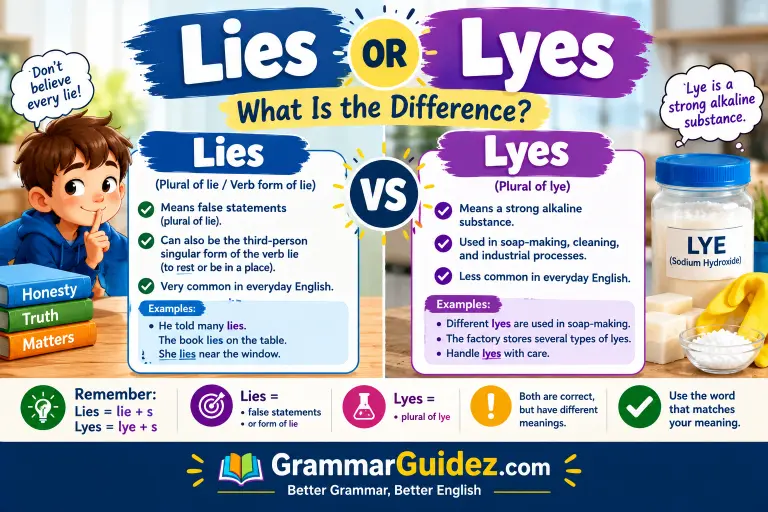
“Lies” and “Lyes” are both correct words, but they have different meanings and uses. Lies is the plural of lie or the third-person singular form of the verb lie. Lyes is the plural of lye, a strong alkaline substance used in products such as soap and cleaning materials.
If you are confused about lies or lyes, you are looking at two real English words. Both lies and lyes are correct spellings, but they have very different meanings.
Lies is the much more common word. It can be the plural of lie, or it can be a verb form of lie.
Lyes, on the other hand, is the plural form of lye. A lye is a strong alkaline substance used in products and industrial processes. The word lyes is much less common in everyday English.
So, the correct word depends on what you want to say.
If you mean false statements, use lies.
If you mean more than one type or quantity of lye, use lyes.
In this guide, you will learn the difference between lies and lyes, their meanings, grammar, pronunciation, common mistakes, examples, and an easy way to remember which word to use.
Quick Answer: Lies or Lyes?
Both lies and lyes are correct words, but they have different meanings.
Lies can mean false statements or can be a form of the verb lie.
Lyes is the plural of lye, a strong alkaline substance.
| Word | Meaning | Common Use |
| Lies | False statements; also a form of “lie” | Very common |
| Lyes | Plural of “lye” | Chemistry, soap-making, industry |
Easy Rule
Remember:
Lies = lie + s
Lyes = lye + s
The letter y stays in lyes because the singular word is lye.
What Does Lies Mean?
Lies has more than one meaning because it can come from the verb lie or the noun lie.
Lies as a Noun
As a noun, lies is the plural of lie.
A lie is a statement that is not true, especially when someone knows it is not true.
So:
One lie → two lies
For example:
- He told a lie.
- He told several lies.
Here, lies means false statements.
Lies as a Verb
Lies can also be the third-person singular form of the verb lie, meaning to rest or be in a particular position.
For example:
- The book lies on the table.
- The dog lies under the tree.
- The town lies near the river.
In these sentences, lies does not mean false statements.
This is why context is important.
What Does Lyes Mean?
Lyes is the plural form of lye.
Lye is a strong alkaline substance. It is used in areas such as soap-making, cleaning, food processing, and industry, depending on the type and application.
The plural is:
lye → lyes
The word is much less common than lies and is usually found in technical, scientific, manufacturing, or soap-making contexts.
For everyday English, you will see lies far more often.
Lies vs. Lyes
The main difference is their meaning.
Lies is connected with the word lie.
Lyes is connected with the word lye.
| Feature | Lies | Lyes |
| Singular form | Lie | Lye |
| Part of speech | Noun or verb | Noun |
| Main meaning | False statements or a form of “lie” | Plural of lye |
| Common in everyday English | ✅ Yes | ❌ No |
| Related to chemistry | Usually no | ✅ Yes |
| Related to false statements | ✅ Yes | ❌ No |
Lies as the Plural of Lie
When lies means false statements, it is simply the plural of lie.
The pattern is:
Lie → Lies
For example:
One lie
Many lies
The spelling changes from lie to lies.
This is a normal plural spelling.
Lies as a Verb
There is another important use of lies.
It can be the third-person singular form of lie, meaning to rest in a flat or relaxed position or to be located somewhere.
For example:
The cat lies on the sofa.
Here, lies is a verb.
It does not mean that the cat is telling something untrue.
Another meaning is location:
The village lies between two mountains.
Here, lies means is located.
The Different Meanings of Lie
The word lie can cause confusion because it has different meanings.
Lie = Tell Something Untrue
This meaning relates to dishonesty.
Lie → lied → lied
Example:
He lied to his friend.
Lie = Rest or Recline
This meaning means to be in a resting position.
Its common forms are:
lie → lay → lain
Example:
I want to lie down.
In the present tense:
She lies on the bed.
So lies can come from the second meaning of lie, as well as being the plural noun of lie.
What Is Lye?
To understand lyes, you first need to understand lye.
Lye is a strong alkaline substance. Common substances referred to as lye include sodium hydroxide and potassium hydroxide.
Lye is used in several applications, including some types of soap-making and industrial processes.
Because lye can be dangerous and corrosive, it must be handled with appropriate safety precautions.
The plural form is:
lyes
This word is mainly useful when discussing more than one lye product, type, or solution.
Why Do Lies and Lyes Cause Confusion?
The confusion comes from pronunciation and spelling.
Lies and lyes are pronounced the same in standard English.
They are both commonly pronounced like:
lyez
This makes them homophones.
Homophones are words that sound the same but have different spellings and meanings.
Because lies and lyes sound alike, you cannot always tell which spelling someone means just by hearing the word.
You need to look at the context.
Lies and Lyes Are Homophones
This is an important point.
Lies and lyes are homophones because they have the same pronunciation but different meanings and spellings.
Think of them like this:
Lies → false statements / form of lie
Lyes → plural of lye
The sound is the same.
The meaning is different.
The spelling is different.
Common Mistakes With Lies and Lyes
Mistake 1: Using Lyes for False Statements
If you mean false statements, do not write lyes.
Correct:
The story contains several lies.
Not:
The story contains several lyes.
Mistake 2: Using Lies for Lye
If you are talking about the chemical substance lye, the plural is lyes.
Correct:
Different lyes may be used for different processes.
Mistake 3: Assuming One Spelling Is Wrong
Unlike many confusing word pairs, both spellings are valid.
Lies is correct.
Lyes is also correct.
The key is choosing the spelling that matches your meaning.
Lies or Lyes in Everyday English
In normal everyday English, lies is much more common.
You may see lies when people talk about:
- Truth and honesty
- False statements
- Stories
- Relationships
- News
- Personal behavior
- Location or position
Lyes is much more specialized.
You are more likely to see it in discussions about:
- Chemistry
- Soap-making
- Manufacturing
- Industrial processes
- Alkaline substances
Therefore, if you are writing normal everyday English and mean false statements, lies is almost certainly the word you need.
How to Remember Lies or Lyes
Use the singular word to remember the spelling.
If the singular is “lie”:
lie → lies
If the singular is “lye”:
lye → lyes
A simple memory trick is:
Lies has “lie” inside it. Lyes has “lye” inside it.
So ask yourself:
Am I talking about a lie?
If yes:
lies
Am I talking about lye?
If yes:
lyes
Lies or Lyes: Comparison Table
| Question | Lies | Lyes |
| Is it a real English word? | Yes | Yes |
| Singular form | Lie | Lye |
| Pronunciation | Same as “lyes” | Same as “lies” |
| False statements? | Yes | No |
| Form of the verb “lie”? | Yes | No |
| Plural of lye? | No | Yes |
| Common everyday word? | Yes | No |
| Technical word? | Sometimes | Often |
Examples of Lies
Here are some examples of lies meaning false statements:
- He told many lies.
- The child admitted that he had told a lie.
- We should not believe his lies.
- Her story was full of lies.
- The truth eventually exposed the lies.
Lies as a Verb
Here are examples where lies is a verb:
- The book lies on the desk.
- The dog lies near the door.
- The house lies at the end of the road.
- The answer lies in understanding the problem.
Notice that these sentences do not involve dishonesty.
Examples of Lyes
Here are examples using lyes as the plural of lye:
- Different lyes can be used in soap-making.
- The factory stores several types of lyes.
- The process requires carefully prepared lyes.
- The properties of different lyes can vary.
- Workers must handle lyes with care.
The word lyes is less common, so these examples are more technical than everyday English.
Is “Lyes” a Common Word?
No.
Lyes is a valid plural form of lye, but it is not common in everyday conversation.
Most English speakers use lies much more often.
If you are reading or writing about ordinary communication, you will probably encounter lies frequently.
If you are reading technical information about lye, soap-making, or chemical processes, you may encounter lyes.
Lies or Lyes: Which One Should You Use?
Use lies when you mean:
- False statements
- More than one lie
- The third-person singular form of the verb lie
- Something that is located somewhere
Use lyes when you mean:
- More than one lye
- Different lye substances, types, or solutions
The meaning determines the spelling.
FAQs About Lies or Lyes
Is lies the correct spelling?
Yes. Lies is a standard English word. It can be the plural of lie or the third-person singular form of the verb lie.
Is lyes a real word?
Yes. Lyes is the plural of lye, a strong alkaline substance.
Are lies and lyes pronounced the same?
Yes. Lies and lyes are homophones and are pronounced the same.
What is the plural of lie?
The plural noun is lies.
Lie → lies
What is the plural of lye?
The plural is lyes.
Lye → lyes
What is the difference between lies and lyes?
Lies is related to lie and can mean false statements or a form of the verb lie. Lyes is the plural of lye, a strong alkaline substance.
Which is more common, lies or lyes?
Lies is much more common in everyday English. Lyes is mainly used in technical or specialized contexts.
Are lies and lyes homophones?
Yes. They have the same pronunciation but different spellings and meanings.
Conclusion
When choosing between lies or lyes, remember that both are correct words. The difference is their meaning.
Lies is the plural of lie and can also be the third-person singular form of the verb lie. It is very common in everyday English.
Lyes is the plural of lye, a strong alkaline substance. It is much less common and is mainly used in technical, scientific, soap-making, or industrial contexts.
The easiest way to choose the correct spelling is to check the singular form:
Lie → Lies
Lye → Lyes
Because lies and lyes sound the same, context is the key.
Remember:
Lies = more than one lie / form of “lie” ✅
Lyes = more than one lye ✅
Neither spelling is automatically wrong. Use the word that matches your meaning.
Read More Articles:

I am Evan Whitmore, an English language writer and the person who started GrammarGuidez.com. I made GrammarGuidez.com to make grammar, spelling, vocabulary and words that are often confused easier to understand.
I like taking to understand English words and grammar rules and turning them into simple and clear explanations. My aim is to help students, writers, bloggers, ESL learners and regular English speakers feel more sure when they write and talk.
At GrammarGuidez.com I work on real life examples easy to understand explanations comparing words, spelling changes and how American English is used every day.
I think learning English doesn’t need to be hard. A good explanation and some good examples can make tough grammar topics much simpler to learn