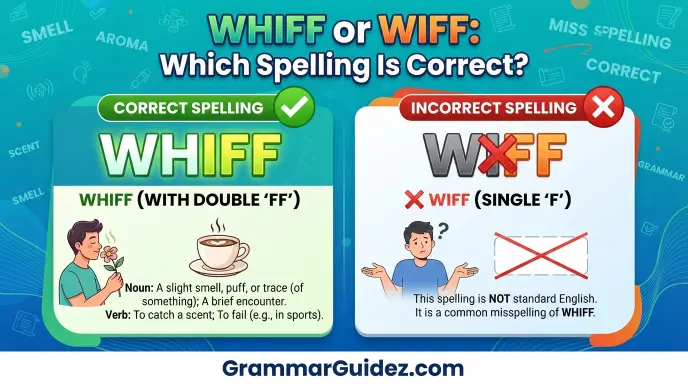
“Whiff” is the correct spelling, while “wiff” is a common misspelling and not the standard English spelling. “Whiff” is a noun meaning a brief or slight smell, while “wiff” has no accepted meaning in standard English.
Have you ever wanted to write whiff or wiff and stopped because both spellings seem to sound the same? You are not alone. This is a common spelling question, especially for English learners.
In modern standard English, whiff is the correct spelling when you mean a small amount of smell, a short puff of air, or a complete miss in some sports contexts. Cambridge Dictionary defines whiff as a slight smell carried through the air, and Merriam-Webster also gives meanings related to a puff of air, an odor, a slight trace, and a strikeout.
Wiff is not the normal modern spelling of this word. It can appear in historical dialects, names, specialized uses, or informal slang, but it should not replace whiff in ordinary English writing.
So if you are writing a school assignment, blog post, email, or professional document, remember:
Whiff is the standard spelling.
Let’s look at the difference in a simple and practical way.
Whiff or Wiff: The Quick Answer
Whiff is the standard spelling in modern English.
It can mean:
- A small amount of smell
- A short puff of air, smoke, or gas
- A slight hint or trace of something
- A complete miss in some sports
- An unsuccessful attempt in informal US usage
For example:
I caught a whiff of fresh coffee.
The pitcher whiffed the batter.
Wiff is not the standard spelling for these meanings.
| Word | Standard modern English? | Common meaning |
| Whiff | ✅ Yes | Smell, puff, hint, or miss |
| Wiff | ❌ No for these standard meanings | Usually a nonstandard or specialized form |
What Does “Whiff” Mean?
Whiff has several meanings, but they are connected by the idea of a small amount, short burst, or brief experience.
1. A Small Smell
This is probably the most common meaning.
A whiff is a brief or slight smell that reaches your nose.
For example:
I caught a whiff of fresh bread.
There was a whiff of smoke in the room.
She noticed a whiff of perfume.
Cambridge defines whiff as a slight smell carried by a current of air.
2. A Short Puff of Air
Whiff can also refer to a small puff or gust.
A whiff of cold air came through the window.
Merriam-Webster includes a quick puff or slight gust of air, odor, gas, smoke, or spray among the word’s meanings.
3. A Slight Hint
The word can be used in a more abstract way.
There was a whiff of suspicion in his comments.
Here, whiff does not mean an actual smell.
It means a small sign or hint of something.
Cambridge gives the expression “a whiff of something” for a slight sign of something.
Whiff as a Verb
Whiff can also be a verb.
As a verb, it can mean to smell or inhale an odor.
For example:
I whiffed the fresh coffee.
The room whiffed of gas.
Cambridge lists whiff as a verb meaning to have an unpleasant smell and also gives sports-related uses.
The common forms are:
- whiff
- whiffs
- whiffed
- whiffing
Example
The dog whiffed the food.
She was whiffing the flowers.
Whiff in Sports
There is another important meaning of whiff.
In US sports language, especially baseball, to whiff can mean to swing and completely miss the ball.
Cambridge describes this as US slang for trying to hit a ball, puck, or person and missing completely. It also uses whiff in baseball for causing a batter to strike out.
For example:
The batter whiffed on the fastball.
He whiffed three times during the game.
Merriam-Webster also lists strikeout as a noun meaning of whiff.
This gives the word an interesting range of meanings:
whiff → smell
whiff → small puff
What Does “Wiff” Mean?
This is where things become slightly more complicated.
For ordinary modern English, wiff is not the standard spelling of whiff.
However, saying that wiff has no existence whatsoever would be too broad.
Historical and dialect sources contain forms spelled wiff. For example, a historical dialect glossary records wiff with meanings connected to a puff of wind and blowing in puffs or gusts.
Wiktionary also records historical English uses of wiff, including Middle English forms with unrelated meanings.
So the better rule is:
Wiff exists in some historical, dialectal, specialized, or informal contexts, but it is not the standard spelling of modern English “whiff.”
That distinction is important for accurate writing.
Why Do People Write “Wiff”?
The most obvious reason is pronunciation.
Whiff is pronounced approximately:
/wɪf/
The spelling can therefore look strange to learners.
When people hear:
“wiff”
they may naturally write:
wiff
But English spelling does not always match pronunciation perfectly.
The standard spelling is:
whiff
not:
wiff
This is similar to many English words where the written form must be learned rather than guessed entirely from sound.
Whiff vs Wiff: A Clear Comparison
| Feature | Whiff | Wiff |
| Standard modern spelling | ✅ Yes | ❌ No |
| Means a slight smell | ✅ Yes | ❌ No |
| Means a puff of air | ✅ Yes | ⚠️ Historical/dialectal uses exist |
| Used in sports | ✅ Yes | ❌ Not standard |
| Used in professional writing | ✅ Yes | ❌ Avoid |
| Used in everyday English | ✅ Yes | ❌ Avoid |
| Historical/dialectal forms | Yes | Yes |
| Recommended for learners | Yes | No |
The safest choice for modern English is clearly whiff.
Whiff in British and American English
Unlike words such as colour/color or centre/center, whiff does not have a British-American spelling difference.
Both British and American English use:
whiff
Cambridge gives the same basic pronunciation /wɪf/ in both British and American English.
Regional comparison
| Variety | Correct spelling |
| American English | whiff |
| British English | whiff |
| Canadian English | whiff |
| Australian English | whiff |
| International English | whiff |
So changing from whiff to wiff does not make your writing more American or British.
Common Mistakes With Whiff
Mistake 1: Writing “wiff” for a smell
❌ I caught a wiff of coffee.
✅ I caught a whiff of coffee.
The standard spelling is whiff.
Mistake 2: Writing “wiff” in sports
❌ The batter wiffed at the ball.
✅ The batter whiffed at the ball.
In standard English sports writing, use whiff.
Mistake 3: Removing “h” because you cannot hear it
❌ There was a wiff of smoke.
✅ There was a whiff of smoke.
The h belongs to the standard spelling even though it does not create a separate /h/ sound.
Real-Life Examples of “Whiff”
At Home
I caught a whiff of something burning.
In a Restaurant
A whiff of garlic came from the kitchen.
In the Garden
There was a pleasant whiff of fresh flowers.
At Work
I noticed a whiff of doubt in his response.
In Sports
The batter took a swing and whiffed.
In Writing
There was a whiff of controversy surrounding the decision.
These examples show that whiff can be both literal and figurative.
“A Whiff of” Has a Special Meaning
One useful phrase to learn is:
a whiff of + noun
It can mean a small amount or slight sign of something.
Literal
I caught a whiff of smoke.
Here, whiff means a small smell.
Figurative
There was a whiff of scandal in the report.
Here, whiff means a slight indication.
Cambridge specifically lists “a whiff of something” as meaning a slight sign of something.
This expression is common in news, commentary, and formal writing.
Why “Whiff” Has Double F
One useful spelling clue is the double f:
whiff
Not:
whif
And not:
wiff
The spelling whiff has been established in English for centuries. Merriam-Webster gives the noun’s first known use as 1591 and traces its origin to an imitative formation.
That long history helps explain why modern English has settled on this spelling.
Whiff, Whiffed, and Whiffing
When you change the word into different grammatical forms, keep the same spelling base.
| Form | Example |
| whiff | I caught a whiff of smoke. |
| whiffs | The room has strange whiffs of smoke. |
| whiffed | He whiffed the ball. |
| whiffing | The dog was whiffing around the kitchen. |
Merriam-Webster lists whiffed, whiffing, and whiffs as forms of the verb.
Avoid:
❌ wiffed
❌ wiffing
when you mean the standard modern word.
Use:
✅ whiffed
✅ whiffing
Easy Ways to Remember Whiff
Here are some simple memory tricks.
Trick 1: WHIFF = What Hits the Nose
Think:
WHIFF → What your nose catches
I caught a whiff of perfume.
Trick 2: Remember “WH”
The standard spelling starts with:
WH + IFF
So:
WHIFF
Trick 3: Think of “whiff of”
The phrase “a whiff of” is very common.
a whiff of smoke
a whiff of perfume
If you remember the phrase, the spelling becomes easier.
Which One Should You Use?
For almost every normal modern English situation, choose:
WHIFF
Use it in:
- School assignments
- Essays
- Blogs
- Emails
- Business writing
- Academic writing
- Newspapers
- Technical writing
- Everyday communication
- Sports writing
Avoid wiff unless you are intentionally quoting a historical, dialectal, specialized, or informal source where that exact spelling matters.
This is an important point: wiff is not simply a second standard spelling of whiff.
Test Yourself
Choose the correct word.
1. I caught a ___ of fresh coffee.
A. wiff
B. whiff
2. The batter ___ at the fastball.
A. wiffed
B. whiffed
3. There was a ___ of smoke in the room.
A. whiff
B. wiff
4. We noticed a ___ of suspicion in his statement.
A. whiff
B. wiff
5. The dog was ___ the air.
A. wiffing
B. whiffing
Answers
- B — whiff
- B — whiffed
- A — whiff
- A — whiff
- B — whiffing
FAQs
Is “whiff” or “wiff” correct?
Whiff is the standard spelling in modern English. It can refer to a slight smell, a small puff of air, a slight indication of something, or a complete miss in certain sports contexts. Wiff is not the standard spelling for these meanings.
Is “wiff” a real word?
Wiff has appeared in historical and dialectal English, so it is not accurate to say that the sequence of letters has never been used as a word. However, it is not the standard modern spelling of whiff. Historical sources record dialectal meanings related to wind or blowing.
What does whiff mean?
A whiff can mean a slight smell or a small amount of air, smoke, or gas. It can also mean a slight hint of something, as in “a whiff of scandal.” In US sports, whiff can also refer to a strikeout or a complete miss.
Is “whiff” used in American English?
Yes. Whiff is standard American English. It is used for smells, slight hints, and sports-related meanings. In US sports slang, to whiff can mean to miss a ball or cause a batter to strike out.
Is “whiff” used in British English?
Yes. Whiff is also standard British English. Cambridge lists the word in both British and American English with the pronunciation /wɪf/.
Why is whiff spelled with “wh”?
The spelling has developed historically over time. Merriam-Webster identifies whiff as an imitative word and records its first known use in the late 16th century. The modern standard spelling is whiff, even though its pronunciation is simply /wɪf/.
Can I use “wiff” in formal writing?
Generally, no. If you mean the modern English word for a slight smell, puff, hint, or sports miss, use whiff. Wiff may appear in historical or dialectal material, but it should not be used as a casual alternative spelling in formal writing.
Conclusion
When you are deciding between whiff or wiff, the answer is straightforward:
✅ WHIFF = standard modern English
❌ WIFF = not the standard spelling for these meanings
Use whiff when talking about a small smell:
I caught a whiff of fresh bread.
Use it for a slight hint:
There was a whiff of doubt in his voice.
And use it in sports:
The batter whiffed at the pitch.
The confusion mainly comes from pronunciation. Whiff sounds like “wiff,” so it is easy to spell it according to what you hear. But English spelling often keeps forms that are not perfectly predictable from pronunciation.
There is also a small historical wrinkle: wiff does occur in historical and dialectal sources, so it is better to call it a nonstandard or specialized form rather than claim that the spelling has never existed.
For modern English writing, though, the rule is easy:
If you mean the smell, puff, hint, or sports miss, write WHIFF.
Read More Articles:
- Non or None: What’s the Difference and How Do You Use Them?
- Soder or Solder: Which Spelling Is Correct?
- Mopped or Moped: What Is the Difference?

I am Elliot Hartwell, an English language writer and the author at GrammarGuidez.com. For the 6 years I have been working with English grammar, vocabulary, spelling and everyday language usage with a focus on making confusing topics easier to understand.
I started GrammarGuidez.com with a goal: to give readers clear and practical answers to common English questions. English can sometimes be confusing especially when two words look or sound similar but have meanings or uses. I enjoy breaking down these differences in a way that’s simple and easy to remember.
I believe learning English should feel simple not overwhelming. My goal is to make every article on GrammarGuidez.com useful, for students, writers, bloggers, teachers and anyone who wants to communicate clearly in English.