“Alligators” and “crocodiles” are both correct words, but they refer to different types of reptiles. “Alligators” are generally wider-snouted reptiles with U-shaped jaws, while “crocodiles” usually have longer, V-shaped snouts and can show some lower teeth when their mouths are closed.
At first glance, alligators and crocodiles can look almost identical. Both are large reptiles with powerful jaws, long tails, armored skin, and strong swimming abilities. That is why people often use the two names as if they mean the same animal.
They are related, but they are not the same animal.
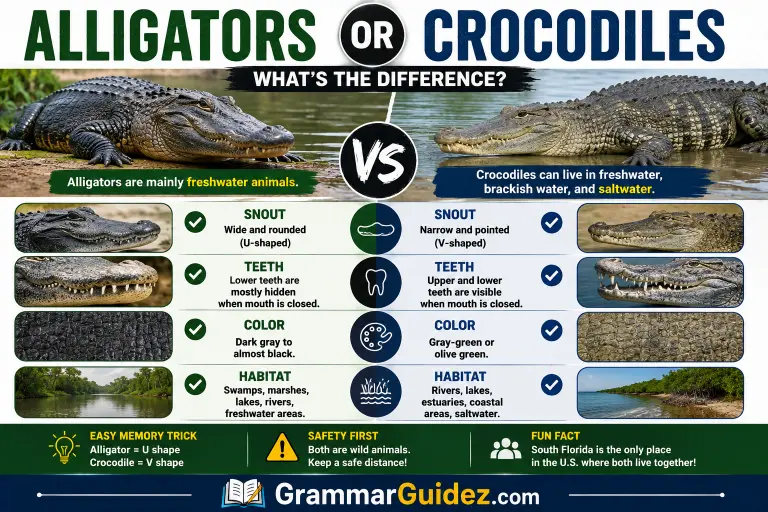
The easiest way to tell them apart is to look at the snout, teeth, color, and habitat. Alligators usually have a broad, rounded, U-shaped snout and darker skin. Crocodiles usually have a narrower, more pointed, V-shaped snout and lighter gray-green coloring. Their teeth also give you a useful clue.
There is another major difference: alligators are mainly freshwater animals, while crocodiles are better adapted to saltwater and brackish environments because crocodiles have salt glands that help them handle salty water.
So, if you have ever wondered “alligators or crocodiles which one am I looking at?”, this guide will help you tell the difference quickly.
The 10-Second Alligator vs Crocodile Test
If you see one of these reptiles from a safe distance, remember four things:
1. Snout
- Alligator → wide and rounded
- Crocodile → narrow and pointed
2. Teeth
- Alligator → lower teeth are mostly hidden when the mouth is closed
- Crocodile → upper and lower teeth can remain visible
3. Color
- Alligator → usually dark gray to almost black
- Crocodile → often gray-green or olive
4. Water
- Alligator → mainly freshwater
- Crocodile → often saltwater or brackish water
These are useful identification clues, although exact appearance can vary among species.
First, What Are They?
Both animals belong to the group called crocodilians.
Crocodilians include:
- Alligators
- Crocodiles
- Caimans
- The gharial
The U.S. National Park Service notes that crocodiles and alligators are members of the crocodilian group, which contains some of the largest living reptiles.
So calling an alligator a crocodilian is correct.
Calling a crocodile a crocodilian is also correct.
But saying that an alligator and crocodile are the same animal is not correct.
Think of it like this:
Crocodilian = the larger animal group
Alligator = one type of crocodilian
Crocodile = another type of crocodilian
Alligator or Crocodile? Look at the Snout
The snout is probably the easiest visual clue.
Alligator: Wide and U-Shaped
Alligators generally have a broad, rounded snout.
It has a shape that can remind you of a wide U.
This broad snout is especially noticeable when you compare an American alligator with an American crocodile.
Crocodile: Narrow and V-Shaped
Crocodiles generally have a longer, narrower snout with a more pointed appearance.
You can think:
Alligator = U
Crocodile = V
The U.S. National Park Service specifically identifies the broader alligator snout and narrower crocodile snout as useful ways to distinguish them.
Easy memory trick
A = Alligator = A wider snout
This is not a scientific rule, but it is an easy memory aid.
Their Teeth Tell Another Story
The teeth provide one of the best clues when you can safely see the animal’s mouth.
An alligator has an overbite. Its upper jaw extends over the lower jaw, so when the mouth is closed, the lower teeth are mostly hidden.
A crocodile has a different jaw shape.
When its mouth is closed, teeth from both the upper and lower jaws can be visible.
That creates the familiar “toothy” appearance often associated with crocodiles.
Remember it this way:
Alligator → mostly top teeth visible
Crocodile → upper and lower teeth can show
This clue is useful, but never approach a wild animal just to inspect its teeth.
Color: Black or Green?
Color can also help.
Alligators
American alligators are generally dark gray to almost black, especially compared with American crocodiles.
Crocodiles
American crocodiles tend to have a grayish-green or olive-green appearance with a lighter underside.
So a simple memory trick is:
Alligator = darker
Crocodile = lighter and more green-gray
However, don’t identify an animal by color alone. Lighting, age, water, mud, and individual variation can affect appearance.
Where Do Alligators Live?
Alligators are strongly associated with freshwater habitats.
The American alligator can be found in:
- Swamps
- Marshes
- Lakes
- Rivers
- Ponds
- Slow-moving freshwater areas
The Smithsonian says American alligators are usually found in freshwater, slow-moving rivers, as well as swamps, marshes, and lakes.
They can tolerate some salty or brackish conditions for limited periods, but they do not have the specialized salt glands that crocodiles have.
Where Do Crocodiles Live?
Crocodiles can live in a wider range of water conditions.
Depending on the species, they may be found in:
- Freshwater
- Brackish water
- Coastal areas
- Estuaries
- Saltwater environments
The American crocodile, for example, lives in coastal areas of south Florida and also occurs in parts of the Caribbean, Mexico, Central America, and northern South America.
Their ability to handle saltwater is one reason crocodiles can occupy coastal habitats.
The Saltwater Difference
This is one of the most interesting differences.
Crocodiles have salt glands that help them deal with salty environments.
American alligators do not have the same salt-secreting adaptation, so they are more strongly associated with freshwater.
That does not mean an alligator can never enter salty or brackish water.
It means crocodiles are better adapted to regular saltwater exposure.
Think of it like this:
Alligator → freshwater specialist
Crocodile → more comfortable with salty environments
Which Is Bigger?
There is no single size rule that works for every species because the crocodilian family includes many different species.
For the animals commonly compared in the United States, the American crocodile can grow quite large, with males potentially reaching around 20 feet, although they rarely exceed about 14 feet in the wild, according to the National Park Service.
American alligators can also become very large. The Smithsonian reports that exceptionally large males can approach 1,000 pounds.
So it is better not to use size alone to identify one.
Instead, combine:
snout + teeth + color + habitat
Which One Is More Dangerous?
This is where popular culture can create confusion.
Movies often portray crocodiles as extremely aggressive monsters. Real wildlife behavior is more complicated.
The American crocodile is generally described by the National Park Service as shy and secretive, and conflicts with humans are relatively uncommon.
That does not mean crocodiles or alligators are safe to approach.
Both are wild predators with powerful jaws.
The National Park Service warns visitors to keep a safe distance from both animals and never feed or harass them.
The safest rule is simple:
Never approach either one.
A Real-World Example: Florida
Florida is especially interesting because it has both American alligators and American crocodiles.
In fact, south Florida is the only place in the United States where these two species naturally coexist.
The difference becomes easier to understand there.
Alligator
Usually:
- Darker
- Broader snout
- Mostly freshwater
- More common
American crocodile
Usually:
- Lighter gray-green
- Narrower snout
- More coastal
- More tolerant of saltwater
The National Park Service identifies south Florida as the only place where both species occur together in the United States.
Why Do People Confuse Them?
There are several good reasons.
They belong to the same group
Both are crocodilians.
They look similar
Both have:
- Long bodies
- Strong tails
- Four short legs
- Armored skin
- Powerful jaws
Both live around water
A person who sees a large reptile swimming may not immediately know which one it is.
Movies blur the difference
Popular culture often uses “crocodile” as a general word for large crocodilian reptiles.
But scientists and wildlife experts distinguish the animals carefully.
Alligator vs Crocodile: Comparison Table
| Feature | Alligator | Crocodile |
| Animal group | Crocodilian | Crocodilian |
| Snout | Broad and rounded | Narrow and pointed |
| Snout shape | U-like | V-like |
| Closed mouth | Lower teeth mostly hidden | More teeth visible |
| Typical color | Dark gray/black | Gray-green/olive |
| Water preference | Mainly freshwater | Freshwater, brackish, or saltwater depending on species |
| Salt glands | No specialized salt glands like crocodiles | Yes |
| Body | Broad and robust | Often more streamlined |
| Common U.S. species | American alligator | American crocodile |
| Best clue | Broad snout | Narrow snout |
The table describes the common visual differences, especially between the American alligator and American crocodile. Individual species can vary.
The “U vs V” Trick
If you forget everything else, remember this:
🐊 Alligator
U-shaped snout
U = Alligator
🐊 Crocodile
V-shaped snout
V = Crocodile
This is one of the easiest ways for beginners to remember the difference. The National Park Service and Smithsonian both identify snout shape as a useful distinguishing feature.
Are Alligators and Crocodiles Related?
Yes.
They share a common evolutionary history and belong to the crocodilian group.
But they developed into different lineages over millions of years.
That is why they share many features while still having important differences in:
- Jaw shape
- Snout shape
- Teeth
- Habitat
- Salt tolerance
- Appearance
- Distribution
So they are close relatives, not identical animals.
What Do Alligators Eat?
Alligators are carnivores.
Their diet can include:
- Fish
- Frogs
- Birds
- Snails
- Other invertebrates
- Mammals
- Other available prey
The National Park Service notes that American alligators eat a wide range of prey, from aquatic animals to mammals that come near the water.
Their powerful jaws help them capture and hold prey.
What Do Crocodiles Eat?
Crocodiles are also carnivorous predators.
Their exact diet varies by species, age, habitat, and available prey.
They may eat fish, birds, reptiles, mammals, and other animals.
Both alligators and crocodiles are important predators in their ecosystems.
How to Tell Them Apart Without Getting Close
If you are watching one in the wild, use your eyes from a safe distance.
Step 1: Look at the snout
Is it broad and rounded?
Likely alligator.
Is it long and pointed?
Likely crocodile.
Step 2: Look at the color
Dark?
More likely alligator.
Gray-green?
More likely crocodile.
Step 3: Look at the water
Freshwater?
Alligator becomes more likely.
Coastal or salty water?
Crocodile becomes more likely.
Step 4: Look at the teeth only if naturally visible
Don’t move closer.
Visible teeth from both jaws can suggest a crocodile.
Mostly upper teeth can suggest an alligator.
A Common Myth: “Green Means Alligator”
This is a common mistake.
Many cartoons and images show alligators as bright green.
Real American alligators are generally much darker, often grayish-black.
American crocodiles are more likely to have gray-green or olive coloring.
So:
Green does not automatically mean alligator.
In fact, for the American species, a gray-green appearance can be a useful clue toward crocodile.
Quick Quiz: Alligator or Crocodile?
1. Which usually has a broader snout?
A. Crocodile
B. Alligator
Answer: B. Alligator
2. Which is generally better adapted to saltwater?
A. Alligator
B. Crocodile
Answer: B. Crocodile
3. Which usually has a narrower, more pointed snout?
A. Alligator
B. Crocodile
Answer: B. Crocodile
4. Which is generally darker in appearance?
A. American alligator
B. American crocodile
Answer: A. American alligator
5. Which animal usually has more visible teeth when its mouth is closed?
A. Alligator
B. Crocodile
Answer: B. Crocodile
6. What group includes both animals?
A. Primates
B. Crocodilians
C. Amphibians
D. Turtles
Answer: B. Crocodilians
FAQs
Are alligators and crocodiles the same?
No. Alligators and crocodiles are different types of crocodilians. They share many physical features, but they differ in snout shape, teeth, coloration, habitat, and saltwater tolerance. Alligators generally have broader snouts and are associated more strongly with freshwater, while crocodiles usually have narrower snouts and greater tolerance for saltwater.
Which is bigger, an alligator or crocodile?
It depends on the species. Some crocodiles can grow considerably larger than American alligators. However, large American alligators can also reach impressive sizes. Because different species have different maximum sizes, it is better not to identify an individual animal by size alone.
Can alligators live in saltwater?
Alligators can tolerate some salty or brackish water for limited periods, but they are mainly freshwater animals. Unlike crocodiles, they lack specialized salt-secreting glands that help crocodiles handle saltwater environments.
Are crocodiles more aggressive than alligators?
Behavior varies by species and individual animal. The American crocodile is generally shy and secretive, while both crocodiles and alligators can be dangerous if approached. The safest approach is to treat both as wild animals and keep a safe distance.
Where can you see alligators and crocodiles together?
In the United States, south Florida is the only place where the American alligator and American crocodile naturally coexist. Everglades National Park is a well-known location where both can be found.
How can I quickly remember alligator vs crocodile?
Use the U vs V trick. An alligator usually has a broad, rounded U-shaped snout. A crocodile usually has a narrower, more pointed V-shaped snout. Then check color, teeth, and habitat for additional clues.
Conclusion
The answer to “alligators or crocodiles?” depends on what you are looking at.
If the animal has a wide, rounded snout, dark coloring, and is living mainly in freshwater, it is more likely an alligator.
If it has a narrower, pointed snout, gray-green coloring, and is found in coastal or salty water, it is more likely a crocodile.
The easiest memory trick is:
Alligator = U-shaped snout + darker color + freshwater
Crocodile = V-shaped snout + lighter color + greater saltwater tolerance
Their teeth offer another strong clue: an alligator’s lower teeth are mostly hidden when its mouth is closed, while a crocodile can show teeth from both jaws.
Most importantly, these are wild predators. If you see one in nature, do not approach, feed, or touch it. The National Park Service recommends keeping a safe distance from both alligators and crocodiles.
Once you remember U for alligator and V for crocodile, telling them apart becomes much easier.

I am Elliot Hartwell, an English language writer and the author at GrammarGuidez.com. For the 6 years I have been working with English grammar, vocabulary, spelling and everyday language usage with a focus on making confusing topics easier to understand.
I started GrammarGuidez.com with a goal: to give readers clear and practical answers to common English questions. English can sometimes be confusing especially when two words look or sound similar but have meanings or uses. I enjoy breaking down these differences in a way that’s simple and easy to remember.
I believe learning English should feel simple not overwhelming. My goal is to make every article on GrammarGuidez.com useful, for students, writers, bloggers, teachers and anyone who wants to communicate clearly in English.