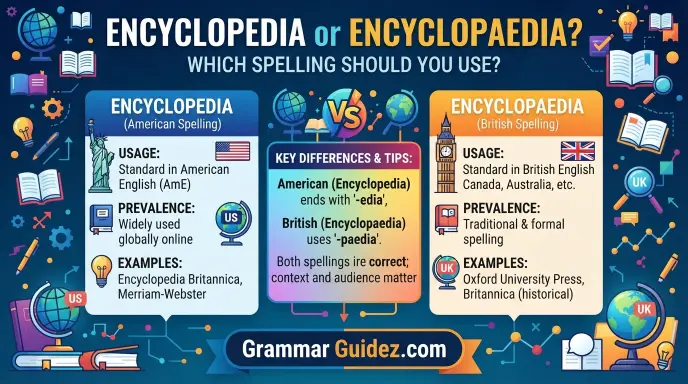
“Encyclopedia” and “encyclopaedia” are both correct spellings, but their usage depends on the variety of English. “Encyclopedia” is the standard spelling in American English, while “encyclopaedia” is the standard spelling in British English. Both refer to a book or resource containing information about many subjects.
Have you ever written encyclopedia or encyclopaedia and wondered which one is correct? Both spellings look familiar, and both appear in reputable English sources. The good news is that both are correct.
The difference is mainly regional spelling. Encyclopedia is the standard form in American English, while encyclopaedia is mainly the British form. Cambridge specifically identifies encyclopaedia as a mainly UK spelling of encyclopedia.
So, unlike pairs such as non and none, neither word is simply a mistake.
The choice depends on the type of English you are using. If your readers are mainly in the United States, encyclopedia is the natural choice. If you are following British English, encyclopaedia is appropriate.
This guide explains the difference, pronunciation, history, regional usage, examples, common mistakes, and an easy way to remember which spelling to use.
Encyclopedia vs Encyclopaedia at a Glance
Here is the answer before we go deeper:
| Spelling | Status | Main usage |
| Encyclopedia | ✅ Correct | American English; also widely used internationally |
| Encyclopaedia | ✅ Correct | Mainly British English |
| Meaning | Same | A reference work containing information on many subjects |
Both words refer to a book, set of books, or digital collection containing information about a broad subject or many areas of knowledge. Cambridge gives encyclopedia this meaning and lists encyclopaedia as the mainly UK spelling.
Simple rule
American English → encyclopedia
British English → encyclopaedia
What Does “Encyclopedia” Mean?
An encyclopedia is a reference work that provides information about different subjects.
Traditionally, an encyclopedia was a large set of books. Today, the word can also refer to a digital collection of information available online.
Oxford defines it as a book or set of books covering all areas of knowledge or a particular subject, as well as a similar digital collection.
Examples
I looked up the information in an encyclopedia.
She used an encyclopedia of animals for her school project.
The website works like an online encyclopedia.
The word can cover both printed and digital reference sources.
What Does “Encyclopaedia” Mean?
Encyclopaedia has exactly the same basic meaning as encyclopedia.
The main difference is the spelling.
The British form contains the extra letters:
encyclopaedia
The American form is:
encyclopedia
Example
British English:
I found the information in an encyclopaedia.
American English:
I found the information in an encyclopedia.
The meaning does not change.
Why Are There Two Spellings?
The difference comes from the history of English spelling and the influence of different language traditions.
The word comes from a Latinized form based on Greek. Oxford traces encyclopedia to the mid-16th century and gives its origin as Modern Latin, from the Greek expression enkuklios paideia, meaning “all-round education.”
Over time, English developed different spelling conventions in different regions.
British English often preserved spellings closer to older forms or European patterns.
American English adopted many simplified spellings.
This is why we see:
- encyclopaedia → British English
- encyclopedia → American English
The same general pattern appears in several other words.
The “AE” vs “E” Pattern
One useful way to understand this pair is to notice the letters in the middle.
British spelling
encyclopaedia
It contains:
ae
American spelling
encyclopedia
It uses:
e
This difference appears in some other English words too:
| British English | American English |
| encyclopaedia | encyclopedia |
| paediatric | pediatric |
| foetus | fetus |
| oestrogen | estrogen |
| anaemia | anemia |
However, English spelling patterns are not perfectly consistent. So it is better to learn each word rather than assume every ae word will follow the same rule.
Is Encyclopedia or Encyclopaedia More Correct?
This is one of the most common questions.
The answer is:
Neither is more correct.
Both are established English spellings.
The important thing is consistency.
If your article follows American English, use:
encyclopedia
If it follows British English, use:
encyclopaedia
Cambridge explicitly describes encyclopaedia as a mainly UK spelling of encyclopedia.
So you should not treat encyclopaedia as a misspelling simply because your preferred style uses encyclopedia.
American English vs British English
This is the key section for writers.
| Region | Preferred spelling |
| 🇺🇸 United States | encyclopedia |
| 🇬🇧 United Kingdom | encyclopaedia |
| 🇨🇦 Canada | Both may appear; style guide matters |
| 🇦🇺 Australia | encyclopaedia is commonly used |
| International English | Either, depending on audience |
For a US-focused website, encyclopedia is usually the safer choice.
For a British-focused publication, encyclopaedia fits the regional spelling style.
The important point
The pronunciation and meaning do not change simply because the spelling changes.
How Do You Pronounce Encyclopedia?
Both spellings have essentially the same pronunciation.
A common pronunciation is approximately:
en-SY-kluh-PEE-dee-uh
The exact sounds can vary slightly by accent.
Oxford gives the pronunciation as:
/ɪnˌsaɪkləˈpiːdiə/
The extra ae in encyclopaedia does not create a completely different word when spoken.
So you can think of the pair this way:
Same word + same meaning + different regional spelling
Where Did the Word Come From?
The history of encyclopedia is surprisingly interesting.
Oxford traces the word to the mid-16th century. Its origin comes through Modern Latin and is based on the Greek expression enkuklios paideia, referring to a broad or all-round education.
The original idea fits the modern meaning quite well.
An encyclopedia brings together knowledge from many areas.
For example, an encyclopedia may contain entries about:
- History
- Science
- Geography
- Animals
- Literature
- Technology
- Art
- Medicine
Modern online encyclopedias can contain millions of articles and cover highly specialized subjects.
Encyclopedia in Modern English
The word is no longer limited to huge printed books.
Today, you can have:
A printed encyclopedia
My school library has an old encyclopedia.
A subject encyclopedia
He bought an encyclopedia of astronomy.
An online encyclopedia
Students often use an online encyclopedia for research.
A children’s encyclopedia
She received a children’s encyclopedia as a gift.
Oxford specifically gives examples such as children’s encyclopedia, encyclopedia of music, and online encyclopedia.
When Should You Use “Encyclopedia”?
Use encyclopedia when your writing follows American English.
This is especially useful for:
- US websites
- American schools
- US businesses
- American publications
- US-focused blogs
- American academic content
- Content targeting US readers
Examples
The student searched the encyclopedia for information about dinosaurs.
This online encyclopedia contains thousands of articles.
I found the answer in an encyclopedia of science.
When Should You Use “Encyclopaedia”?
Use encyclopaedia when you are following British English.
It is appropriate for:
- UK publications
- British schools
- UK-focused websites
- British academic writing
- British publishers
- Content using British spelling throughout
Examples
The student searched the encyclopaedia for information about dinosaurs.
The library has a large encyclopaedia collection.
She consulted an encyclopaedia of British history.
What About “Encyclopedia Britannica”?
There is an interesting example that sometimes confuses writers.
The famous reference work is commonly known as Encyclopaedia Britannica.
Oxford lists The Encyclopaedia Britannica as the name of the well-known reference work.
Notice that the title uses:
Encyclopaedia
That does not mean that encyclopedia is wrong in American English.
A proper name or established title can preserve its own spelling.
So:
encyclopedia = standard US spelling
encyclopaedia = mainly UK spelling
Encyclopaedia Britannica = established title
Common Writing Mistakes
Mistake 1: Calling “encyclopaedia” incorrect
❌ Encyclopaedia is always wrong.
That is not correct.
It is a standard British spelling.
Better:
✅ Encyclopaedia is mainly used in British English.
Mistake 2: Mixing the spellings
You might write:
The encyclopaedia contains useful information, but the online encyclopedia is easier to search.
This is not necessarily grammatically wrong, but it can make your article’s spelling style inconsistent.
If you are writing for a US audience, choose:
encyclopedia
If you are writing for a UK audience, choose:
encyclopaedia
A Useful Style Tip for Bloggers
If you run an English-language website, decide which variety of English you want to use before publishing lots of articles.
For example, a US-focused website might consistently use:
- encyclopedia
- color
- favorite
- organize
- center
A British-focused website might use:
- encyclopaedia
- colour
- favourite
- organise
- centre
Consistency creates a more polished reading experience.
It also helps readers understand which regional variety your content follows.
Examples Side by Side
Here are some simple examples.
| American English | British English |
| I bought an encyclopedia. | I bought an encyclopaedia. |
| The encyclopedia contains useful facts. | The encyclopaedia contains useful facts. |
| She searched an online encyclopedia. | She searched an online encyclopaedia. |
| He wrote an encyclopedia article. | He wrote an encyclopaedia article. |
| This is a medical encyclopedia. | This is a medical encyclopaedia. |
The sentence structure and meaning remain the same.
Only the regional spelling changes.
Which Spelling Is Best for Content?
For content, both spellings can be useful, but your main choice should match your target audience.
If you target the United States, use:
encyclopedia
If you target the United Kingdom, use:
encyclopaedia
Do not repeatedly insert both spellings just to target keywords. That can make the writing unnatural.
Instead, write naturally and mention the alternative spelling where it helps the reader.
For example:
Encyclopedia is the standard American spelling, while encyclopaedia is mainly used in British English.
That single sentence covers the search intent without stuffing the keyword.
A Quick Memory Trick
Remember:
🇺🇸 America likes the shorter form
encyclopedia
🇬🇧 Britain keeps the “ae”
encyclopaedia
You can remember:
British = AE
American = E
This is not a rule for every English word, but it works well for this particular spelling pair.
Mini Quiz: Choose the Right Spelling
1. Which spelling is mainly American?
A. Encyclopaedia
B. Encyclopedia
2. Which spelling is mainly British?
A. Encyclopedia
B. Encyclopaedia
3. Do the two words have different meanings?
A. Yes
B. No
4. Which spelling is used in the established title Encyclopaedia Britannica?
A. Encyclopaedia
B. Encyclopedia
5. Is “encyclopaedia” a misspelling?
A. Yes
B. No
Answers
- B — Encyclopedia
- B — Encyclopaedia
- B — No
- A — Encyclopaedia
- B — No
FAQs
Is encyclopedia or encyclopaedia correct?
Both are correct. Encyclopedia is the standard American spelling, while encyclopaedia is mainly the British spelling. The meaning is the same. Cambridge specifically identifies encyclopaedia as a mainly UK spelling of encyclopedia.
Is encyclopaedia British or American?
Encyclopaedia is mainly British English. American English normally uses encyclopedia. The two spellings have the same meaning and are pronounced essentially the same way.
Is encyclopedia the American spelling?
Yes. Encyclopedia is the standard American spelling. Oxford’s American English dictionary gives encyclopedia as the noun and provides the American pronunciation.
Why does British English use “encyclopaedia”?
The spelling reflects the word’s long history and older spelling traditions. The word ultimately comes through Modern Latin from Greek, and British English retained the ae form in this word. American English commonly uses the simplified e spelling.
Does encyclopedia mean the same as encyclopaedia?
Yes. Both words refer to a reference work containing information about many subjects or a particular field. Cambridge defines encyclopedia in this sense and lists encyclopaedia as its mainly UK spelling.
Which spelling should I use in an American article?
Use encyclopedia. It is the natural spelling for American English and is the best choice if your website primarily targets US readers.
Which spelling should I use in British English?
Use encyclopaedia if you are consistently following British spelling conventions. The important thing is to maintain the same spelling style throughout your article.
Is Encyclopaedia Britannica spelled correctly?
Yes. Encyclopaedia Britannica is the established name of the famous reference work. Oxford lists it under that spelling.
Conclusion
So, which one should you choose?
The answer is both.
Encyclopedia and encyclopaedia are two regional spellings of the same word. The main difference is not meaning, pronunciation, or grammar. It is English spelling style.
Use encyclopedia for American English:
The student used an encyclopedia for her research.
Use encyclopaedia for British English:
The student used an encyclopaedia for her research.
The easiest rule is:
🇺🇸 American English → encyclopedia
🇬🇧 British English → encyclopaedia
If you are writing for a US audience, encyclopedia is the better choice. If your readers are mainly in the UK, encyclopaedia fits the local spelling style.
Most importantly, do not treat one as a spelling error. Both forms have a legitimate place in English. Choose the one that matches your audience, then use it consistently.
Read More Articles:
- Non or None: What’s the Difference and How Do You Use Them?
- Soder or Solder: Which Spelling Is Correct?
- Mopped or Moped: What Is the Difference?

I am Evan Whitmore, an English language writer and the person who started GrammarGuidez.com. I made GrammarGuidez.com to make grammar, spelling, vocabulary and words that are often confused easier to understand.
I like taking to understand English words and grammar rules and turning them into simple and clear explanations. My aim is to help students, writers, bloggers, ESL learners and regular English speakers feel more sure when they write and talk.
At GrammarGuidez.com I work on real life examples easy to understand explanations comparing words, spelling changes and how American English is used every day.
I think learning English doesn’t need to be hard. A good explanation and some good examples can make tough grammar topics much simpler to learn