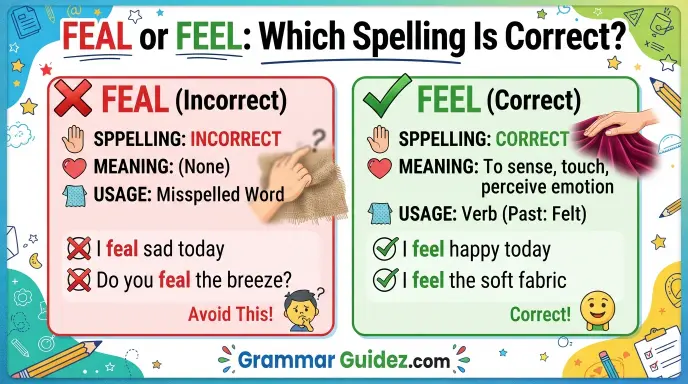
“Feel” is the correct spelling, while “feal” is generally a misspelling when you mean to describe experiencing a sensation, emotion, or opinion. “Feel” is a verb meaning to experience something through your senses or emotions, while “feal” has no standard English meaning in this context.
Have you ever typed feal or feel and wondered which one is correct? The confusion is understandable because both words look almost identical and sound very similar.
But in everyday modern English, the answer is simple: feel is the word you normally want.
Feel is a common English verb used for physical sensations, emotions, opinions, and the act of touching something to examine it. Cambridge lists feel with meanings such as experiencing something physical or emotional, having an opinion, and touching something.
Feal does exist, but it is an archaic word meaning faithful. Collins records feal as an old-fashioned word and traces it to Old French and Latin.
So, if you want to say that you experience an emotion, touch something, or have a certain sensation, use feel.
Feel = standard modern English
Feal = archaic word meaning faithful
Let’s explore the difference with clear examples.
The Short Answer: Feal vs Feel
If you are writing a normal sentence today, feel is almost certainly the correct choice.
| Word | Meaning | Modern usage |
| Feel | Experience, sense, touch, or have an opinion | ✅ Very common |
| Feal | Faithful or loyal | ⚠️ Archaic |
For example:
I feel tired today. ✅
I can feel the cold air. ✅
Please feel the fabric. ✅
But:
I feal tired today. ❌
That sentence is incorrect because feal does not mean “feel.”
What Does “Feel” Mean?
Feel is one of the most useful verbs in English. It has several meanings.
1. To Experience an Emotion
You can use feel when talking about emotions.
I feel happy today.
She feels nervous before exams.
They felt sad after the news.
Cambridge defines feel as experiencing something physical or emotional.
Common emotional expressions include:
- feel happy
- feel sad
- feel angry
- feel nervous
- feel excited
- feel afraid
- feel lonely
- feel comfortable
2. To Experience a Physical Sensation
We also use feel for physical experiences.
I feel cold.
She felt a sharp pain.
My hands feel warm.
He feels sick.
This is one of the most common uses of the word. Cambridge gives physical examples involving pain, illness, temperature, and other sensations.
3. To Touch Something
Feel can also mean touching something, usually to discover what it is like.
Feel the surface of the table.
She felt the fabric.
He felt the wall to find the switch.
Cambridge lists this as a separate meaning: touching something, especially with the hands, to examine it.
4. To Have an Opinion
Sometimes feel means think or have an opinion.
I feel that we should leave early.
She feels that the plan is too expensive.
They felt that something needed to change.
Cambridge includes this meaning under feel as a verb of opinion.
What Does “Feal” Mean?
This is where the two words become very different.
Feal is a real English word, but it is archaic. Collins defines it as an old-fashioned word meaning faithful.
For example, in historical writing, you may encounter:
He remained feal to his king.
Here, feal means faithful or loyal.
However, this is not normal modern conversational English.
You would normally write:
He remained faithful to his king.
So if you see feal in an old text, do not automatically assume it is a spelling mistake. It may be an intentional archaic word.
Why Do People Confuse Feal and Feel?
The main reason is their spelling and pronunciation.
Both contain:
- f
- e
- l
And in modern pronunciation, feel is pronounced /fiːl/.
Because feal is rarely encountered in everyday English, many people who see or hear it may assume it is simply a misspelling of feel.
For modern writing, however, the distinction is easy:
Feel = experience or touch
Feal = archaic “faithful”
Feel Has Many Grammatical Forms
One reason feel is so common is that it changes into several useful forms.
| Form | Example |
| feel | I feel happy. |
| feels | She feels tired. |
| felt | He felt sick yesterday. |
| feeling | I am feeling better. |
The past tense and past participle are felt, not feeled. Cambridge lists felt as the past form of feel.
Examples
I feel cold.
She feels nervous.
We felt excited.
They are feeling better.
A Common Grammar Point: Feel vs Felt
Learners sometimes confuse the present and past forms.
Present
I feel tired today.
Past
I felt tired yesterday.
Do not write:
❌ I feeled tired.
The correct form is:
✅ I felt tired.
This irregular form is worth remembering because feel → felt → felt.
Feel in Everyday Expressions
You will see feel in many common phrases.
Feel like
I feel like eating pizza.
This can express a desire to do or have something. Cambridge includes feel like something/doing something among the common uses of the verb.
Feel free
Feel free to ask questions.
This means that someone is welcome to do something.
Feel better
I hope you feel better soon.
Feel sorry
I feel sorry for him.
Feel certain
I feel certain that she is right.
These expressions are common in everyday English.
“Feel” as a Noun
Although many learners first learn feel as a verb, it can also be a noun.
For example:
I love the feel of silk.
Here, feel means the way something seems when you touch it. Cambridge lists this noun meaning as well.
It can also describe the character or atmosphere of a place.
The restaurant has a relaxed feel.
You can also say:
She has a feel for languages.
This means she has a natural understanding or ability in that area.
Feal vs Feel: The Important Difference
The easiest way to understand this pair is to focus on meaning rather than spelling.
| Feature | Feel | Feal |
| Standard modern English | ✅ Yes | ❌ No |
| Common today | ✅ Yes | ❌ Rare |
| Verb | ✅ Yes | ❌ Not in its usual archaic sense |
| Meaning | Experience, sense, touch, opinion | Faithful, loyal |
| Used in everyday conversation | ✅ Yes | ❌ No |
| Used in modern writing | ✅ Yes | Rare |
| Historical/archaic usage | Yes | ✅ Yes |
So these words are not interchangeable.
British English and American English
Unlike spelling pairs such as color/colour, there is no meaningful British-American difference between feel and feal.
Both British and American English use:
feel
Cambridge lists the pronunciation for both UK and US English, with feel pronounced /fiːl/ in its main dictionary entry.
So you should not think:
British = feal
That is wrong.
The correct rule is:
British English → feel
American English → feel
Feal is not an alternative regional spelling of feel.
When Should You Use “Feel”?
Use feel whenever you mean things such as:
- Experience an emotion
- Experience a physical sensation
- Touch something
- Have an opinion
- Sense something
- Seem or have a particular quality
Examples
I feel happy.
The water feels cold.
Can you feel the fabric?
I feel that we should wait.
The room feels different today.
These are all normal modern uses.
When Might You See “Feal”?
You are most likely to encounter feal in:
- Historical literature
- Old texts
- Poetry
- Historical discussions
- Dialectal material
- Reproductions of older language
Its meaning is related to faithful or loyal. Collins specifically labels it as archaic.
For example:
He was feal to his lord.
A modern writer would normally replace this with:
He was faithful to his lord.
Therefore, don’t use feal simply because it looks like a variation of feel.
Common Mistakes
Mistake 1: Using “feal” for emotions
❌ I feal happy today.
✅ I feel happy today.
Why?
The modern verb for experiencing an emotion is feel.
Mistake 2: Using “feal” for physical sensations
❌ I can feal the cold.
✅ I can feel the cold.
Mistake 3: Writing “feeled”
❌ I feeled tired yesterday.
✅ I felt tired yesterday.
Mistake 4: Assuming feal is British English
❌ British English uses feal.
✅ British English uses feel.
Feal is an archaic word, not a British spelling of feel.
Examples You Can Use
Here are some natural examples for everyday writing.
Emotional
I feel much better now.
She feels excited about the trip.
Physical
I feel a strange pain in my arm.
The water feels warm.
Touch
Feel this soft blanket.
He felt the surface carefully.
Opinion
I feel that this is the best option.
She feels strongly about the issue.
Atmosphere
The room feels peaceful.
Historical
The knight remained feal to his king.
The last example is unusual in modern English and has an intentionally old-fashioned tone.
A Simple Memory Trick
Here’s an easy way to remember the difference:
FEEL = Feeling
Both start with:
FEE…
Think:
FEEL = Feeling
If you are talking about an emotion, sensation, touch, or opinion, use feel.
FEAL = Faithful
Think:
FEAL = old word for Faithful
You will rarely need feal in modern writing.
Quick Practice
Choose feel or feal.
1. I ___ happy today.
2. Can you ___ the softness of this fabric?
3. She ___ nervous before the test.
4. The water ___ cold.
5. The old text described him as ___ to his king.
Answers
- feel
- feel
- feels
- feels
- feal
The fifth answer is different because it uses the archaic meaning of feal.
FAQs
Is “feal” a correct word?
Yes, feal is a real English word, but it is archaic. Collins defines it as an old-fashioned word meaning faithful. It is not the normal modern spelling of feel.
Is “feel” or “feal” correct?
For almost all modern English writing, feel is correct. Use it when you mean to experience an emotion or sensation, touch something, or have an opinion. Feal has a separate archaic meaning related to being faithful or loyal.
Is “feal” the British spelling of “feel”?
No. Feel is used in both British and American English. Feal is an archaic word, not a British spelling variant. Cambridge gives feel as the standard word in both UK and US English.
What does feal mean?
Feal means faithful or loyal. It is an archaic English adjective. The word is rarely used in modern everyday English. Collins traces it through Old French to Latin fidēlis.
What is the past tense of feel?
The past tense of feel is felt.
Present: I feel tired.
Past: I felt tired.
The past participle is also felt.
Can I use “feal” instead of “feel”?
No. Do not use feal as a normal alternative spelling of feel. In modern English, feel is the correct word for experiencing something, touching something, or having an opinion.
How do you pronounce feel?
Feel is pronounced /fiːl/ in both British and American English. It has the same vowel sound as the ee in see.
Conclusion
When choosing between feal or feel, remember that these words have different roles.
✅ Feel
Feel is the standard modern English word.
Use it for:
- Emotions
- Physical sensations
- Touch
- Opinions
- Awareness
- Atmosphere
I feel happy.
I can feel the rain.
The room feels cold.
⚠️ Feal
Feal is a real but archaic word meaning faithful or loyal.
He remained feal to his king.
This word belongs mainly to historical or deliberately old-fashioned language.
The best rule for modern writers is therefore very simple:
If you mean “experience,” “sense,” or “touch,” use FEEL.
Don’t let the similar spelling confuse you. Feel is the word you will need in almost every normal conversation, email, essay, blog post, and professional document.
Read More Articles:
- Non or None: What’s the Difference and How Do You Use Them?
- Soder or Solder: Which Spelling Is Correct?
- Mopped or Moped: What Is the Difference?

I am Elliot Hartwell, an English language writer and the author at GrammarGuidez.com. For the 6 years I have been working with English grammar, vocabulary, spelling and everyday language usage with a focus on making confusing topics easier to understand.
I started GrammarGuidez.com with a goal: to give readers clear and practical answers to common English questions. English can sometimes be confusing especially when two words look or sound similar but have meanings or uses. I enjoy breaking down these differences in a way that’s simple and easy to remember.
I believe learning English should feel simple not overwhelming. My goal is to make every article on GrammarGuidez.com useful, for students, writers, bloggers, teachers and anyone who wants to communicate clearly in English.