“Come” and “cum” are both used in English, but they have different meanings and contexts. “Come” is a common verb meaning to move toward someone or something or to arrive, while “cum” is informal slang and is also used in some formal expressions to mean combined with or serving as.
The words come or cum are easy to confuse because they can have the same pronunciation. However, they are not interchangeable.
In normal everyday English, come is the correct and standard word. It is a very common verb used for movement, arrival, change, and many other situations.
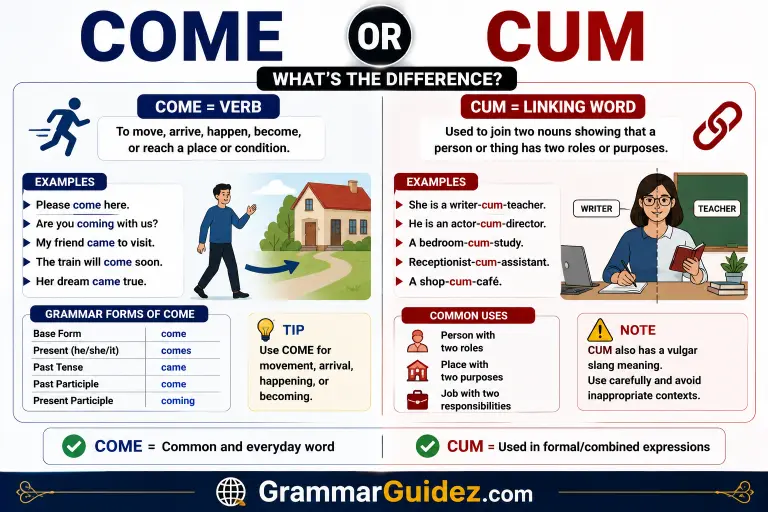
Cum, on the other hand, has a completely different use. In formal or written expressions, it can join two nouns to show that one person or thing has two roles or purposes. For example, a bedroom-cum-study is a room used as both a bedroom and a study. Cambridge explains that cum comes from Latin and is used to connect two nouns.
There is also a vulgar slang meaning of cum, so writers should be careful about context.
This article explains the difference between come and cum, their meanings, grammar, examples, common mistakes, and the situations where each word is appropriate.
Come or Cum: Quick Answer
Here is the simple answer:
| Word | Main Meaning | Common Use |
| Come | Move, arrive, happen, become, or reach | Everyday English |
| Cum | And; combined with; having two roles | Formal or descriptive expressions |
Examples
Please come here. ✅
The guests will come at 7 p.m. ✅
She is a writer-cum-teacher. ✅
Please cum here. ❌
The easiest rule is:
Use COME as the normal verb.
Use CUM only for its specific meanings and contexts.
What Does “Come” Mean?
Come is one of the most common verbs in English.
It usually means to move toward the speaker, listener, or a particular place.
Cambridge describes come as moving or travelling toward the speaker or with the speaker.
Examples
Come here for a minute.
Are you coming with us?
She came to my house yesterday.
They will come tomorrow.
The word come has many other uses as well.
Come Meaning: To Arrive
You can use come to mean arrive.
Has the bus come yet?
My package came this morning.
The teacher came late.
Cambridge lists arrive as one of the common meanings of come.
Come Meaning: To Happen
Come can also describe something that happens or arrives in time.
Winter will come soon.
The day finally came.
An opportunity came at the right time.
This usage is very common in both speaking and writing.
Come Meaning: To Become
Sometimes come describes a change.
Her dream came true.
The rope came loose.
The door came open.
I came to understand the problem.
Merriam-Webster lists several uses of come related to reaching a condition, result, or conclusion.
The Grammar Forms of “Come”
Come is an irregular verb.
| Verb Form | Word |
| Base form | come |
| Present with he/she/it | comes |
| Past tense | came |
| Past participle | come |
| Present participle | coming |
Examples
I come here every week.
She comes here every week.
She came yesterday.
A common mistake is using comed.
❌ She comed yesterday.
✅ She came yesterday.
What Does “Cum” Mean?
The non-vulgar dictionary meaning of cum is quite different from come.
Cum can join two nouns and show that a person or thing has two jobs, roles, or purposes.
Cambridge defines cum as a word used to join two nouns when a person or thing does two things or has two purposes.
For example:
She is a writer-cum-teacher.
This means:
She is both a writer and a teacher.
Another example is:
A bedroom-cum-study.
This means:
A room that is both a bedroom and a study.
Oxford also gives examples such as bedroom-cum-study and barman-cum-waiter.
How to Use “Cum” Correctly
The most common non-vulgar use of cum is in a combined expression.
Person with two roles
He is an actor-cum-director.
This means he is both an actor and a director.
Place with two purposes
They built a kitchen-cum-dining room.
This means the space is used as both a kitchen and a dining room.
Job with two responsibilities
She works as a receptionist-cum-assistant.
This means she performs both roles.
The pattern is usually:
noun + cum + noun
It is often written with hyphens:
actor-cum-director
bedroom-cum-study
writer-cum-editor
The Main Difference Between Come and Cum
The difference is very simple once you understand their grammar.
| Feature | Come | Cum |
| Main word type | Verb | Preposition/linking word |
| Common in daily English | Yes | Less common |
| Means movement | Yes | No |
| Means arrive | Yes | No |
| Means “and/as well as” | No | Yes |
| Used for two roles | No | Yes |
| Example | Come with me | Writer-cum-editor |
The words may sound alike, but their meanings are very different.
Come vs Cum in Everyday Sentences
Let’s look at some clear examples.
Movement
Please come inside. ✅
Please cum inside. ❌
Arrival
The train will come soon. ✅
The train will cum soon. ❌
Two roles
She is a teacher-cum-writer. ✅
She is a teacher-come-writer. ❌
Two purposes
This room is a bedroom-cum-office. ✅
This room is a bedroom-come-office. ❌
Is “Cum” a Correct Spelling of “Come”?
Generally, no.
You should not use cum as an alternative spelling when you mean the normal verb come.
For example:
❌ I will cum tomorrow.
If you mean arrival, the correct sentence is:
✅ I will come tomorrow.
Cambridge specifically identifies cum as a separate word and notes that its use as a spelling for come is not standard.
So, if you are writing about:
- moving
- arriving
- visiting
- happening
- becoming
you almost certainly need come.
Come and Cum Are Not British and American Spellings
This is an important point.
Some English words have different British and American spellings:
- colour / color
- theatre / theater
- apologising / apologizing
However, come and cum are not a British-English versus American-English spelling pair.
Both British and American English use:
come
for movement and arrival.
Cum has its own separate meaning in English.
Oxford lists cum as a word used for linking two nouns, meaning “and” or “as well as.”
Therefore:
🇺🇸 American English → come
🇬🇧 British English → come
The word cum is not simply another regional spelling of come.
The Origin of “Come”
Come is a very old English word.
Merriam-Webster traces it back to Old English and notes related words in other Germanic languages.
That helps explain why come has unusual verb forms:
come → came → come
Like many old English verbs, its past tense does not simply add -ed.
The Origin of “Cum”
The word cum comes from Latin, where it meant with.
Cambridge and Oxford both identify its Latin origin.
In English, it became useful for combining two roles or functions.
For example:
singer-cum-songwriter
This means:
singer and songwriter
Merriam-Webster describes this use as meaning roughly along with being or and, often in hyphenated phrases.
Is “Cum” Formal or Informal?
In its non-vulgar sense, cum is often seen in written descriptions and somewhat formal expressions.
You may find it in:
- Newspaper writing
- Biographies
- Job descriptions
- Academic writing
- Property descriptions
- Descriptions of people’s roles
However, in everyday conversation, people often use simpler alternatives.
Instead of:
He is a businessman-cum-writer.
You could say:
He is a businessman and writer.
Or:
He works as both a businessman and a writer.
These alternatives are often clearer, especially for English learners.
A Note About the Other Meaning of “Cum”
Cum can also appear as vulgar slang in English. Major dictionaries record this as a separate slang usage.
Because of that meaning, writers should be careful about context.
For professional, academic, business, and educational writing, use cum only when you clearly mean:
and / as well as / combined with
For example:
office-cum-library
The meaning is clear and non-vulgar in this context.
Which One Should You Use?
For Students
Use come when talking about movement or arrival.
Come to class on time.
Use cum only when combining two roles or purposes.
student-cum-athlete
For Bloggers
Use come for normal sentences.
New ideas come from experience.
Use cum only when it makes the description clearer.
travel-cum-lifestyle blog
In many cases, and may sound more natural.
For Businesses
Business writing usually prefers clear language.
Instead of:
manager-cum-salesperson
You can write:
manager and salesperson
or:
a manager who also handles sales
These options may be easier for international readers.
For Academic Writing
Use come according to its normal grammatical meaning.
Use cum carefully because some readers may find the Latin-style construction formal or old-fashioned.
Clarity should always come first.
Common Mistakes With Come and Cum
Mistake 1: Using Cum Instead of Come
❌ I will cum to your office tomorrow.
✅ I will come to your office tomorrow.
Why?
The sentence is about movement or arrival, so come is correct.
Mistake 2: Using Come for Two Roles
❌ She is a writer-come-editor.
✅ She is a writer-cum-editor.
Or, more naturally:
✅ She is a writer and editor.
Mistake 3: Writing “Comed”
❌ He comed late.
✅ He came late.
Remember:
come → came → come
Mistake 4: Thinking Cum Is an Alternative Spelling
❌ Cum is another spelling of come.
✅ Cum is a separate word with different meanings.
Everyday Examples of “Come”
Emails
Please come to the meeting at 10 a.m.
School
Many students come to school by bus.
Business
Our new products will come out next month.
Social Media
Come and check out our latest post.
Daily Conversation
What time are you coming home?
Everyday Examples of “Cum”
Jobs
He is a designer-cum-photographer.
Rooms
They have a dining room-cum-office.
Roles
She became a singer-cum-actress.
Projects
The website is an information-cum-learning platform.
Remember that these expressions can often be replaced with simpler words.
She is a singer and actress.
The room is used as both an office and a dining room.
For many readers, these alternatives are easier to understand.
Tips to Remember the Difference
Here are a few simple memory tricks.
COME = Movement
Think:
Come here.
If someone can move or arrive, use come.
CUM = Combined
Think:
Cum = Combined roles.
For example:
teacher-cum-writer
One person has two roles.
Ask Yourself One Question
Are you talking about:
Movement or arrival?
→ Use COME
Two jobs or two purposes?
→ You may use CUM
This simple question solves most confusion.
Mini Quiz: Come or Cum?
Choose the correct word.
1. Please ___ here.
A. Come
B. Cum
2. She is a writer-___-editor.
A. Come
B. Cum
3. The guests will ___ at 8 p.m.
A. Come
B. Cum
4. This is a bedroom-___-office.
A. Come
B. Cum
5. My parents will ___ tomorrow.
A. Come
B. Cum
6. He works as a teacher-___-coach.
A. Come
B. Cum
7. When will you ___ home?
A. Come
B. Cum
8. The building is a shop-___-café.
A. Come
B. Cum
Answers
- A — Come
- B — Cum
- A — Come
- B — Cum
- A — Come
- B — Cum
- A — Come
- B — Cum
Fill in the Blanks
Choose come or cum.
- Please ______ to my office.
- She is a writer-______-teacher.
- When will they ______ back?
- The room is a bedroom-______-study.
- I hope you can ______ tomorrow.
- He is a chef-______-restaurant owner.
- Many people ______ here every year.
- They built a library-______-learning center.
Answers
- come
- cum
- come
- cum
- come
- cum
- come
- cum
FAQs
Is it come or cum?
It depends on what you mean. Come is the standard verb for movement, arrival, and many other common meanings. Cum is a separate word used to link two nouns and show that something has two roles or purposes.
Is cum another spelling of come?
No. Cum is not a standard alternative spelling of come when you mean movement or arrival. For example, “Please come here” is correct. Cambridge treats cum as a separate word with its own meanings.
What does cum mean in non-vulgar English?
In its non-vulgar dictionary use, cum means roughly and, as well as, or combined with. It often joins two nouns, such as bedroom-cum-study.
How do you use cum in a sentence?
You can use cum between two nouns when a person or thing has two roles or purposes.
For example:
She is a writer-cum-teacher.
This means she is both a writer and a teacher.
Is cum British or American English?
Cum is used as an English word in both British and American dictionaries, but it is not a regional spelling variant of come. Its use as a connector between nouns has a separate meaning and comes from Latin.
What is the past tense of come?
The past tense of come is came.
Present: I come.
Past: I came.
The past participle is:
I have come.
Merriam-Webster lists the principal forms as come, came, come.
Should I use cum in professional writing?
You can, but use it carefully. Expressions such as writer-cum-editor are correct, but and, also, or both may be clearer for many readers.
Is “bedroom-cum-study” correct?
Yes. Bedroom-cum-study means a room used as both a bedroom and a study. This is a standard dictionary example of the noun-linking use of cum.
Conclusion
The difference between come or cum is not a simple spelling variation.
These words have different meanings and grammatical uses.
Use COME for:
- Movement
- Arrival
- Visiting
- Happening
- Becoming
- Reaching a place or condition
Please come here.
The bus will come soon.
Her dream came true.
Use CUM when you mean:
- And
- As well as
- Combined with
- Having two roles
- Having two purposes
She is a writer-cum-teacher.
It is a bedroom-cum-study.
For everyday English, come is the word you will use far more often. Cum has a specialized meaning and should not replace come in ordinary sentences.
The easiest rule to remember is:
Movement or arrival = COME
Two roles or purposes = CUM
Once you remember this difference, choosing the correct word becomes much easier.
Read More Articles:
- Feal or Feel: Which Spelling Is Correct?
- Apposed or Opposed: What’s the Difference?
- Non or None: What’s the Difference and How Do You Use Them?

I am Elliot Hartwell, an English language writer and the author at GrammarGuidez.com. For the 6 years I have been working with English grammar, vocabulary, spelling and everyday language usage with a focus on making confusing topics easier to understand.
I started GrammarGuidez.com with a goal: to give readers clear and practical answers to common English questions. English can sometimes be confusing especially when two words look or sound similar but have meanings or uses. I enjoy breaking down these differences in a way that’s simple and easy to remember.
I believe learning English should feel simple not overwhelming. My goal is to make every article on GrammarGuidez.com useful, for students, writers, bloggers, teachers and anyone who wants to communicate clearly in English.