“Whelp” and “welp” are both used in English, but they have different meanings and contexts. “Whelp” is a noun meaning a young dog or other young animal, while “welp” is an informal expression, often used online, to show resignation, disappointment, or acceptance of an awkward situation.
Whelp or welp? These two words may look similar, but they have very different meanings and uses.
The short answer is:
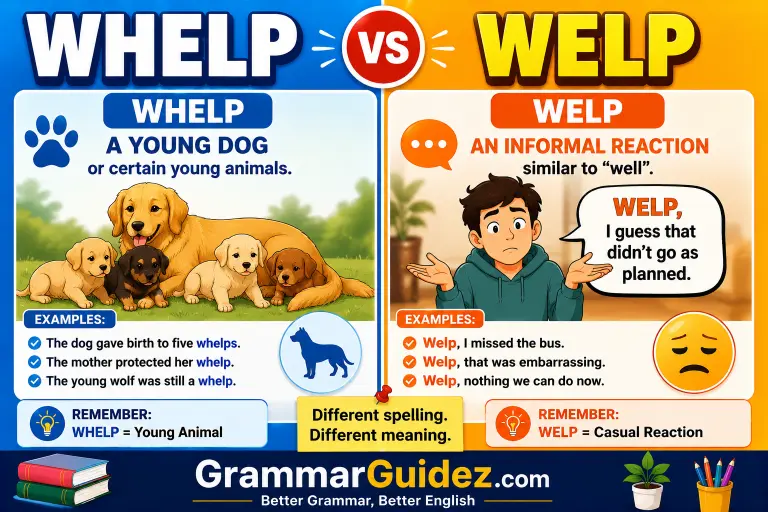
Whelp is a standard English word. It usually means a young dog or the young of certain wild animals.
Welp is an informal expression often used online or in casual conversation as a humorous form of “well.”
For example:
The dog gave birth to several whelps.
Here, whelp refers to young dogs.
Now look at this:
Welp, I guess we have to start again.
Here, welp is an informal reaction similar to saying:
Well, I guess we have to start again.
Although whelp and welp can look and sound similar, they are not interchangeable. One is a standard dictionary word connected with young animals, while the other is mainly used in casual speech, social media, memes, and informal writing.
This guide explains the difference between whelp or welp, including meanings, pronunciation, examples, grammar, slang usage, common mistakes, and easy memory tricks.
Whelp or Welp: Quick Answer
| Word | Meaning | Usage |
| Whelp | A young dog or certain young wild animals | Standard English |
| Welp | An informal reaction similar to “well” | Casual and online English |
Simple Examples
The mother dog stayed close to her whelps.
Welp, that did not go as planned.
The easiest way to remember is:
Young animal → Whelp
Casual reaction → Welp
What Does Whelp Mean?
Whelp is a standard English word that usually refers to:
A young dog.
It can also refer to the young of certain wild animals.
Examples
The dog gave birth to five whelps.
The young wolf was called a whelp.
The mother protected her whelp.
Today, puppy is much more common in everyday English when talking about a young dog.
For example, most people would naturally say:
The dog had five puppies.
instead of:
The dog had five whelps.
However, whelp is still a real and correct English word.
What Does Welp Mean?
Welp is an informal expression.
It is commonly used as a casual, humorous, or slightly resigned version of:
Well
For example:
Welp, that was embarrassing.
Welp, I tried my best.
Welp, I guess the plan failed.
The word often expresses a feeling such as:
- resignation
- disappointment
- awkwardness
- acceptance
- surprise
- mild frustration
- humor
It is especially common in:
- social media
- text messages
- memes
- online comments
- casual conversations
Whelp vs. Welp: The Main Difference
The main difference is their meaning.
Whelp
Whelp is connected with animals.
Example:
The wolf protected its whelp.
Welp
Welp is an informal reaction.
Example:
Welp, I missed the bus.
The two words should not be used interchangeably.
Is Welp a Real Word?
Welp is widely used in informal English.
However, it is not normally used in formal writing as a replacement for well.
For example, in a formal email, this would sound too casual:
❌ Welp, the meeting has been cancelled.
A better choice would be:
✅ Well, the meeting has been cancelled.
Or, in a professional context:
✅ Unfortunately, the meeting has been cancelled.
However, in a text message, this is completely natural:
Welp, there goes my weekend.
Why Do People Say “Welp”?
People often use welp to make their reaction sound more casual or humorous.
It can suggest:
“Well… what can I do now?”
For example:
Welp, I forgot my keys.
The speaker may be disappointed but is accepting the situation.
Another example:
Welp, that was a complete disaster.
This often has a humorous or sarcastic tone.
What Does “Welp” Express?
The meaning of welp can change slightly depending on the situation.
Resignation
Welp, I guess that’s over.
Meaning:
I accept that the situation is over.
Disappointment
Welp, we lost the game.
Meaning:
That is disappointing, but it happened.
Awkwardness
Welp, that was awkward.
Meaning:
The situation was uncomfortable or embarrassing.
Humor
Welp, there goes my diet.
Meaning:
The speaker is joking about failing to follow a diet.
Acceptance
Welp, nothing we can do now.
Meaning:
We have to accept the situation.
Whelp as a Noun
The most common traditional use of whelp is as a noun.
It refers to:
A young dog.
It can also refer to the young of some related wild animals.
Examples
The whelp stayed close to its mother.
The hunter saw several young whelps.
The animal protected its whelp.
In everyday modern English, puppy is usually the more common word.
Whelp as a Verb
Whelp can also be used as a verb.
It can refer to an animal giving birth to young.
Example
The dog whelped during the night.
This means:
The dog gave birth.
This use is much less common in everyday conversation.
You are more likely to hear people say:
The dog gave birth to puppies.
Whelp in Everyday English
Although whelp is a correct English word, it is not as common as puppy.
More Common
The dog had puppies.
Less Common
The dog had whelps.
Both may be understood, but puppies is more natural in modern everyday English.
Welp in Internet Slang
Welp became especially popular in informal online communication.
People often use it when something unexpected or disappointing happens.
Examples
Welp, my internet stopped working.
Welp, I failed the challenge.
Welp, that didn’t take long.
Welp, guess I’m staying home.
The word often gives the sentence a relaxed and humorous feeling.
Whelp or Welp in Text Messages
If you are writing casually to friends, you may use:
Welp
Example:
Welp, I’m late again.
However, if you are discussing a young animal, use:
Whelp
Example:
The dog protected her whelp.
The context makes the correct spelling clear.
Whelp or Welp: Pronunciation
Whelp is generally pronounced like:
/welp/
Welp is also generally pronounced like:
/welp/
Because they can sound the same, context is important.
Ask yourself:
Am I talking about a young animal?
Use:
Whelp
Or:
Am I giving an informal reaction?
Use:
Welp
Common Mistake
Common Mistake 1: Using Welp for a Young Animal
Incorrect:
❌ The dog gave birth to several welps.
Correct:
✅ The dog gave birth to several whelps.
Why?
Because whelp is the standard word connected with young animals.
Common Mistake 2: Using Whelp as an Informal Reaction
Incorrect:
❌ Whelp, I guess the movie is over.
Better:
✅ Welp, I guess the movie is over.
Why?
Because welp is the informal expression used as a reaction.
Common Mistake 3: Using Welp in Formal Writing
Avoid:
❌ Welp, we have reviewed your application.
For professional writing, use:
✅ Well, we have reviewed your application.
Or choose a more professional transition.
Welp is best kept for casual communication.
Common Mistake 4: Thinking Welp Is Always a Spelling Error
In formal English, welp may be inappropriate in many situations.
However, in casual internet language, it can be intentional.
For example:
Welp, that’s life.
Here, welp is being used deliberately to create a casual tone.
Whelp vs. Puppy
A whelp and a puppy can refer to a young dog.
However, puppy is much more common.
| Word | Meaning | Common Today? |
| Puppy | A young dog | Very common |
| Whelp | A young dog or young animal | Less common |
Everyday English
We adopted a puppy.
This sounds more natural than:
We adopted a whelp.
In most modern situations, puppy is the better choice.
Welp vs. Well
This comparison is important.
Well
Well is a standard English word.
Example:
Well, I understand your point.
It can be used in both casual and formal situations.
Welp
Welp is a casual and informal version often used for humor or resignation.
Example:
Welp, that didn’t work.
For formal writing, choose:
Well
For casual texts and social media, you may use:
Welp
Whelp vs. Welp vs. Well
| Word | Meaning | Best Use |
| Whelp | A young dog or young animal | Animal-related writing |
| Welp | Informal reaction | Texts and social media |
| Well | Standard word and expression | General and formal writing |
Examples
The mother cared for her whelp.
Welp, I forgot my phone.
Well, let’s discuss the problem.
Can Welp Be Used Professionally?
Usually, it is better not to use welp in professional writing.
For example, avoid:
Welp, your order is delayed.
Instead, write:
Unfortunately, your order is delayed.
Or:
We regret to inform you that your order is delayed.
In casual communication with friends or people you know well, welp can be perfectly acceptable.
Whelp in Older and Literary English
You may also encounter whelp in older writing or literature.
Historically, the word could sometimes be used in other ways, including as an insulting term for a young person.
This use is not appropriate for normal modern conversation unless you are discussing historical or literary language.
The most useful modern meaning to remember is:
Whelp = a young dog or young animal
When Should You Use Whelp?
Use whelp when writing about:
- young dogs
- certain young wild animals
- animal birth
Examples
The whelp followed its mother.
The dog was preparing to whelp.
The young animal was still a whelp.
When Should You Use Welp?
Use welp in casual situations when you want to express:
- acceptance
- disappointment
- surprise
- awkwardness
- humor
Examples
Welp, I guess we are lost.
Welp, that was unexpected.
Welp, there goes my plan.
Welp, time to try again.
Whelp or Welp: The Context Test
When you are unsure, ask yourself one simple question.
Are You Talking About an Animal?
Use:
Whelp
Example:
The mother protected her whelp.
Are You Reacting to a Situation?
Use:
Welp
Example:
Welp, that was a bad idea.
Are You Writing Formally?
Usually choose:
Well
instead of:
Welp
Example:
Well, we need to consider the available options.
Whelp or Welp: Example Sentences
Whelp Examples
The dog stayed close to her whelp.
The young whelp followed its mother.
The animal gave birth to several whelps.
The mother protected her whelp from danger.
Welp Examples
Welp, I missed the train.
Welp, I guess we have to wait.
Welp, that didn’t go as planned.
Welp, there goes my free time.
Easy Memory Trick
Here is an easy way to remember the difference.
Whelp Has “H”
Think:
Whelp = H for hound
A hound is a dog.
So if the word is connected with a young dog or animal, remember:
Whelp
Welp Is Like a Casual “Well”
Think:
Well → Welp
The p spelling creates a casual and humorous sound.
So remember:
Welp = casual reaction
Whelp or Welp: Quick Comparison Table
| Feature | Whelp | Welp |
| Meaning | Young dog or young animal | Informal reaction |
| Standard English | Yes | Informal usage |
| Formal Writing | Yes, when relevant | Usually no |
| Social Media | Rare | Common |
| Example | The whelp followed its mother | Welp, that failed |
Quick Quiz: Whelp or Welp?
Choose the correct word.
1. The mother dog cared for her ______.
A. Whelp
B. Welp
Answer: Whelp
2. ______, I guess we have to start again.
A. Whelp
B. Welp
Answer: Welp
3. The animal gave birth to several ______.
A. Whelps
B. Welps
Answer: Whelps
4. ______, that was embarrassing.
A. Whelp
B. Welp
Answer: Welp
5. A young dog can be called a ______.
A. Whelp
B. Welp
Answer: Whelp
Fill in the Blanks
Choose whelp or welp.
- The young ______ stayed close to its mother.
- ______, I forgot to save my work.
- The dog gave birth to several ______.
- ______, that plan failed quickly.
- The mother protected her ______.
Answers
- whelp
- welp
- whelps
- welp
- whelp
FAQs
What is the difference between whelp and welp?
Whelp is a standard English word for a young dog or certain young animals. Welp is an informal expression used as a casual version of “well.”
Is welp a real word?
Welp is widely used in informal communication, especially online, in text messages, and on social media.
It is best avoided in formal writing.
What does whelp mean?
Whelp usually means a young dog. It can also refer to the young of certain wild animals.
Is whelp another word for puppy?
Yes, whelp can refer to a young dog.
However, puppy is much more common in modern everyday English.
What does welp mean in slang?
Welp is often used as an informal reaction showing acceptance, disappointment, awkwardness, or humor.
Example:
Welp, that didn’t work.
Is welp the same as well?
Not exactly.
Welp is an informal and playful expression based on the sound of well.
For formal writing, use well.
How do you pronounce whelp and welp?
Both are generally pronounced:
/welp/
Because they can sound the same, you need to use the context to choose the correct spelling.
Should I use welp in a professional email?
Usually, no.
Use well or another professional phrase instead.
Conclusion
Both whelp and welp can be seen in English, but they have very different uses.
Use whelp when talking about:
- a young dog
- a young animal
- animal birth
Example:
The mother protected her whelp.
Use welp as an informal reaction in casual communication.
Example:
Welp, I guess we have to try again.
For professional or formal writing, avoid using welp as a replacement for well.
The easiest way to remember is:
Whelp = young animal
Welp = casual reaction
So, when choosing between whelp or welp, simply look at the context. If an animal is involved, choose whelp. If you are reacting casually to a situation, welp may be the right informal choice.
Read More Articles:
- Together or Togather: Correct Usage
- Dam or Damn: Meaning and Usage
- Focused or Focussed: Which Is Correct?

I am Elliot Hartwell, an English language writer and the author at GrammarGuidez.com. For the 6 years I have been working with English grammar, vocabulary, spelling and everyday language usage with a focus on making confusing topics easier to understand.
I started GrammarGuidez.com with a goal: to give readers clear and practical answers to common English questions. English can sometimes be confusing especially when two words look or sound similar but have meanings or uses. I enjoy breaking down these differences in a way that’s simple and easy to remember.
I believe learning English should feel simple not overwhelming. My goal is to make every article on GrammarGuidez.com useful, for students, writers, bloggers, teachers and anyone who wants to communicate clearly in English.