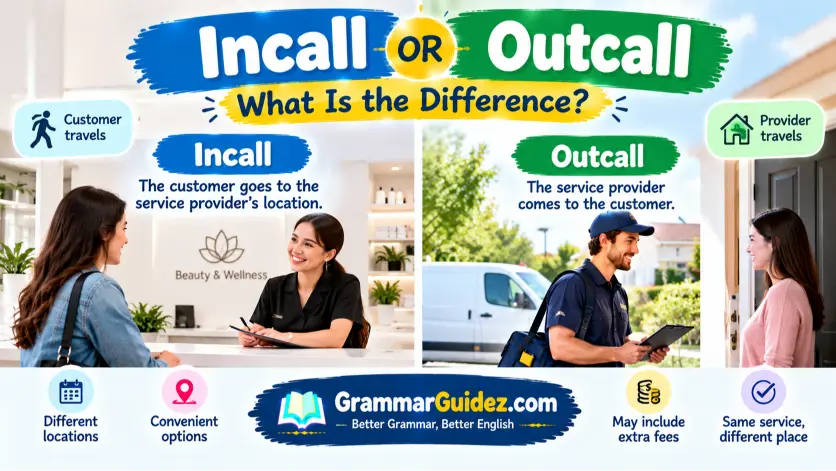
“Incall” means a service provided at the provider’s location, while “outcall” means the provider travels to the customer’s location. Both terms are correct, and their meaning depends on the service or industry.
Have you seen the words incall and outcall and wondered what they mean? These terms describe where a service takes place. They are often used in appointment listings, wellness services, and other service-based businesses.
The main difference is simple. Incall means the customer goes to the service provider. Outcall means the service provider comes to the customer.
Both terms can help people understand how an appointment works. However, they are not used in every type of everyday conversation. This guide explains their meanings, spelling, common uses, and differences in simple English.
Quick Answer: Incall vs. Outcall
- Incall: The customer visits the service provider’s location.
- Outcall: The service provider travels to the customer’s location.
For example, a customer who visits a clinic for an appointment uses an incall arrangement. If a technician travels to the customer’s home, that is an outcall arrangement.
| Feature | Incall | Outcall |
| Who travels? | The customer | The service provider |
| Where does it happen? | At the provider’s location | At the customer’s chosen location |
| Travel needed by customer | Usually yes | Usually no |
| Travel needed by provider | Usually no | Usually yes |
| Possible extra travel fee | Often lower | May be higher |
| Main benefit | A set service location | Convenience for the customer |
The exact details depend on the business. The words mainly describe who travels and where the service takes place.
What Does Incall Mean?
Incall is a service term used for an appointment that takes place at the service provider’s location. The customer travels to that location to receive the service.
The location might be an office, clinic, salon, studio, or another place where the provider works.
How Is Incall Used?
A business may use incall to explain that customers must visit its own location. This helps customers understand the arrangement before they book an appointment.
The term is especially useful when a business offers both visits at its location and visits to customers.
When Should You Use Incall?
Use incall when you want to describe a service where the customer visits the provider.
Common situations include:
- A customer visiting a service office.
- A client attending an appointment at a studio.
- A person receiving a service at a provider’s clinic.
- A booking that requires the customer to travel to a fixed location.
Keep in mind that incall is a specialized term. In everyday writing, it may be clearer to say “appointment at the provider’s location.”
What Does Outcall Mean?
Outcall is a service term for an appointment where the provider travels to the customer. The service takes place at the customer’s home, office, hotel, or another agreed location.
The exact location depends on the type of service and the provider’s rules.
How Is Outcall Used?
Businesses may offer outcall services when they can work at a customer’s location instead of requiring every customer to visit their office.
This can save the customer a trip. However, the provider may need extra time to travel and prepare.
When Should You Use Outcall?
Use outcall when the provider travels to the customer.
Common situations include:
- A technician visiting a customer’s home.
- A consultant meeting a client at their office.
- A mobile service provider visiting an agreed location.
- A professional offering appointments outside their main workplace.
In general writing, “home visit,” “on-site service,” or “mobile service” may be more familiar to readers. Choose the phrase that best matches the service.
Incall vs. Outcall: Key Differences
The main difference is the direction of travel. The service itself may be the same, but the location changes.
1. Location
With an incall appointment, the customer goes to the provider’s place of work. With an outcall appointment, the provider travels to the customer’s chosen location.
2. Convenience
Incall appointments require customers to travel. Outcall appointments may be easier for people who cannot easily leave home or prefer a service at their own location.
However, convenience depends on travel distance, scheduling, and the type of service.
3. Cost
Incall appointments may cost less because the provider does not need to travel to the customer.
Outcall services may include travel charges or a higher fee. This is not a universal rule, so customers should check the provider’s price list.
4. Scheduling
Incall appointments usually take place within the provider’s normal working hours and location.
Outcall appointments may need extra planning because the provider must allow time for travel. Some businesses may also limit the areas they serve.
5. Equipment and Setup
Some services need special tools or equipment. A clinic or studio may have everything ready at its own location.
For an outcall service, the provider must decide if the required equipment can be carried and used at the customer’s location.
Is Incall One Word or Two?
Incall is commonly written as one word when used as a service term. However, it is specialized vocabulary rather than a word used frequently in general conversation.
Depending on the sentence, writers may use a phrase such as “an appointment at the provider’s location” instead.
Do not assume that every use of “in call” means the same thing as the service term incall. In other contexts, the two words may have different meanings.
Is Outcall One Word or Two?
Outcall is also commonly written as one word when it refers to a service in which the provider travels to the customer.
It is often used in service descriptions and appointment listings. In general writing, a phrase such as “home visit” or “service at your location” may be easier to understand.
The best wording depends on the audience. Use the specialized term when readers are likely to know it, and explain it when clarity matters more than brevity.
Are Incall and Outcall Formal English Words?
Both terms appear in English, especially in service listings and appointment-related contexts. However, they are not as common in everyday conversation as words such as visit, appointment, and home service.
Their use also varies by industry. Some businesses use them as standard booking labels, while others prefer clearer phrases.
For professional writing, explain the terms the first time they appear if your audience may not know them.
For example, a service page could define an incall appointment as one held at the provider’s location and an outcall appointment as one held at the customer’s location.
This approach helps customers understand the booking options without needing to know specialized vocabulary.
Incall vs. Outcall in Different Services
The meaning depends on the service being offered, but the basic difference remains the same.
| Service type | Incall arrangement | Outcall arrangement |
| Beauty services | Customer visits a salon or studio | Provider visits the customer |
| Consulting | Client visits the consultant’s office | Consultant visits the client’s office |
| Technical support | Customer brings an item to a service center | Technician visits the customer |
| Wellness services | Customer visits the provider’s facility | Provider travels to an agreed location |
| Professional appointments | Customer visits the provider | Provider visits the customer |
Not every business offers both options. Some services must take place at a fixed location because they require special equipment, facilities, or working conditions.
Common Mistakes with Incall and Outcall
Mistake 1: Mixing Up Who Travels
The most common mistake is confusing which person must travel.
Remember:
- Incall: The customer goes to the provider.
- Outcall: The provider goes to the customer.
Mistake 2: Assuming Outcall Is Always More Expensive
Outcall services may cost more because of travel time and transportation. However, some providers charge the same rate for both arrangements.
Always check the actual price rather than assuming one option is more expensive.
Mistake 3: Assuming Every Business Offers Both Options
A business may only serve customers at its own location. Another business may operate entirely through home visits.
Check the service description before booking.
Mistake 4: Using Specialized Terms with Every Audience
Some readers may not know the words incall and outcall. If you are writing for a general audience, simpler wording may be better.
Instead of relying only on the term, explain where the appointment will take place.
Mistake 5: Treating Incall and Outcall as Opposite Services
The services themselves are not necessarily different. The main difference is the location and who travels. Both arrangements may offer the same service, depending on the provider.
How to Choose Between Incall and Outcall
The right option depends on your needs and the service being offered.
Consider these questions before making a booking:
- Do you prefer to travel, or would you rather have the provider visit you?
- Is the provider’s location easy to reach?
- Does the service require special equipment?
- Is there an additional travel fee?
- Does the provider serve your area?
- Which arrangement fits your schedule?
If you can easily visit the provider and want to use their facilities, an incall appointment may suit you.
If travel is difficult or the provider can work at your location, an outcall appointment may be more convenient.
Always confirm the location, cost, timing, and service details before booking.
Fill in the Blanks
Complete each sentence with incall or outcall.
- When the customer visits the provider’s office, it is an ______ appointment.
- When a technician travels to a customer’s home, it is an ______ service.
- In an ______ arrangement, the customer travels to the provider.
- An ______ appointment may save the customer a trip.
- The customer should check if the provider offers ______ or outcall appointments.
Answers
- incall
- outcall
- incall
- outcall
- incall
Mini Quiz
1. What does incall usually mean?
A. The provider travels to the customer.
B. The customer visits the provider.
C. The appointment is canceled.
Answer: B. Incall means the customer goes to the provider’s location.
2. What does outcall usually mean?
A. The provider travels to the customer.
B. The customer travels to the provider.
C. No appointment is needed.
Answer: A. Outcall means the provider comes to the customer’s location.
3. Which arrangement may require a travel fee?
A. Outcall
B. Incall only
C. Neither can involve travel costs
Answer: A. Outcall may include a travel fee, depending on the provider.
4. Are incall and outcall always different services?
A. Yes, they must be different.
B. No, they can be the same service at different locations.
C. Yes, one is always canceled.
Answer: B. The main difference is where the service takes place.
5. What is clearer for readers who do not know these terms?
A. Use unexplained jargon.
B. Explain where the appointment takes place.
C. Leave out the location.
Answer: B. Clear wording helps readers understand the booking arrangement.
FAQs
1. What is the difference between incall and outcall?
Incall means the customer visits the service provider’s location. Outcall means the service provider travels to the customer.
2. Does incall mean I go to them?
Yes. In the usual service-related meaning, an incall appointment takes place at the provider’s location.
3. Does outcall mean they come to me?
Yes. An outcall arrangement means the provider travels to the customer’s location, if that service is offered.
4. Is incall cheaper than outcall?
It may be cheaper because the provider does not need to travel. However, pricing depends on the business, service, and any additional fees.
5. Are incall and outcall the same service?
They can describe the same type of service offered in different locations. The key difference is who travels.
6. Are incall and outcall written as one word?
They are commonly written as one word in service-related contexts. Some writers may use alternative wording to make the meaning clearer.
7. Are incall and outcall used in professional settings?
Yes. They appear in some service listings and booking systems. However, “appointment at our location” and “home visit” may be clearer for general audiences.
8. Which word should I use in everyday English?
Use incall and outcall if your audience understands these service terms. Otherwise, explain the location directly to avoid confusion.
Conclusion
Incall and outcall describe two ways to arrange a service appointment.
An incall appointment takes place at the provider’s location, so the customer travels to them. An outcall appointment takes place at the customer’s location, so the provider travels to the customer.
Remember the simple rule: Incall = you go to the provider. Outcall = the provider comes to you.
The words may be useful in booking listings, but clear phrases such as “visit our office” or “home visit available” can be easier for a general audience to understand.
Read More Articles:

I am Elliot Hartwell, an English language writer and the author at GrammarGuidez.com. For the 6 years I have been working with English grammar, vocabulary, spelling and everyday language usage with a focus on making confusing topics easier to understand.
I started GrammarGuidez.com with a goal: to give readers clear and practical answers to common English questions. English can sometimes be confusing especially when two words look or sound similar but have meanings or uses. I enjoy breaking down these differences in a way that’s simple and easy to remember.
I believe learning English should feel simple not overwhelming. My goal is to make every article on GrammarGuidez.com useful, for students, writers, bloggers, teachers and anyone who wants to communicate clearly in English.