“Weaning” is the correct spelling. It means slowly stopping a baby from drinking breast milk or helping someone or an animal stop depending on something. “Weening” is usually a misspelling of “weaning.”
Are you unsure if to write weening or weaning? The two words look almost the same, but they do not have the same everyday use.
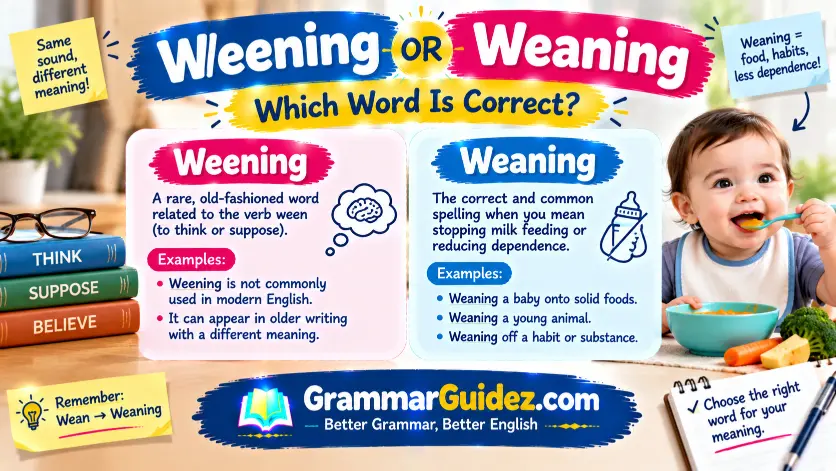
Weaning is the correct and common spelling when you mean helping a baby stop drinking breast milk or helping someone slowly stop a habit or dependence. The word weening is rare in modern English and may appear in older writing with a different meaning.
In this guide, you will learn the difference between weening and weaning, how to use the words, and which spelling to choose.
Quick Answer: Weening or Weaning?
Weaning is the word you usually need. It comes from the verb wean, which means to help a baby or young animal move from its mother’s milk to other food. It can also mean gradually reducing dependence on something.
Weening is a rare word linked to the old verb ween, meaning to think, suppose, or believe. In everyday modern writing, people may also use weening by mistake when they mean weaning.
| Word | Meaning | Everyday use |
| Weaning | Gradually stopping milk feeding or reducing dependence | Common |
| Weening | A rare form related to the old verb ween | Uncommon |
Easy rule: If you are talking about babies, food, habits, or reducing dependence, use weaning.
What Does Weaning Mean?
Weaning is the process of helping a baby or young animal stop relying only on its mother’s milk and begin taking other food.
The word can also describe slowly reducing a person’s dependence on something, such as a habit, substance, or form of support.
Weaning as a Process
Weaning often happens gradually. A baby may begin eating suitable solid foods while milk feeding continues. The exact process depends on the child and family.
The word is also used for young animals that begin eating food other than their mother’s milk.
Weaning Away from a Habit
The word weaning can describe moving away from a habit or dependence over time.
For example, a person may try to reduce their reliance on sugary drinks. A company may work to reduce its dependence on a particular supplier.
In these cases, weaning does not refer to feeding a baby. It means gradually becoming less dependent on something.
What Does Weening Mean?
Weening is not the usual spelling for the process of stopping milk feeding or reducing dependence.
It is connected to the older verb ween, which can mean to think, suppose, or believe. This use is rare in modern everyday English.
Because weening looks and sounds similar to weaning, people sometimes confuse the two spellings.
If you are writing about infant feeding, changing habits, or reducing dependence, choose weaning.
Weening vs. Weaning: Main Differences
The main difference is meaning and common usage.
| Feature | Weening | Weaning |
| Common in modern English | No | Yes |
| Related base word | Ween | Wean |
| Common meaning | Rare or old-fashioned idea of thinking or supposing | Gradually stopping milk feeding or reducing dependence |
| Used for infant feeding | No | Yes |
| Used for reducing a habit | No, not in the usual sense | Yes |
| Best choice for everyday writing | Usually not | Yes |
The most important point is that these spellings are not interchangeable in ordinary modern writing.
When Should You Use Weaning?
Use weaning in these common situations.
1. When Talking About a Baby
Weaning can describe the process of introducing other foods as a baby moves beyond relying only on milk.
The exact feeding plan depends on the baby’s needs and professional guidance.
2. When Talking About Young Animals
The word also applies to young animals that stop relying on their mother’s milk and begin eating other food.
It is common in writing about farming, animal care, and wildlife.
3. When Talking About Habits
Weaning can describe slowly reducing a habit or dependence.
This use appears in phrases such as weaning someone off something.
4. When Talking About Dependence on Something
People, businesses, and governments can all be described as weaning themselves off a product, service, or resource when they gradually reduce their reliance on it.
Common Phrases with Weaning
Here are some common expressions that use the correct spelling.
- Weaning a baby: Helping a baby move toward foods other than milk.
- Weaning an animal: Helping a young animal stop relying on its mother’s milk.
- Weaning off a habit: Gradually reducing a habit or dependence.
- Weaning off a substance: Gradually reducing reliance on a substance, with professional guidance when needed.
- Weaning from support: Gradually reducing the need for a type of help or support.
These phrases use weaning, not weening.
Why Do People Confuse Weening and Weaning?
There are a few simple reasons.
The Words Look Similar
Both words have seven letters, and only one vowel changes. This small difference can make the spellings easy to mix up.
The Words Sound Similar
In common pronunciation, weaning sounds like “WEE-ning.” The rare word weening is also pronounced similarly. Hearing the words may not help you identify the correct spelling.
Wean Is Less Familiar to Some Writers
Some writers may not use the verb wean very often. When they need the word weaning, they may guess the spelling.
Learning the base word makes the correct spelling easier to remember.
How to Remember the Correct Spelling
Use this simple memory trick:
Wean → Weaning
The word weaning keeps the letter a from wean.
Think of the phrase “wean a baby.” When you add -ing, you get weaning.
Remember:
- Wean → Weaning
- Weaned → Weaning
- Weening → Not the usual spelling for this meaning
This trick works for writing about feeding, habits, and dependence.
Common Mistakes with Weening and Weaning
Mistake 1: Writing Weening a Baby
Incorrect for the usual meaning: The parents started weening their baby.
Correct: The parents started weaning their baby.
Use weaning when you mean moving away from milk feeding.
Mistake 2: Writing Weening Off a Habit
Incorrect for standard modern usage: She is weening herself off the habit.
Correct: She is weaning herself off the habit.
The correct phrase is weaning off.
Mistake 3: Assuming Weening Is Always the Correct Form
The spelling weening has a rare historical use, but it is not the standard word for reducing dependence or changing feeding habits.
For clear modern writing, use weaning when that is your intended meaning.
Mistake 4: Changing the Spelling in Related Words
Remember the main forms:
- Wean
- Weans
- Weaned
- Weaning
Learning these forms helps you avoid spelling mistakes.
Is Weaning the Correct Spelling in American and British English?
Yes. Weaning is the standard spelling in both American and British English when referring to this process. It is not a difference between US and UK spelling.
| Meaning | American English | British English |
| Moving a baby toward other foods | Weaning | Weaning |
| Changing a young animal’s feeding | Weaning | Weaning |
| Gradually reducing dependence | Weaning | Weaning |
You can use weaning for these meanings regardless of if you are writing for American or British readers.
Fill in the Blanks
Choose weening or weaning to complete each sentence.
- The family is ______ their baby onto other foods.
- The farmer is ______ the young animals.
- He is slowly ______ himself off the habit.
- The correct spelling for reducing dependence is ______.
- She learned how to spell ______ correctly.
Answers
- weaning
- weaning
- weaning
- weaning
- weaning
Mini Quiz
1. Which spelling is correct for the process of moving a baby toward other foods?
A. Weening
B. Weaning
C. Weaningg
Answer: B Weaning. This is the standard spelling for the process.
2. What is the base word of weaning?
A. Ween
B. Wean
C. Weaning
Answer: B Wean. Add -ing to wean to form weaning.
3. Which phrase is standard modern English?
A. Weening off a habit
B. Weaning off a habit
C. Ween offing a habit
Answer: B Weaning off a habit. This phrase describes gradually reducing dependence.
4. Is weaning spelled differently in American and British English?
A. Yes
B. No
C. Only in formal writing
Answer: B No. Both varieties use weaning.
5. Is weening the usual spelling for reducing dependence?
A. Yes
B. No
C. Both are equally common
Answer: B No. Weaning is the standard spelling for that meaning.
FAQs
1. Is it weening or weaning?
Use weaning when you mean stopping milk feeding or gradually reducing dependence. Weening is rare and is not the standard spelling for these meanings.
2. Is weening a real word?
Yes, weening can appear as a form of the old verb ween, meaning to think or suppose. However, this use is uncommon in modern English.
3. What does weaning mean?
Weaning can mean helping a baby or young animal stop relying on its mother’s milk. It can also mean gradually reducing dependence on a habit, substance, or other thing.
4. Is weaning used in both American and British English?
Yes. The spelling weaning is used in both varieties of English.
5. How do you spell weaning?
The correct spelling is w-e-a-n-i-n-g.
6. What is the base word of weaning?
The base word is wean. Adding -ing gives you weaning.
7. Can weaning refer to habits?
Yes. People can use weaning off to describe gradually reducing dependence on a habit or something they regularly use.
8. Why is weening often marked as a spelling mistake?
Many writers use weening when they intend to write weaning. Spell-checkers may flag it because it is rare and is not the usual spelling for the intended meaning.
Conclusion
The difference between weening or weaning is simple once you know the base word.
Weaning is the correct and common spelling when talking about infant feeding, young animals, habits, or reducing dependence. Weening is rare and may appear in older writing with a different meaning.
When writing for a modern audience, choose weaning for the usual meanings. Remember the base word wean, and you will find the spelling easier to get right.
Read More Articles:

I am Evan Whitmore, an English language writer and the person who started GrammarGuidez.com. I made GrammarGuidez.com to make grammar, spelling, vocabulary and words that are often confused easier to understand.
I like taking to understand English words and grammar rules and turning them into simple and clear explanations. My aim is to help students, writers, bloggers, ESL learners and regular English speakers feel more sure when they write and talk.
At GrammarGuidez.com I work on real life examples easy to understand explanations comparing words, spelling changes and how American English is used every day.
I think learning English doesn’t need to be hard. A good explanation and some good examples can make tough grammar topics much simpler to learn