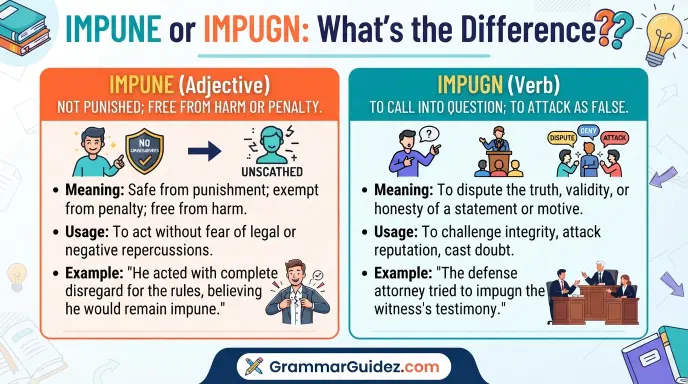
“Impugn” is the correct word, while “impune” is not a standard English word and is usually a misspelling. “Impugn” is a verb meaning to question, challenge, or attack the truth, honesty, or validity of something, whereas “impune” has no accepted meaning in standard English.
Some English words confuse people because they look similar. Others are confusing because they sound almost exactly the same.
Impune and impugn are especially tricky because many people may hear the same pronunciation but see two different spellings.
However, these words are not equal in modern English.
If you want a verb that means to challenge, question, criticize, or attack someone’s honesty, character, motives, or claims, the correct word is:
Impugn
For example:
The lawyer tried to impugn the witness’s credibility.
This means the lawyer tried to question or attack the witness’s credibility.
Impune, on the other hand, is not the normal modern English verb used for this meaning. It has historical and Latin connections and is now largely obsolete in English usage.
So, for most modern writing, the answer is simple:
Use impugn when you mean to challenge or cast doubt on something.
This guide explains the difference between impune and impugn, including meaning, spelling, pronunciation, grammar, examples, common mistakes, and easy ways to remember the correct word.
The Fast Answer: Impune or Impugn?
Here is the simplest answer.
| Word | Modern English Use | Main Meaning |
| Impugn | ✅ Correct and established | To challenge, criticize, or question |
| Impune | ⚠️ Rare and obsolete in English | Historically connected with being unpunished |
Correct Modern Example
The article did not impugn his honesty.
This means the article did not question or attack his honesty.
Common Incorrect Use
The article did not impune his honesty. ❌
If you mean challenge or question, use impugn.
Start With the Meaning You Want
The easiest way to choose between these two words is to ask one question:
Do I mean “to challenge or cast doubt on something”?
If the answer is yes, use impugn.
Examples
She impugned his motives.
The report impugned the company’s claims.
He did not want to impugn her integrity.
The lawyer attempted to impugn the evidence.
In all these examples, impugn means to challenge, question, criticize, or attack through words or arguments.
What Does Impugn Mean?
Impugn is a formal transitive verb.
It means:
- To challenge
- To question
- To criticize
- To attack as false
- To cast doubt on
- To question someone’s honesty or integrity
It is often used when discussing:
- Character
- Reputation
- Integrity
- Motives
- Claims
- Evidence
- Decisions
- Arguments
Simple Example
Nobody should impugn her character without evidence.
This means nobody should question or attack her character without evidence.
Another Example
The lawyer impugned the witness’s credibility.
The lawyer tried to make people doubt if the witness was trustworthy.
Impugn is usually used in formal English rather than casual conversation.
Instead of saying:
I impugn his motives.
Many people in everyday speech would say:
I question his motives.
or:
I doubt his motives.
However, impugn is useful in legal, academic, political, and professional writing.
What Does Impune Mean?
Impune is very different from impugn.
In modern everyday English, impune is not normally used as a standard verb meaning “challenge” or “question.”
Historically, it was connected with the idea of being unpunished or acting without punishment.
Today, most English learners and writers will rarely need to use impune in normal writing.
This is important because people sometimes write impune when they actually mean:
impugn
For example:
❌ The writer impuned the politician’s honesty.
If the meaning is “questioned the politician’s honesty,” the correct word is:
✅ The writer impugned the politician’s honesty.
For modern English writing, impugn is almost always the word you need in this comparison.
Why Are Impune and Impugn Confusing?
The biggest reason is pronunciation.
The two words can sound very similar or identical depending on how they are spoken.
Impugn
Approximate pronunciation:
im-PYOON
The final gn is silent.
You do not pronounce it like:
im-pug-n ❌
Instead, the word ends with a sound similar to:
noon
or:
moon
So:
impugn = im-PYOON
This silent-letter pattern makes the spelling difficult.
Many learners may assume that the word should be spelled:
impune
because that spelling appears to match the pronunciation.
However, when you mean challenge or question, the correct spelling is:
I-M-P-U-G-N
The Important Grammar Difference
Understanding grammar can help you avoid the mistake.
Impugn Is a Verb
You can use impugn in different verb forms.
Base Form
They may impugn his motives.
Third-Person Singular
The article impugns his reputation.
Past Tense
The speaker impugned her integrity.
Present Participle
They are impugning the decision.
The normal verb forms are:
| Form | Word |
| Base form | Impugn |
| Present | Impugns |
| Past | Impugned |
| -ing form | Impugning |
This is the standard modern verb pattern.
How to Use Impugn in a Sentence
Impugn normally takes a direct object.
In simple terms, you impugn something.
Common Objects After Impugn
You can impugn:
- Someone’s character
- Someone’s motives
- Someone’s integrity
- Someone’s honesty
- Someone’s credibility
- A claim
- An argument
- Evidence
- A decision
Examples
The journalist refused to impugn the minister’s motives.
The evidence impugned his earlier statement.
Her comments seemed to impugn his professional judgment.
The criticism did not impugn the quality of the research.
Notice that impugn often appears before an abstract idea.
For example:
impugn credibility
impugn integrity
These are common formal patterns.
Impugn Is Not the Same as Disagree
One common mistake is using impugn when simple disagreement is meant.
For example:
I impugn your choice of restaurant.
This sounds unusually strong and formal.
If you simply disagree, say:
I disagree with your choice of restaurant.
Impugn usually suggests more than ordinary disagreement.
It often means questioning if something is:
- Honest
- True
- Reliable
- Valid
- Trustworthy
- Morally sound
Compare
I disagree with his opinion.
This means you have a different opinion.
I impugn his motives.
This means you question if his motives are honest or good.
The second sentence is much stronger.
Impugn in Legal and Professional Writing
Impugn is especially common in formal contexts.
Legal Writing
Lawyers may use the word when discussing:
- Witness credibility
- Evidence
- Motives
- Testimony
- Character
Example:
The defense attempted to impugn the witness’s credibility.
This means the defense tried to make people doubt the witness.
Academic Writing
In academic writing, impugn can be used when challenging an argument or claim.
The new evidence may impugn the earlier conclusion.
This means the evidence may call the earlier conclusion into question.
Professional Writing
In professional settings, the word is often used carefully.
This criticism is not intended to impugn the team’s integrity.
This means:
The criticism is not intended to question if the team is honest or ethical.
Because impugn can sound strong, formal writers should use it only when that meaning is intended.
Impune vs Impugn: A Real-World Decision Test
Before using either word, follow this simple test.
Question 1: Do you mean “to challenge or question”?
Use:
Impugn
Example:
They impugned the report’s accuracy.
Question 2: Are you writing a normal modern English sentence?
If yes, impune is usually not the word you need.
The spelling impune has historical and Latin connections rather than functioning as the normal modern English verb meaning “challenge.”
Question 3: Are you unsure?
Try replacing the word with:
question
or:
challenge
If the sentence still makes sense, impugn may be the correct formal word.
Example:
They questioned his motives.
This can become:
They impugned his motives.
Common Mistakes With Impugn
Mistake 1: Writing Impune Instead of Impugn
❌ The lawyer tried to impune his character.
✅ The lawyer tried to impugn his character.
If the meaning is to question or challenge, use impugn.
Mistake 2: Pronouncing the “G”
Some learners may pronounce every letter.
❌ im-pug-n
The final letters do not work that way in standard pronunciation.
The word is pronounced approximately:
im-PYOON
Mistake 3: Using Impugn for Simple Disagreement
❌ I impugn your favorite movie.
This sounds too strong for a simple difference of opinion.
Better:
I disagree with your opinion about the movie.
Use impugn when questioning truth, honesty, motives, credibility, or validity.
Mistake 4: Confusing Impugn With Insult
Impugn can criticize or question something, but it does not simply mean “insult.”
For example:
He insulted his colleague.
This is direct rude behavior.
But:
He impugned his colleague’s motives.
This means he questioned if the colleague had honest or good reasons.
The meanings are related in some situations but are not identical.
Impugn vs Other Similar Words
Sometimes writers use impugn when a simpler word may be better.
Impugn vs Question
Question is more common and neutral.
I question his decision.
Impugn is stronger and more formal.
I impugn his motives.
Impugn vs Criticize
Criticize means expressing disapproval.
The manager criticized the report.
Impugn often focuses on questioning truth, honesty, or integrity.
The manager impugned the report’s accuracy.
Impugn vs Challenge
Challenge means questioning if something is correct or valid.
They challenged the claim.
Impugn can also challenge something but often has a stronger suggestion of attacking its truth, honesty, or integrity.
British English vs American English
The spelling impugn is used in both British and American English.
| Region | Standard Spelling |
| United States | Impugn |
| United Kingdom | Impugn |
| Canada | Impugn |
| Australia | Impugn |
| International English | Impugn |
There is no common British spelling of impune that replaces impugn.
So this is not like:
- colour vs color
- theatre vs theater
- apologise vs apologize
When you mean “challenge or question,” impugn is the standard spelling in major varieties of modern English.
Origin: Why Does Impugn Have a Silent “GN”?
The unusual spelling becomes easier to understand when you look at the word’s history.
Impugn comes through French and ultimately from Latin impugnare, which carried the idea of attacking or fighting.
This historical connection explains why the modern word still has a strong sense of verbal attack.
Over time, English moved away from the older physical sense of attacking and kept the more figurative meaning.
Today, you usually impugn someone through words, arguments, criticism, or evidence.
That is why the word often appears in serious discussions about:
- Integrity
- Reputation
- Claims
- Motives
- Evidence
Its historical spelling also helps explain why the final gn remains even though the word is pronounced without a clear final “g” sound.
Easy Memory Tricks
Here are simple ways to remember the correct spelling.
Trick 1: Think “Pugnacious”
The words impugn and pugnacious have historical connections with fighting.
Think:
Impugn = verbal fight
You are attacking an idea, claim, motive, or reputation.
Trick 2: Remember the Silent GN
The correct word is:
im-pu-gn
Even though the final letters are not pronounced separately, they are part of the correct spelling.
Trick 3: Use the “Question Test”
Ask yourself:
Am I questioning this person’s honesty, motives, or credibility?
If yes:
Impugn
Trick 4: Think of “Impugn Integrity”
A useful phrase to remember is:
impugn someone’s integrity
This helps connect the word with questioning honesty or character.
Everyday Examples
Although impugn is formal, you may still see it in many areas.
In News Writing
The article did not impugn the official’s honesty.
In Business
The review should criticize the policy without impugning the staff’s motives.
In Academic Writing
The study does not impugn the validity of previous research.
In Law
The attorney attempted to impugn the witness’s credibility.
In Professional Emails
I am not trying to impugn your judgment, but I believe we should review the decision.
This is a polite but formal way to say that you are questioning a decision without directly attacking the person.
Quick Quiz: Impune or Impugn?
Choose the correct word.
1. The lawyer tried to ______ the witness’s credibility.
A. impune
B. impugn
2. The article did not ______ his honesty.
A. impugn
B. impune
3. She refused to ______ her colleague’s motives.
A. impune
B. impugn
4. The criticism seemed to ______ the manager’s integrity.
A. impugn
B. impune
5. If you mean “challenge or question,” which spelling should you use?
A. impune
B. impugn
6. The evidence may ______ the earlier claim.
A. impugn
B. impune
7. ______ is commonly used as a formal verb in modern English.
A. Impugn
B. Impune
8. The speaker did not want to ______ the scientist’s reputation.
A. impune
B. impugn
Answers
- B — impugn
- A — impugn
- B — impugn
- A — impugn
- B — impugn
- A — impugn
- A — impugn
- B — impugn
Fill in the Blanks
Complete each sentence with impugn or the correct form of impugn.
- The lawyer tried to ______ the witness’s credibility.
- Her comments did not ______ his honesty.
- The article ______ the politician’s motives.
- They were ______ the accuracy of the report.
- Nobody should ______ another person’s integrity without evidence.
- The criticism ______ his professional judgment.
- The new evidence may ______ the old theory.
- She avoided ______ her colleague’s character.
- The argument does not ______ the value of the research.
- The speaker carefully avoided ______ anyone’s motives.
Answers
- impugn
- impugn
- impugned
- impugning
- impugn
- impugned
- impugn
- impugning
- impugn
- impugning
FAQs
Is impune a correct English word?
Impune has historical and obsolete English usage and also appears in Latin contexts. However, it is not the normal modern English verb meaning “to challenge” or “to question.” If that is your intended meaning, use impugn.
Which is correct: impune or impugn?
If you mean to question, challenge, criticize, or cast doubt on someone’s character, motives, honesty, or claims, the correct word is impugn.
What does impugn mean?
Impugn means to challenge or attack something as questionable, false, dishonest, or lacking integrity. It is commonly used in formal writing about motives, character, credibility, evidence, and claims.
How do you pronounce impugn?
Impugn is pronounced approximately:
im-PYOON
The final gn is not pronounced as separate sounds.
Is impugn a formal word?
Yes. Impugn is generally considered formal. In casual English, people often use simpler alternatives such as question, challenge, doubt, or criticize.
Can you impugn a person?
Yes, but the word is often used more specifically with something connected to the person.
For example:
impugn someone’s character
impugn someone’s motives
These expressions clearly explain what is being questioned.
What is the past tense of impugn?
The past tense and past participle are:
impugned
Example:
The lawyer impugned the witness’s credibility.
What is the difference between impugn and question?
Question is a common and neutral verb. Impugn is more formal and usually stronger. To impugn something often means questioning its honesty, truth, validity, credibility, or integrity.
Conclusion
For modern English writers, the key difference is simple.
Impugn is the correct modern verb when you mean to challenge, question, or cast doubt on something.
Use impugn when discussing:
- Motives
- Integrity
- Character
- Credibility
- Honesty
- Claims
- Arguments
- Evidence
Examples:
The lawyer impugned the witness’s credibility.
She did not want to impugn his motives.
The article impugned the accuracy of the report.
Impune should not normally be used as a replacement for impugn in modern English.
The easiest memory rule is:
If you mean “question or challenge,” use IMPUGN.
Remember that impugn is a formal word. In everyday writing, simpler alternatives such as question, challenge, or doubt may sometimes sound more natural.
Once you connect
impugn with questioning someone’s credibility or integrity, the correct spelling becomes much easier to remember.
Read More Articles:
- Erk or Irk: Meaning and Correct Usage
- Alluding or Eluding: What’s the Difference?
- Apposed or Opposed: Which Word Is Correct?

I am Elliot Hartwell, an English language writer and the author at GrammarGuidez.com. For the 6 years I have been working with English grammar, vocabulary, spelling and everyday language usage with a focus on making confusing topics easier to understand.
I started GrammarGuidez.com with a goal: to give readers clear and practical answers to common English questions. English can sometimes be confusing especially when two words look or sound similar but have meanings or uses. I enjoy breaking down these differences in a way that’s simple and easy to remember.
I believe learning English should feel simple not overwhelming. My goal is to make every article on GrammarGuidez.com useful, for students, writers, bloggers, teachers and anyone who wants to communicate clearly in English.