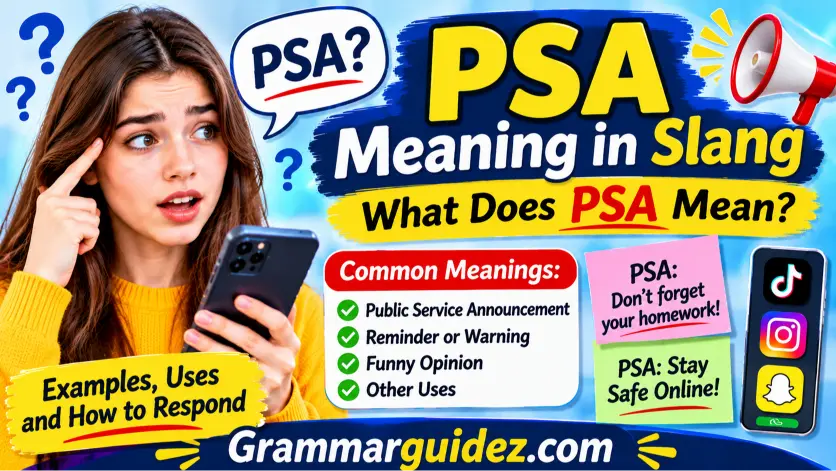
“PSA Meaning in Slang: PSA stands for “Public Service Announcement.” In texting and on social media, it introduces an important reminder, warning, or piece of information that people should know”.
Have you ever seen someone start a message with “PSA:” and wondered what it means? You may notice this abbreviation in text messages, TikTok captions, Instagram posts, group chats, or online comments. It is often used before someone shares information they think other people should know.
PSA usually stands for Public Service Announcement. In everyday online conversations, people use it to introduce reminders, helpful tips, warnings, opinions, or funny observations. It does not always mean that someone is making a serious announcement. Sometimes people use PSA jokingly to make an ordinary statement sound important.
For example, someone might write “PSA: Bring snacks if you’re going on a road trip.” It is simply a friendly reminder. Understanding PSA is easy once you know how it is used.
In this guide, you will learn what PSA means in slang, how people use it on social media, its different meanings, examples, and natural ways to respond.
What Does PSA Mean in Slang?
PSA stands for “Public Service Announcement.” Traditionally, it refers to a message shared to inform people about something important, such as safety, health, public awareness, or useful information.
In slang and casual online communication, PSA is used more loosely. People often write it before a reminder, tip, warning, opinion, or announcement they want others to notice.
For example:
PSA: Don’t forget to charge your phone before leaving home.
Here, the sender is giving a simple reminder. They are not creating an official announcement. They are using PSA to make the message stand out.
People also use PSA in a funny or sarcastic way. They may introduce an ordinary opinion as if it were important news.
PSA: Pizza tastes better when you don’t have to share it.
This is a playful statement, not an actual public announcement.
PSA Full Form
| Abbreviation | Full Form | Meaning |
| PSA | Public Service Announcement | Informative message or announcement |
| PSA | Prostate-Specific Antigen | Medical term |
| PSA | Professional Sports Authenticator | Trading-card grading company |
| PSA | Point of Sale (not usually the standard abbreviation in all systems) | Business/payment context |
The most common meaning in texting and social media is Public Service Announcement.
Quick Answer: What Does PSA Mean in Text?
PSA means Public Service Announcement.
People use it in texts, comments, and social media posts to introduce something they want others to know. It can be a reminder, warning, helpful tip, announcement, opinion, or joke.
Example:
PSA: The store closes early today.
The sender is sharing information they believe other people may need.
Is PSA Slang or an Abbreviation?
PSA is technically an abbreviation, not originally slang. Its full form is Public Service Announcement, a term traditionally used for public information messages.
However, people now use PSA casually on the internet. It has become part of informal online language because it appears in memes, captions, group chats, and everyday conversations.
For example:
- PSA: Drink some water.
- PSA: Stop spending money you don’t have.
- PSA: That restaurant is closed on Mondays.
- PSA: You deserve a good night’s sleep.
These are not necessarily official announcements. They are casual messages introduced with PSA to grab attention.
So, PSA is not originally slang, but its casual online use is often considered internet slang.
Why Do People Use PSA in Text Messages?
People use PSA because it makes a message look noticeable and important. It is a quick way to introduce information without writing a long opening sentence.
1. To Share a Reminder
People use PSA to remind friends, family, coworkers, or followers about something.
Example:
PSA: Your assignment is due tomorrow.
The sender wants everyone to remember the deadline.
2. To Give Helpful Advice
PSA can introduce advice that may help someone avoid a problem or make a better decision.
Example:
PSA: Always save a copy of your important files.
The message gives a useful tip.
3. To Warn People
Someone may use PSA to warn others about something they should avoid.
Example:
PSA: Don’t click links from unknown accounts.
The sender is sharing a warning about online safety.
4. To Share an Opinion
People sometimes introduce their personal opinions with PSA to make them sound like important information.
Example:
PSA: Comfortable shoes are better than fashionable shoes that hurt.
This is an opinion presented as a friendly announcement.
5. To Make People Laugh
PSA is often used for humorous or exaggerated statements.
Example:
PSA: Monday should come with an extra cup of coffee.
The sender is joking and making a relatable observation.
What Does PSA Mean on TikTok?
On TikTok, PSA usually stands for Public Service Announcement. Creators use it before sharing advice, warnings, reminders, opinions, or information in videos, captions, and comments.
The tone can be serious, helpful, funny, dramatic, or sarcastic.
For example:
PSA: You don’t have to answer every message immediately.
This is a friendly reminder.
Another example:
PSA: Stop wearing white shoes when it’s raining.
This could be practical advice or a humorous comment.
TikTok creators also use PSA to draw attention to common mistakes, trends, personal experiences, or things they think viewers should know.
PSA does not have a special TikTok-only meaning. It generally keeps the same meaning across social media.
What Does PSA Mean on Instagram?
On Instagram, PSA is used in captions, Stories, comments, Reels, and direct messages.
People use it when they want followers to notice a reminder, announcement, useful tip, or opinion.
For example:
PSA: This café has the best coffee in town.
The person is sharing a recommendation.
You may also see PSA used for serious information, such as reminders about online safety, event changes, or community updates.
The meaning depends on the content that follows the abbreviation.
What Does PSA Mean on Snapchat?
On Snapchat, PSA usually means Public Service Announcement.
Someone may use it in a chat or Story to share a quick warning, reminder, or piece of information.
For example:
PSA: Don’t forget your jacket. It’s cold outside.
It is simply a message intended to get attention.
Friends may also use PSA jokingly when sharing funny opinions or everyday observations.
What Does PSA Mean on Facebook?
On Facebook, PSA is often used in posts, group discussions, community updates, and comments.
People may use it to announce something, share advice, warn others, or remind a group about an event.
For example:
PSA: The community meeting has moved to Saturday.
In this case, the abbreviation introduces an update that people should know.
It can also be used casually, such as:
PSA: Leftovers are sometimes better than the original meal.
That is a personal opinion shared in a playful way.
What Does PSA Mean in a Group Chat?
In group chats, PSA is usually used to get everyone’s attention.
Someone might write PSA before sharing information that is relevant to the whole group.
Examples include:
- PSA: We’re meeting at 7, not 8.
- PSA: Bring your own snacks.
- PSA: The deadline is tonight.
- PSA: Please check the group poll.
- PSA: Don’t forget your charger.
It is a convenient way to make an announcement without sounding too formal.
Is PSA Always Serious?
No. PSA can be serious, casual, funny, sarcastic, or dramatic.
The abbreviation itself does not determine the tone. The words that come after it make the meaning clear.
Serious PSA
PSA: Never share your banking password with anyone.
This is a serious safety reminder.
Helpful PSA
PSA: Keep a bottle of water with you during long trips.
This is practical advice.
Funny PSA
PSA: Snacks disappear faster when you share them.
This is a joke or playful observation.
Sarcastic PSA
PSA: Apparently, sleeping eight hours makes people feel better.
The writer is making a humorous point.
Opinion-Based PSA
PSA: Everyone deserves a day without unnecessary drama.
This expresses a personal opinion.
When PSA is used humorously, the writer often pretends that a small everyday observation is an important public announcement.
Examples of PSA in Text Messages
Here are some everyday examples of how people use PSA in text messages and online conversations.
Example 1: A Friendly Reminder
Friend 1: PSA, our meeting is tomorrow morning.
Friend 2: Thanks for reminding me!
Meaning: The sender is reminding everyone about the meeting.
Example 2: Sharing Useful Advice
Friend 1: PSA: Save your work before shutting down your computer.
Friend 2: Good advice. I almost lost my files yesterday.
Meaning: The sender is sharing a helpful tip.
Example 3: Warning Someone
Friend 1: PSA: Don’t leave your drinks unattended.
Friend 2: That’s actually important.
Meaning: The message warns people about a possible problem.
Example 4: Sharing a Funny Opinion
Friend 1: PSA: Fries taste better when they’re stolen from someone else’s plate.
Friend 2: That’s definitely true.
Meaning: The sender is making a humorous observation.
Example 5: Announcing a Change
Friend 1: PSA: We’re meeting at the other restaurant tonight.
Friend 2: Got it. Thanks!
Meaning: The sender is sharing an update.
Example 6: Giving a Social Reminder
Friend 1: PSA: If someone says they’re busy, give them some space.
Friend 2: I needed to hear that.
Meaning: The sender is sharing advice about respecting other people’s time.
Example 7: Making a Dramatic Statement
Friend 1: PSA: Coffee is the real hero of early mornings.
Friend 2: No arguments here.
Meaning: The sender is jokingly treating a personal opinion like an announcement.
Example 8: Sharing Information
Friend 1: PSA: The library closes at 5 today.
Friend 2: Thanks! I’ll go earlier.
Meaning: The sender is sharing useful information.
How to Respond to PSA in Text
Usually, you do not need to respond to PSA itself. You respond to the information or statement that comes after it.
Your reply depends on what the person is sharing.
1. When PSA Is a Reminder
You can respond:
- “Thanks for the reminder!”
- “Good to know.”
- “Got it.”
- “I won’t forget.”
2. When PSA Is Helpful Advice
You can reply:
- “That’s actually helpful.”
- “Good tip!”
- “I’ll keep that in mind.”
- “Thanks for sharing.”
3. When PSA Is a Warning
You can reply:
- “Thanks for letting us know.”
- “Good catch.”
- “I’ll be careful.”
- “That’s important information.”
4. When PSA Is Funny
You can reply:
- “This is the information I needed.”
- “Couldn’t agree more.”
- “Finally, someone said it.”
- “This announcement deserves an award.”
5. When PSA Is an Opinion
You can respond:
- “I agree with that.”
- “That’s a fair point.”
- “I see what you mean.”
- “Not everyone will agree, but I get your point.”
PSA vs. FYI: What’s the Difference?
PSA stands for Public Service Announcement. It is often used to draw attention to a reminder, warning, announcement, opinion, or information that the sender thinks people should notice.
FYI stands for For Your Information. It is used to share information someone may need or find useful, without necessarily asking them to take action.
| Abbreviation | Full Form | Main Purpose |
| PSA | Public Service Announcement | Draw attention to a message |
| FYI | For Your Information | Share useful information |
| PS | Postscript | Add a note at the end of a message |
| BTW | By the Way | Add another point or topic |
PSA Example
PSA: The parking lot closes at 9 tonight.
This sounds like an announcement or reminder for everyone.
FYI Example
FYI, the parking lot closes at 9 tonight.
This simply shares information with someone.
The difference is small in casual texting, and people sometimes use them in similar situations.
PSA vs. PS: Are They the Same?
No. PSA and PS have different meanings.
- PSA: Public Service Announcement.
- PS: Postscript, an extra note added after the main message.
For example:
PSA: Bring your umbrella tomorrow.
This is a reminder for people.
PS: I also bought some snacks.
This is an additional note after the main message.
Do not confuse the two abbreviations because they serve different purposes.
PSA vs. BTW
BTW means “By the Way.” It is used when someone wants to add another point or bring up something related or unrelated to the current conversation.
PSA is used to highlight a reminder, warning, opinion, or announcement.
For example:
PSA: The store closes early today.
BTW: I bought your favorite snacks.
PSA draws attention to something the sender thinks people should know. BTW introduces an additional thought.
Can PSA Be Used Sarcastically?
Yes. PSA is often used sarcastically or humorously online.
People may use it to make an ordinary statement sound like a serious announcement.
For example:
PSA: Nobody wants to wake up early on a Sunday.
The writer is not providing official information. They are making a relatable joke.
Another example:
PSA: Pizza is always a good idea.
This is a personal opinion presented in a dramatic way.
Sarcastic PSA messages are common because the abbreviation creates a serious tone, while the statement itself may be silly or exaggerated.
Is PSA Rude?
No, PSA is not rude or offensive by itself.
It is simply an abbreviation for Public Service Announcement. It is generally used to share information, reminders, tips, warnings, or opinions.
However, the message that follows PSA can be rude, offensive, sarcastic, or critical.
For example:
PSA: Stop being rude to people who are trying to help.
The abbreviation is neutral. The statement is direct and critical.
A friendly PSA is usually helpful or informative, while a sarcastic PSA may sound playful or judgmental depending on the context.
When Should You Use PSA?
PSA is suitable for casual conversations and online communication.
You can use it in:
- Text messages.
- Group chats.
- Instagram captions.
- TikTok videos.
- Facebook posts.
- Reddit discussions.
- Discord messages.
- Casual workplace chats.
It is useful when you want to draw attention to something people should know.
For example:
PSA: The deadline is Friday, not Monday.
This is a simple way to make an important reminder noticeable.
When Should You Avoid Using PSA?
Although PSA is widely understood online, it may not be the best choice in every situation.
Avoid using it when:
- Writing a formal business report.
- Sending a professional email to a client.
- Writing academic work.
- Making an official announcement that needs a formal tone.
- Communicating with people who may not understand internet abbreviations.
Instead, use clear phrases such as:
- Important Notice
- Friendly Reminder
- Announcement
- Please Note
- Important Update
- A Quick Reminder
These expressions may sound more professional and clear.
Other Meanings of PSA
PSA has several meanings outside texting and slang. The correct meaning depends on the subject and the situation.
1. Public Service Announcement
This is the main meaning in texting and social media.
It refers to a message intended to inform, remind, warn, or draw attention to something.
2. Prostate-Specific Antigen
In medicine, PSA stands for Prostate-Specific Antigen. It is a protein measured through a blood test in certain medical situations.
If you see PSA in a medical report or doctor’s conversation, it may refer to this medical term rather than internet slang.
3. Professional Sports Authenticator
In the trading-card industry, PSA is known as Professional Sports Authenticator, a company associated with authentication and grading of collectibles, especially sports cards and trading cards.
If someone discusses card grades or collectible values, PSA may refer to this company.
4. Point of Sale
In retail and payment settings, POS is the standard abbreviation for Point of Sale. People sometimes confuse POS with PSA because the letters are similar.
POS usually refers to the place or system where customers pay for products or services.
5. Philippine Statistics Authority
In the Philippines, PSA stands for Philippine Statistics Authority, a government agency responsible for official statistics and civil registration services.
This meaning is common in government paperwork and official records.
The main takeaway is that PSA usually means Public Service Announcement in casual texting, but the topic helps identify other meanings.
Common Mistakes People Make With PSA
Mistake 1: Thinking PSA Is Always an Official Announcement
Online, PSA is often used for casual reminders, personal opinions, and jokes. It does not always represent a government agency or formal announcement.
Mistake 2: Thinking PSA Is a Rude Word
PSA is not offensive by itself. It is a neutral abbreviation. The message that follows determines its tone.
Mistake 3: Confusing PSA With FYI
PSA draws attention to something the sender wants others to notice. FYI simply shares information.
Mistake 4: Using PSA Without Understanding the Context
PSA can have different meanings in medicine, trading cards, government records, and online communication. Always check the context.
Mistake 5: Using PSA in Every Professional Message
PSA is common online, but formal communication may require more professional wording, such as “Important Notice” or “Reminder.”
Fill in the Blanks
Complete these sentences to test your understanding of PSA.
- PSA usually stands for Public Service ______.
- People use PSA to share reminders, tips, warnings, or useful ______.
- PSA is commonly used on TikTok, Instagram, and other social ______.
- FYI stands for For Your ______.
- PSA can be used in a serious, helpful, funny, or ______ tone.
Answers
- Announcement
- Information
- Media
- Information
- Sarcastic
Mini Quiz: Test Your Knowledge of PSA
1. What does PSA usually stand for in slang?
A. Please Send Again
B. Public Service Announcement
C. Personal Social Account
D. Private Service Alert
Correct Answer: B. Public Service Announcement
Explanation: PSA is commonly used to introduce a reminder, announcement, tip, or warning.
2. How do people commonly use PSA online?
A. To share useful information or reminders
B. To end every conversation
Correct Answer: A. To share useful information or reminders
Explanation: PSA draws attention to information the writer thinks others should notice.
3. Is PSA always serious?
A. Yes, always
B. No, it can also be funny or sarcastic
C. It only means a warning
D. It is always offensive
Correct Answer: B. No, it can also be funny or sarcastic
Explanation: Online users often use PSA humorously to introduce opinions or everyday observations.
4. What does FYI stand for?
A. Find Your Information
B. For Your Information
C. Follow Your Interest
D. First Year Included
Correct Answer: B. For Your Information
Explanation: FYI is used to share information someone may find useful.
5. Which sentence uses PSA correctly?
A. PSA: Don’t forget to save your work.
B. PSA means I am leaving forever.
C. PSA is a greeting used every morning.
D. PSA means the conversation is finished.
Correct Answer: A. PSA: Don’t forget to save your work.
Explanation: PSA introduces a reminder that the sender wants people to notice.
FAQs About PSA
1. What does PSA mean in slang?
PSA means Public Service Announcement. In casual online communication, it introduces information, advice, reminders, warnings, opinions, or funny observations that the writer wants others to notice.
2. What does PSA mean in texting?
In texting, PSA usually means Public Service Announcement. People use it to draw attention to something useful or important, such as a reminder about a meeting or a warning about a mistake.
3. What does PSA mean on TikTok?
On TikTok, PSA is used before advice, warnings, reminders, opinions, and humorous observations. It helps creators get viewers’ attention before sharing their message.
4. Is PSA considered slang?
PSA is originally an abbreviation, not traditional slang. However, its casual use in social media posts, texts, and online jokes makes it part of informal internet language.
5. Is PSA rude?
No. PSA is not rude or offensive by itself. It is a neutral abbreviation. The message following it may be helpful, serious, sarcastic, or critical.
6. What does PSA mean on Instagram?
On Instagram, PSA means Public Service Announcement. It is used in captions, Stories, comments, and Reels to share reminders, information, warnings, or opinions.
7. What does PSA mean in a group chat?
In a group chat, PSA is usually an announcement or reminder intended for everyone. It helps draw attention to information that the whole group may need.
8. What is the difference between PSA and FYI?
PSA means Public Service Announcement and is often used to make a message stand out. FYI means For Your Information and is used to share information with someone.
9. Can PSA be used as a joke?
Yes. People use PSA humorously or sarcastically to make everyday opinions sound like serious announcements. The meaning is still Public Service Announcement, but the tone is playful.
10. What is the full form of PSA?
The most common full form of PSA in texting and online slang is Public Service Announcement. In other fields, it may have different meanings, such as Prostate-Specific Antigen or Professional Sports Authenticator.
Conclusion
PSA usually means “Public Service Announcement” in slang, texting, and online conversations. People use it to introduce something they believe others should know, such as a helpful tip, reminder, warning, announcement, or opinion. Although the abbreviation originally came from formal public-information messages, its online use is often casual, humorous, or sarcastic.
You may see PSA on TikTok, Instagram, Snapchat, Facebook, Reddit, and in everyday group chats. It does not always mean that the message is serious or official. Sometimes someone uses PSA simply to make a funny statement sound important. PSA is also different from FYI, which means “For Your Information.”
If you see PSA at the beginning of a message, read what follows to understand its tone and purpose. Knowing this abbreviation can help you understand online conversations more easily and recognize when someone is sharing important information or simply making a joke.
Read More About:

I am Elliot Hartwell, an English language writer and the author at GrammarGuidez.com. For the 6 years I have been working with English grammar, vocabulary, spelling and everyday language usage with a focus on making confusing topics easier to understand.
I started GrammarGuidez.com with a goal: to give readers clear and practical answers to common English questions. English can sometimes be confusing especially when two words look or sound similar but have meanings or uses. I enjoy breaking down these differences in a way that’s simple and easy to remember.
I believe learning English should feel simple not overwhelming. My goal is to make every article on GrammarGuidez.com useful, for students, writers, bloggers, teachers and anyone who wants to communicate clearly in English.