“Tricks” and “treats” are both correct words, but they have different meanings. “Tricks” are clever acts, pranks, or actions meant to surprise or deceive, while “treats” are enjoyable things given as a reward, such as candy or special food.
Halloween brings costumes, candy, spooky decorations, and one famous phrase: “Trick or treat!”
But what if you see “tricks or treats” instead? Is that also correct? Can you say “tricks or treats” when going from house to house? Or is “trick or treat” the standard form?
These questions can confuse English learners because both expressions contain the same two words. The difference looks small, but the usual phrase has a clear form.
In modern English, “trick or treat” is the standard expression used by children on Halloween. It can refer to the Halloween custom itself or the words children say when asking for candy or other treats. Cambridge Dictionary defines it as the phrase children say when they go trick-or-treating at Halloween.
“Tricks or treats” is not completely meaningless. It is an older variant that appeared in early uses of the Halloween expression. Today, however, “trick or treat” is the normal choice.
This guide explains the difference, history, grammar, usage, examples, and easy ways to remember the correct form.
Tricks or Treats – Quick Answer
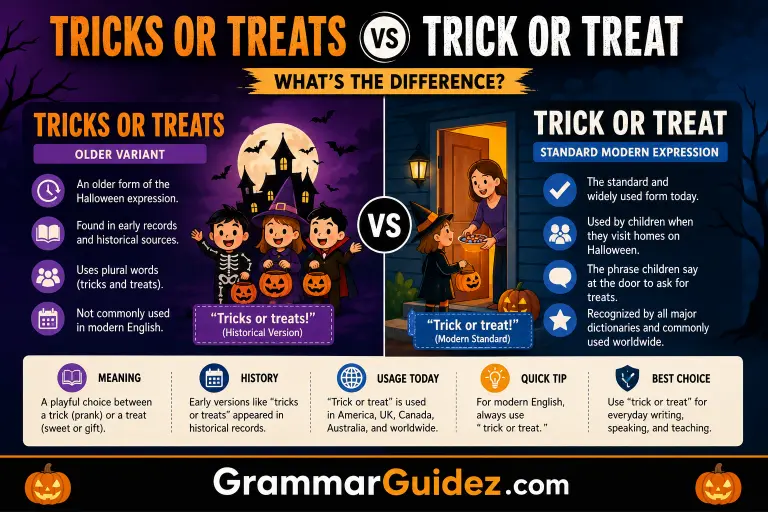
“Trick or treat” is the standard modern expression.
Children traditionally say “Trick or treat!” when they visit homes on Halloween to ask for candy, sweets, or another small treat. The phrase carries the playful idea that the child wants a treat or may play a trick if no treat is given. Oxford describes it as a traditional Halloween activity in which children visit houses and say “Trick or treat?”
“Tricks or treats” is an older variant. Historical records show that plural forms such as “tricks or treats” were used in the early history of the phrase. The modern form became the widespread standard.
Simple example
- Correct and standard: “The children shouted, ‘Trick or treat!’”
- Older variant: “The children shouted, ‘Tricks or treats!’”
For modern writing and everyday English, choose trick or treat.
What Does “Trick or Treat” Mean?
Meaning of “Trick or Treat”
Trick or treat is a Halloween expression and noun phrase.
As an expression, it is what children traditionally say when they visit homes in costume and ask for treats.
For example:
“The children knocked on the door and shouted, ‘Trick or treat!’”
As a noun, trick or treat can refer to the Halloween custom itself.
Merriam-Webster defines it as a Halloween practice in which children in costumes go from door to door saying “trick or treat” while asking for treats.
Pronunciation
A common pronunciation is:
trick or treat
/ˌtrɪk ɔːr ˈtriːt/
The exact pronunciation of or may change slightly in natural speech.
Examples
- “We went trick-or-treating last night.”
- “The children yelled, ‘Trick or treat!’”
- “Our neighborhood is busy with trick-or-treaters.”
What Does “Tricks or Treats” Mean?
Meaning of “Tricks or Treats”
Tricks or treats is an older variant of the Halloween expression.
The words are pluralized, so they suggest multiple tricks and multiple treats. However, this is not the usual modern wording.
Historical research shows that “tricks or treats” appeared among early forms of the Halloween chant. The Dictionary of Canadianisms on Historical Principles records it as a spelling variant and explains that the form now widely used is “trick or treat.”
Merriam-Webster also notes that earlier versions included plural forms. Its historical account discusses an early 1928 example using “Tricks or treats!” before the modern form became established.
Examples
You may encounter “tricks or treats” in:
- Older books
- Historical articles
- Vintage Halloween material
- Discussions about the history of the phrase
- Creative or playful writing
For normal modern English, however, “trick or treat” is the better choice.
What Is the Difference Between Tricks or Treats and Trick or Treat?
The main difference is standard modern usage versus an older variant.
| Feature | Trick or Treat | Tricks or Treats |
| Modern usage | Standard | Uncommon |
| Halloween phrase | Yes | Historical variant |
| Grammar | Singular nouns | Plural nouns |
| Common today | Very common | Rare |
| Used by children | Yes | Usually no |
| Dictionaries | Standard entry | Usually treated as a variant |
| Best choice today | Yes | No |
| Example | “Trick or treat!” | “Tricks or treats!” |
The important point is that “tricks or treats” is not simply a second equally common modern spelling.
It is a historical form that existed before “trick or treat” became the dominant expression.
Why Does “Trick or Treat” Use Singular Words?
At first glance, “trick or treat” may seem strange.
Why not say “tricks or treats”?
The phrase works as a fixed expression. It does not need to follow the normal pattern you might expect from two ordinary plural nouns.
The child is essentially presenting a choice:
A trick or a treat?
The “trick” represents the playful consequence of receiving no treat. The “treat” represents the candy or other gift the child wants.
Merriam-Webster explains the phrase as involving an implied threat to play a trick on people who refuse to provide a treat.
Origin and History of Trick or Treat
The history of Halloween is much older than the modern phrase trick or treat.
Halloween traditions have roots in older customs from Britain and Ireland. However, the exact development of the modern phrase happened much later.
Historical evidence places early recorded forms of the Halloween chant in Canada.
The Dictionary of Canadianisms records “tricks or treats” in an early 1917 example. It also records other early variations, including “treat or trick.” The form “trick or treat” became the widespread modern version.
Merriam-Webster’s historical research also traces early examples to Canada in the 1920s and notes a 1928 U.S. example using “Tricks or treats!”.
So, the plural version has a real place in the history of the expression. It is simply not the normal form today.
Etymology
The expression combines two simple English words:
- Trick = a prank, joke, or act of mischief
- Treat = something pleasant given as a reward
The phrase creates a playful choice: give a treat, or risk a trick.
British English vs American English
Today, “trick or treat” is understood in both American and British English.
Oxford notes that the activity began in the United States in the 1930s and later became common in Britain as well.
| Region | Common Expression |
| United States | Trick or treat |
| United Kingdom | Trick or treat |
| Canada | Trick or treat |
| Australia | Trick or treat |
| International English | Trick or treat |
There can be differences in the words used for candy and sweets, but the main Halloween expression remains trick or treat.
For example:
- American English: “The kids asked for candy.”
- British English: “The kids asked for sweets.”
The phrase itself stays the same.
Which One Should You Use?
For almost all modern situations, use trick or treat.
Students
Use trick or treat in school assignments, essays, and English exercises.
Bloggers
Use trick or treat when writing about Halloween unless you are specifically discussing the historical form tricks or treats.
Businesses
Use trick or treat in modern Halloween promotions.
Example:
“Join us for a fun trick-or-treat event!”
Academic Writing
If you discuss the history of the expression, you may mention tricks or treats as an older variant.
Professional Writing
Use trick or treat when referring to the modern Halloween activity.
Everyday Communication
If a child knocks on your door, the familiar phrase is:
“Trick or treat!”
Common Mistakes
Mistake 1: Using “tricks or treats” as the normal modern phrase
❌ “The children went around saying tricks or treats.”
✅ “The children went around saying trick or treat.”
The second sentence uses the standard modern expression.
Mistake 2: Changing the phrase to “treat or trick”
❌ “Treat or trick!”
✅ “Trick or treat!”
“Treat or trick” appeared as an early variant, but it is not the normal modern form.
Mistake 3: Confusing the phrase with “trick-or-treating”
These are related but different forms.
- Trick or treat! = the words children say.
- Trick-or-treating = the activity.
- Trick-or-treater = a person taking part in the activity.
Oxford lists trick-or-treating as the noun for the activity.
Everyday Examples
Emails
“We are hosting a trick-or-treat event for local families.”
Academic Writing
“The phrase ‘trick or treat’ became associated with Halloween in North America during the twentieth century.”
Business Writing
“Our store will offer free treats to children who come trick-or-treating.”
Social Media
“Who is ready for trick or treat night? ”
Daily Conversation
“Are the kids going trick-or-treating tonight?”
“Yes. They already have their costumes ready.”
Trick or Treat, Trick-or-Treat, or Trick or Treating?
These forms can look confusing.
Trick or treat
Use this for the expression:
“Trick or treat!”
Trick-or-treat
This hyphenated form can be used when the expression functions as part of a compound word or modifier.
Example:
“We are planning a trick-or-treat event.”
Usage can vary by dictionary and style guide, so follow the style used by your publication.
Trick-or-treating
Use this for the activity.
“The children went trick-or-treating.”
Trick-or-treater
Use this for a person who goes from house to house asking for treats.
“A group of trick-or-treaters came to our door.”
Tips to Remember the Difference
Here are a few easy memory tricks:
- Trick or treat is the standard modern phrase.
- Think of it as a choice: one trick or one treat.
- Children say “Trick or treat!”
- The activity is trick-or-treating.
- A child taking part is a trick-or-treater.
- Tricks or treats is mainly useful when discussing older or historical usage.
- If you are unsure, choose trick or treat.
A simple rule is:
Modern Halloween → Trick or treat.
Quiz
1. Which is the standard modern Halloween expression?
A. Tricks or treats
B. Trick or treat
C. Treats or trick
D. Treat or tricks
2. What do children usually say at the door?
A. Treat or trick
B. Tricks and treats
C. Trick or treat
D. Tricks or treat
3. Which form describes the Halloween activity?
A. Trick-or-treating
B. Tricks-or-treating
C. Treat-or-tricking
D. Trick-and-treating
4. Which is an older variant?
A. Trick or treat
B. Tricks or treats
C. Trick treats
D. Treat trick
5. What does “treat” usually mean in this context?
A. A punishment
B. A Halloween gift or sweet
C. A costume
D. A joke
6. What does “trick” refer to?
A. A playful prank or act of mischief
B. A candy bar
C. A costume
D. A Halloween song
7. Which sentence is best for modern English?
A. “The children shouted tricks or treats.”
B. “The children shouted trick or treat.”
C. “The children shouted treat or trick.”
D. “The children shouted tricks and treat.”
8. Which word describes a person who goes trick-or-treating?
A. Trick-treater
B. Trick-or-treater
C. Treat-tricker
D. Trickster
Answers
- B
- C
- A
- B
- B
- A
- B
- B
Fill in the Blanks
Complete each sentence with the best word or phrase.
- The children shouted, “_____!”
- We are going _____ tonight.
- A group of _____ came to our door.
- “Tricks or treats” is an _____ form.
- The usual modern expression is “_____.”
- A _____ can mean candy or another small gift.
- A _____ can mean a prank.
- The Halloween activity is called _____.
Answers
- Trick or treat
- trick-or-treating
- trick-or-treaters
- older / historical
- trick or treat
- treat
- trick
- trick-or-treating
FAQs
Is “tricks or treats” correct?
“Tricks or treats” has historical evidence as an older variant of the Halloween expression. However, it is not the standard modern form. Today, “trick or treat” is the normal phrase used by children when asking for Halloween treats. Historical sources document several early variations before the modern form became widespread.
Is it “trick or treat” or “tricks or treats”?
The standard modern expression is “trick or treat.” Children say it when they visit homes on Halloween. “Tricks or treats” appeared in earlier usage, but modern English normally uses the singular forms. Cambridge and Oxford both give trick or treat as the established expression.
Why do we say “trick or treat”?
The phrase presents a playful choice. A child asks for a treat, such as candy, while the trick represents the possibility of a prank if no treat is given. Today, the phrase is mainly a traditional Halloween greeting rather than a serious threat. Merriam-Webster describes this implied threat as part of the phrase’s meaning.
Is “trick or treat” American English?
It is strongly associated with North American Halloween culture, but the expression is also used in British English and elsewhere. Oxford notes that the practice became common in Britain as well. The phrase is now widely recognized internationally.
What is the difference between trick or treat and trick-or-treating?
“Trick or treat” is the phrase children say at the door. “Trick-or-treating” is the activity of visiting homes to ask for Halloween treats. For example, a child might say “Trick or treat!” while the whole activity is called trick-or-treating.
Should I write “trick or treat” or “trick-or-treat”?
It depends on how the expression is being used. “Trick or treat!” is normally written as the spoken phrase. A hyphenated form can appear when it works as part of a compound expression, such as trick-or-treat event. Always follow the style rules of your publication.
Did people ever say “tricks or treats”?
Yes. Historical records show that “tricks or treats” was used in early versions of the Halloween chant. The Dictionary of Canadianisms records it as an early variant, while Merriam-Webster also discusses historical examples. The form that became widespread is “trick or treat.”
Conclusion
When choosing between “tricks or treats” and “trick or treat,” the answer is simple: use “trick or treat” for modern English.
“Trick or treat!” is the familiar Halloween expression children use when they visit homes and ask for candy, sweets, or other treats. It is also used to describe the Halloween custom itself. Cambridge, Oxford, and Merriam-Webster all recognize the standard expression.
“Tricks or treats” is not simply a spelling mistake. It has a place in the history of the phrase. Early records show several variations, including plural forms such as “tricks or treats.” Over time, however, “trick or treat” became the dominant form.
So remember this easy rule:
For modern Halloween English, say “Trick or treat!”
If you are writing about historical Halloween language, you can mention “tricks or treats” as an older variant.
Once you learn this small difference, you can use the Halloween expression with confidence.
Read More Articale
Churches or Church’s: Which One Is Correct?
Friend or Faux: What Does It Mean?

I am Elliot Hartwell, an English language writer and the author at GrammarGuidez.com. For the 6 years I have been working with English grammar, vocabulary, spelling and everyday language usage with a focus on making confusing topics easier to understand.
I started GrammarGuidez.com with a goal: to give readers clear and practical answers to common English questions. English can sometimes be confusing especially when two words look or sound similar but have meanings or uses. I enjoy breaking down these differences in a way that’s simple and easy to remember.
I believe learning English should feel simple not overwhelming. My goal is to make every article on GrammarGuidez.com useful, for students, writers, bloggers, teachers and anyone who wants to communicate clearly in English.